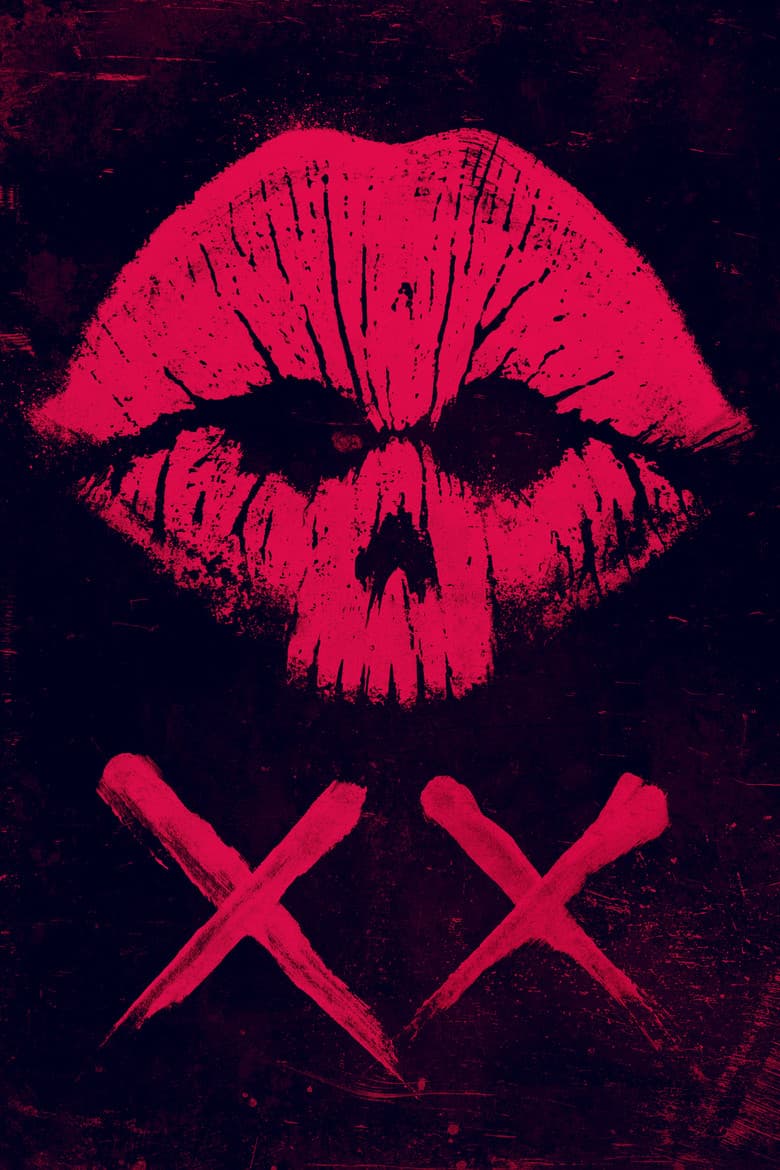
XX is a horror anthology made of four short stories linked by a strange stop-motion tale. The stories follow a mother whose family stops eating, a mother hiding her dead husband before her daughter’s party, four friends facing a creature in the wilderness, and a single mother facing her son’s dark nature. The settings move from a city train and a neat home to a desert camp and a lonely small town. The tone shifts between quiet dread, black comedy, bloody creature horror, and devil-themed family horror.
The film puts women at the center of every main story and gives each segment a female lead. Three stories focus on mothers who feel trapped by care, guilt, or fear while trying to protect their children or keep a perfect home. The stories question old ideas that women should be calm, loving, and fully devoted mothers, and they often give the women the clearest knowledge or strongest will. One story also changes the father in its source story into a mother, making the gender choice part of the story itself. These themes are central to the film’s design, but the movie uses horror, dark humor, and family fear instead of long political speeches.
Community feedback
Was our 81% Woke rating accurate?
Breakdown
These are the editorial factors and ratings behind our score for XX.
Woke representation / casting
Every main segment gives its lead role to a woman, and the project was built around that rule. The film and its marketing make women in horror the main identity message, not a small background choice. The pattern is strong and repeated across the anthology, but it centers gender more than race, sexuality, or other identity groups.
80%
Woke political dialogue
Not present. The stories do not use clear spoken lines that promote DEI, identity politics, or modern activist causes. The dialogue stays with family trouble, fear, violence, and supernatural danger.
0%
Identity-driven story themes
The anthology makes female viewpoint its main story idea. Three segments center mothers who face guilt, pressure, fear, or the demand to keep a family safe and perfect. The women often hold the key knowledge or strongest will, while men are absent, helpless, violent, or used for dark humor. The ideas recur across the film, but the stories present them through horror and black comedy rather than long political speeches.
65%
Western institutional / cultural critique
XX repeatedly shows social roles and institutions failing women or placing unfair demands on them. The Box centers the pressure and resentment tied to motherhood, while The Birthday Party turns perfect parenting into a trap. Her Only Living Son shows school adults protecting a boy after he attacks a girl, and the story links that failure to male violence. This modern gender critique is important but limited to parts of an anthology.
52%
Woke character or canon changes
The Box changes Jack Ketchum’s original lead from a father to a mother. Vuckovic said the change was made to fit the women-lead rule and to explore mixed feelings about motherhood and pressure placed on women. The change shapes one of the four main stories, while the other segments do not make clear identity changes to established characters.
34%
Anti-woke backlash and complaints
Not present. The separate X research found no anti-woke posts, boycott, or review-bombing about XX. Web and audience criticism focused on uneven quality or whether the female-led premise was enough, not on claims that the movie pushed DEI or identity politics.
0%
Creator track record context
The four directors have a mixed creator track record. St. Vincent and Vuckovic have the clearest recurring links to gender, sexuality, women’s agency, and representation, while Kusama is moderate and Benjamin is mainly genre-focused. The listed producers, writer, and casting team add mostly low or moderate signals, so the whole team shows a clear but uneven context.
54%
Production
Movie · 2016
In 1630, a farmer relocates his family to a remote plot of land on the edge of a forest where strange, unsettling things happen.
Movie · 2016
Lorraine and Ed Warren travel to north London to help a single mother raising four children alone in a house plagued by malicious spirits.
Movie · 2024
A live broadcast of a late-night talk show in 1977 goes horribly wrong, unleashing evil into the nation's living rooms.
Movie · 2022
Inspired by the true story of a family who believed they were possessed by spirits. This film follows a woman who must protect her child from a curse.
Movie · 2017
Several years after the tragic death of their little girl, a doll maker and his wife welcome a nun and several girls from a shuttered orphanage into their home, soon becoming the…
Movie · 2026
After breaking the mysterious "One Wish Willow" to win his crush's heart, a hopeless romantic finds himself getting exactly what he asked for but soon discovers that some desires…
Movie · 2016
Rebecca must unlock the terror behind her little brother's experiences that once tested her sanity, bringing her face to face with a supernatural spirit attached to their mother.
Movie · 2023
Still reeling from the tragic death of their mother, a teenage girl and her younger sister find themselves plagued by a sadistic presence in their house and struggle to get their…
