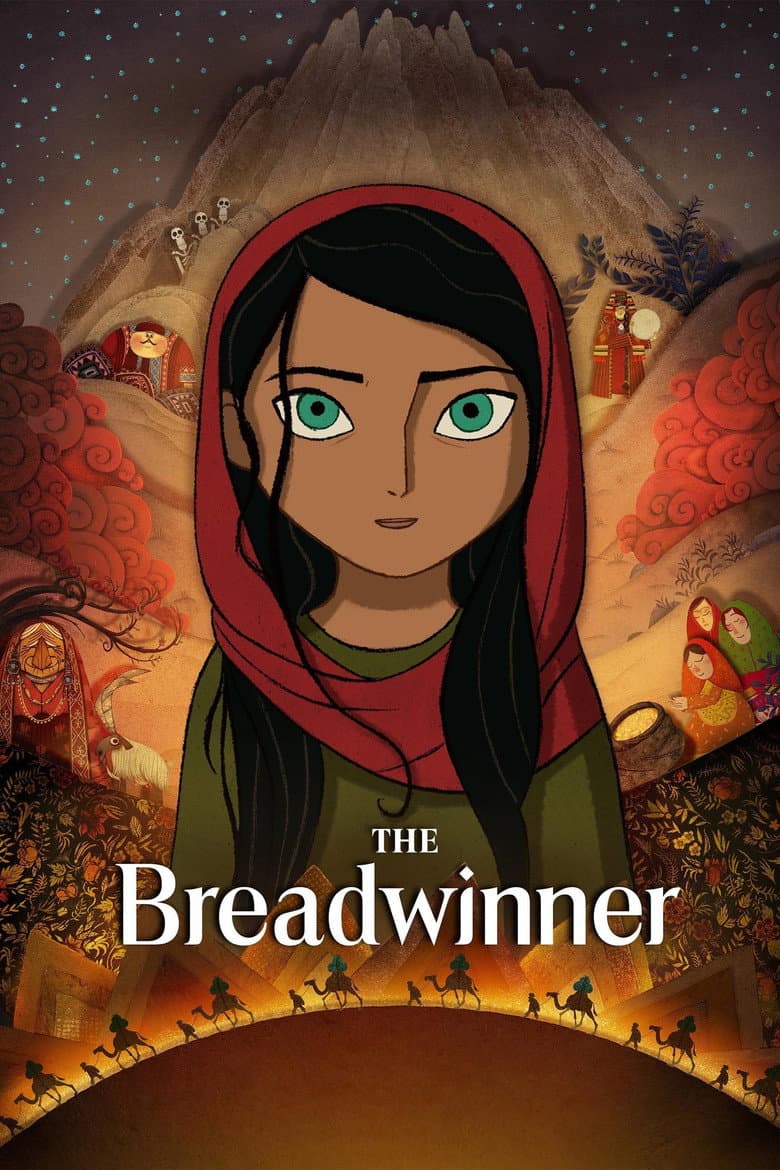
The Breadwinner follows Parvana, an eleven-year-old girl living with her family in Kabul in 2001. The Taliban arrests her father, who cannot walk well, and the family soon lacks food, water, and a way to leave home. Parvana cuts her hair and wears her dead brother’s clothes so she can work in the market and try to help her father. The film mixes hard war drama with a colorful story about an evil Elephant King, so its mood moves between fear, sadness, courage, and hope.
Gender freedom is the film’s main social message. The story repeatedly shows that girls cannot study, work, travel, or protect their families as freely as boys, and it makes Parvana and her friend Shauzia the most active problem solvers. The film presents girls’ education, women’s work, and female courage as good, while the Taliban’s male rule is shown as cruel and dangerous. These themes are central and easy to notice, but they grow from the film’s Afghan war setting rather than from a modern Western campaign.
Community feedback
Was our 51% Woke rating accurate?
Breakdown
These are the editorial factors and ratings behind our score for The Breadwinner.
Woke representation / casting
Not present. The film shows Afghan characters in an Afghan setting, and the central casting fits the story’s place and time. The animated voice cast is not used as a visible diversity statement.
0%
Woke political dialogue
Parvana’s father says women once went to university, while Taliban men say women must stay home and threaten punishment. Parvana and Shauzia also say that appearing as boys lets them work and move around. These lines make gender freedom part of the spoken story, but they describe Taliban rules in 2001 instead of giving a modern activist speech.
25%
Identity-driven story themes
The film centers on a girl who must change her public identity to work and protect her family. The story repeatedly shows girls facing limits on school, work, travel, and marriage. Parvana and Shauzia are the main young problem solvers, while the Taliban’s male rule blocks their choices. Female courage and access to education are central messages.
64%
Western institutional / cultural critique
Not present. The film condemns Taliban control in Afghanistan, not modern Western institutions. It does not attack Christianity, capitalism, or ordinary Western family life.
0%
Woke character or canon changes
Not relevant. The film follows the main characters from Deborah Ellis’s novel. Its changes are normal story cuts and additions for an animated adaptation, not identity-driven rewrites.
0%
Anti-woke backlash and complaints
Not present. No clear anti-woke backlash is documented. A few online comments question the film’s view of Islam, but they do not clearly describe a woke or DEI agenda.
0%
Creator track record context
Deborah Ellis openly links her work to feminism, peace work, girls in war, and women in Afghanistan. Nora Twomey repeatedly makes stories about female leads, cultural identity, and gender equality. Several producers also have strong social-justice or diversity-centered media records. This context fits the film’s focus on female freedom.
64%
Production
Movie · 2024
Popular, outgoing Fujino is celebrated by her classmates for her funny comics in the class newspaper. One day, her teacher asks her to share the space with Kyomoto, a truant…

Movie · 2017
A young man arrives at the last hometown of painter Vincent van Gogh to deliver the troubled artist's final letter and ends up investigating his final days there.
Movie · 2023
While the Second World War rages, the teenage Mahito, haunted by his mother's tragic death, is relocated from Tokyo to the serene rural home of his new stepmother Natsuko, a woman…

Movie · 2022
A man narrates stories of his life as a 10-year-old boy in 1969 Houston, weaving tales of nostalgia with a fantastical account of a journey to the moon.

Movie · 2019
The summer of his high school freshman year, Hodaka runs away from his remote island home to Tokyo, and quickly finds himself pushed to his financial and personal limits.
Movie · 2024
A colossal-sized omnibus film bringing together the last two episodes of Attack on Titan in the franchise's first-ever theatrical experience.
Movie · 2023
After it's discovered that a teacher at South Park Elementary has an OnlyFans page, Randy is compelled to take a closer look at the seedy underbelly of the world of online…
Movie · 2024
In 1985, the murder of a government-sponsored superhero draws his outlawed colleagues out of retirement and into a mystery that threatens to upend their personal lives and the…
