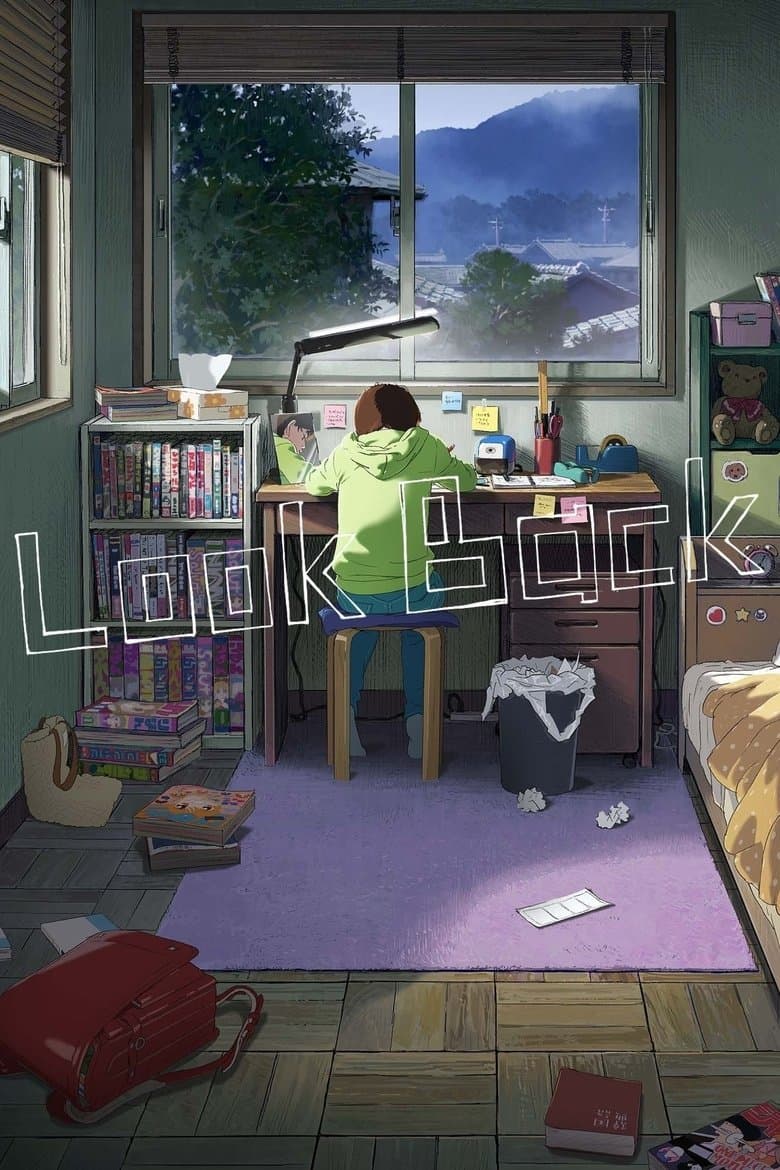
Look Back follows Fujino, a confident schoolgirl in a small Japanese town who draws four-panel comics. She meets Kyomoto, a shy classmate who stays home but draws far better backgrounds. Jealousy turns into friendship and a shared dream of making manga. Their work brings joy, pressure, distance, and grief, and the film shifts from warm humor to sudden tragedy. The story follows them from childhood into early adulthood.
The film puts two girls at the center of a creative partnership rooted in school life and shared work. Their friendship drives their growth, while art gives both girls a way to reach another person. Kyomoto’s social fear and Fujino’s jealousy lead to hard choices. The final loss turns the story toward guilt, memory, and the choice to keep creating. Fujino’s success cannot replace the friend who helped her begin again.
Community feedback
Was our 2% Woke rating accurate?
Breakdown
These are the editorial factors and ratings behind our score for Look Back.
Woke representation / casting
Not present. Fujino and Kyomoto are Japanese girls in a Japanese school setting, which fits the story. The film does not frame their casting as a diversity or identity statement.
0%
Woke political dialogue
Not present. The dialogue centers on drawing, rivalry, friendship, and grief. It contains no modern identity, DEI, gender-role, or activist message.
0%
Identity-driven story themes
Not present. The film focuses on creative work, friendship, ambition, social anxiety, loss, and regret. Gender is part of the characters but is not treated as a political cause or a battle over identity.
0%
Western institutional / cultural critique
Not present. The story shows school pressure, art-school danger, and the strain of professional drawing. It does not turn those events into a modern attack on Western institutions, family, Christianity, patriarchy, or capitalism.
0%
Woke character or canon changes
Not relevant. The film keeps Fujino and Kyomoto as the same girls from Fujimoto’s manga. Its added scenes and changed timing concern work, dialogue, and grief rather than race, gender, sexuality, or a hero role.
0%
Anti-woke backlash and complaints
Not present. Audience and news coverage were largely emotional or positive. No meaningful complaint that the film pushes DEI, identity politics, or activist politics was found. Fan readings of the friendship as queer are not anti-woke backlash.
0%
Creator track record context
Oshiyama’s prior public record centers on craft, artists, and labor, not activism. Fujimoto often writes about trauma, exploitation, sexuality, and social dependence, but he has no well-documented activist or DEI public record. The three producers have no documented activist or representation-first profile. This gives the film mild creator context, not a strong political pattern.
8%
Production
Movie · 2024
In 1985, the murder of a government-sponsored superhero draws his outlawed colleagues out of retirement and into a mystery that threatens to upend their personal lives and the…
Movie · 2017
A young man arrives at the last hometown of painter Vincent van Gogh to deliver the troubled artist's final letter and ends up investigating his final days there.
Movie · 2021
In the aftermath of the Fourth Impact, stranded without their Evangelions, Shinji, Asuka and Rei find refuge in one of the rare pockets of humanity that still exist on the ruined…
Movie · 2025
In a brutal war between devils, hunters, and secret enemies, a mysterious girl named Reze has stepped into Denji's world, and he faces his deadliest battle yet, fueled by love in…
Movie · 2024
A colossal-sized omnibus film bringing together the last two episodes of Attack on Titan in the franchise's first-ever theatrical experience.
Movie · 2023
After it's discovered that a teacher at South Park Elementary has an OnlyFans page, Randy is compelled to take a closer look at the seedy underbelly of the world of online…
Movie · 2020
Tanjiro Kamado, joined with Inosuke Hashibira, a boy raised by boars who wears a boar's head, and Zenitsu Agatsuma, a scared boy who reveals his true power when he sleeps, boards…
Movie · 2019
When a hulking monster arrives on Earth and begins a mindless rampage, the Justice League is quickly called in to stop it.
