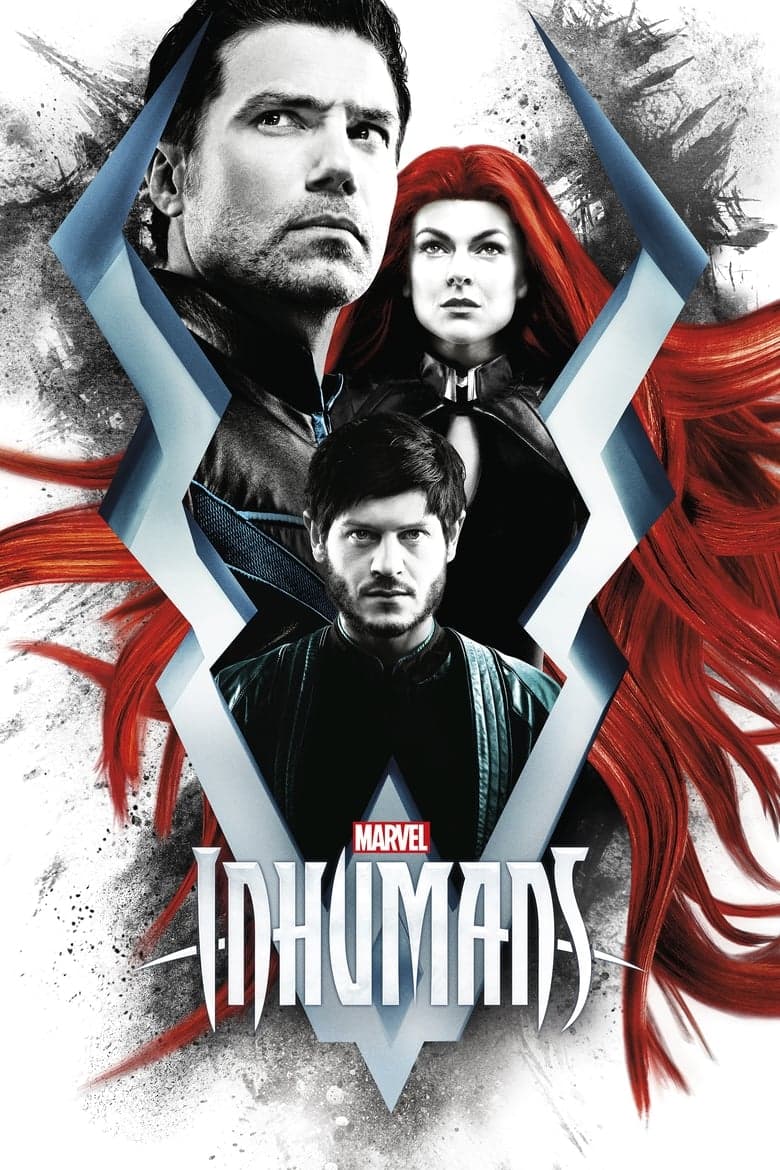
Started September 29, 2017 · Canceled · Based on 1 season, 8 episodes through November 10, 2017 · TV-PG
Black Bolt rules the Inhumans as king of Attilan, a hidden city on the moon. His brother Maximus starts a military coup after arguing that the Inhumans should return to Earth and take a stronger place among humans. The royal family escapes to Hawaii, where they search for one another while police, scientists, and Maximus's guards hunt them. The tone mixes family drama, superhero fights, science fiction, and light comedy, but the story also follows a fight over power and social rank.
The clearest identity-focused material comes from the show's diverse royal family and its repeated contrast between humans and Inhumans. The society places people into castes based on the powers they receive, while Maximus promises to end that system and build a new society where everyone is equal. Several episodes discuss people who are treated as freaks, forced into jobs, or rejected because they are human or have unwanted powers. The show also includes a short Hawaiian history point about outside rulers turning Hawaii into a state, but most of the season stays focused on the royal coup, family loyalty, and the struggle to survive.
Community feedback
Was our 38% Woke rating accurate?
Breakdown
These are the editorial factors and ratings behind our score for Marvel's Inhumans.
Woke representation / casting
Several major roles use black and Asian actors, including Gorgon, Karnak, and Triton, while Sonya Balmores plays the leading guard Auran. Eme Ikwuakor and Ken Leung described the cast as a diverse family in interview coverage. The show gives no race-based story reason for the mix, and the choice is easy for viewers to see. The series does not make race part of the plot, so this is a visible but limited representation signal.
32%
Woke political dialogue
Characters repeatedly argue about Attilan's strict caste system. Maximus calls for the old system to end and promises equal opportunity and freedom. A Hawaiian character says outside rulers turned Hawaii into a state and took away its king. These ideas recur in the season, but most dialogue stays about a fictional royal power struggle rather than current politics.
31%
Identity-driven story themes
The show treats genetic change as a social label that decides where people may live and work. People with weak powers or no powers are sent to mines, and Maximus uses their anger to challenge the royal family. The story also compares Inhumans who fear humans with Inhumans who learn to trust human allies. The theme returns across the season, but the main story remains a family fight over a throne.
38%
Western institutional / cultural critique
The show criticizes Attilan's royal privilege, Genetic Council, and caste rules. It also includes one Hawaiian line about outside rulers replacing local rule. The story does not attack Christianity, family life, or ordinary Western customs. The criticism is limited because its main target is a fictional moon kingdom.
18%
Woke character or canon changes
Not relevant. The adaptation changes some comic details, but no identity-driven change to a known character or canon is clearly shown or publicly framed.
0%
Anti-woke backlash and complaints
Not present. The X research pass found no anti-woke reaction, and news coverage focused on weak effects, costumes, Medusa's hair, acting, and pacing. Some reviews discussed race or inclusiveness, but they did not say the show was pushing woke or DEI politics.
0%
Creator track record context
Cached context rates Scott Buck 15/100 and Jeph Loeb 12/100, while most listed writers and directors are low or mild. Charles Murray is higher at 52/100 for representation-first work, and Kevin Tancharoen is 29/100 for identity comments. Scott Buck's title interviews describe a family drama and do not frame it as an activist project.
24%
Production
TV Show · 2021
The 'Bad Batch' of elite and experimental clones make their way through an ever-changing galaxy in the immediate aftermath of the Clone Wars.
TV Show · 2022
Journey into the lives of two distinctly different Jedi from the prequel era – Ahsoka Tano and Count Dooku. Each will be put to the test as they make choices that will define…
TV Show · 2024
A journey into the fearsome Galactic Empire through the eyes of two warriors on divergent paths.
TV Show · 2026
After the Clone Wars, Maul plots to rebuild his criminal syndicate on a planet untouched by the Empire.
TV Show · 2025
Two outlaws must navigate the galaxy's dangerous underworld as they chart their destinies.
TV Show · 2019
The life of Christ through the eyes of those who encountered him.
TV Show · 2022
When an explosive battle with Dr. Eggman shatters the universe, Sonic races through parallel dimensions to reconnect with his friends and save the world.
TV Show · 2020
Merlin’s apprentice joins Arcadia’s heroes on a time-bending adventure in Camelot, where conflict is brewing between the human, troll and magical worlds.
