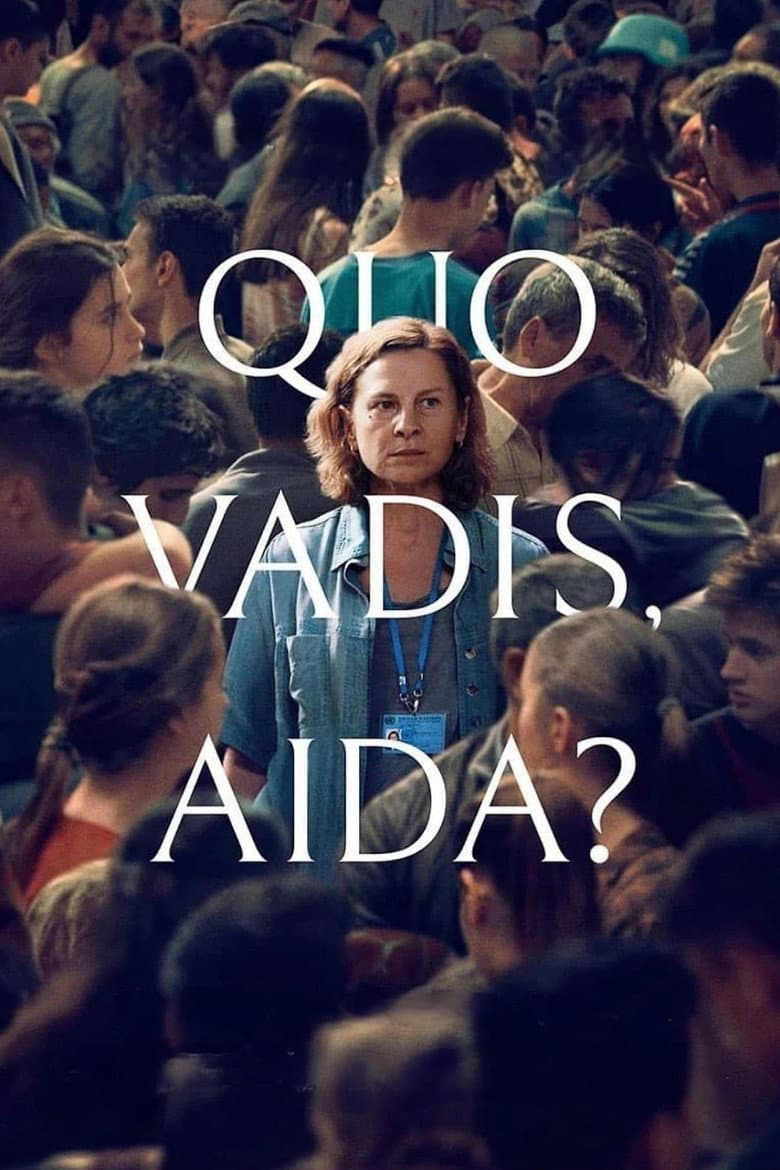
Quo Vadis, Aida? follows Aida, a schoolteacher who works as a translator for the United Nations in Srebrenica in July 1995. When Bosnian Serb forces take the town, Aida tries to get her husband and two sons into the crowded UN base and keep them alive. The soldiers separate men from women while the peacekeepers hide behind rules and wait for help that never comes. The film is tense, bleak, and deeply sad, but it also shows small acts of care, memory, and courage.
The story uses a feminist perspective by putting a woman and mother at the center of a war run by male soldiers and officials. Aida moves between civilians and officials, so the audience sees both her family’s danger and the wider failure around her. The film repeatedly criticizes the UN’s broken promises and slow decisions as a major part of the tragedy. It ends with Aida teaching children in the same town, where she must live beside families linked to the men who killed her loved ones.
Community feedback
Was our 77% Woke rating accurate?
Breakdown
These are the editorial factors and ratings behind our score for Quo Vadis, Aida?.
Woke representation / casting
Not present. The film uses regional actors for its Bosnian and Serbian characters and a European cast for the UN peacekeepers. The film does not show a diversity-first casting pattern or present casting as a broad identity message.
0%
Woke political dialogue
Not present. The dialogue centers on war orders, UN rules, family survival, and the massacre. The film does not use recurring modern DEI, gender, or activist slogans.
0%
Identity-driven story themes
The film puts Aida, a mother and translator, at the center of a war controlled by male soldiers and officials. Aida repeatedly acts while male institutions fail, and the story gives women the main emotional and moral viewpoint. The ending follows her return to teaching and her effort to live beside families linked to the killers. Žbanić openly describes the film as using a feminist perspective, so this identity lens is central even though the story is about a real 1995 atrocity.
64%
Western institutional / cultural critique
The film repeatedly shows the UN and Dutch peacekeepers hiding behind rules while civilians face death. The story presents international leaders as slow, weak, and more worried about procedure and political risk than protecting people. Žbanić says the UN should serve human rights instead of political interests. This is a strong critique of Western and international institutions, but it grows from the real Srebrenica failure rather than a broad attack on Western culture.
56%
Woke character or canon changes
The film changes the real translator behind Hasan Nuhanović’s memoir from a man named Hasan into a fictional woman named Aida. Aida becomes a mother, wife, and teacher who carries the story through her family’s loss. Žbanić says she made the change so viewers could connect with a woman protecting her family and to show the war through a woman’s eyes. The change is central to the film, even though the surrounding events remain closely tied to documented history.
60%
Anti-woke backlash and complaints
Serbian and Republika Srpska outlets and nationalist groups called the film anti-Serbian propaganda and said it demonized Serbs. The complaints spread through named media, protests, threats, and attacks on Serbian actors, so the dispute had real reach. The attacks said the film favored Bosniak victims and blamed Serb forces, but they were mainly a nationalist fight over Srebrenica rather than a broad DEI campaign. The X evidence found no anti-woke complaints, and isolated online claims had no wider pickup.
38%
Creator track record context
Žbanić has a strong record of feminist, war-memory, and human-rights films. Her work often questions nationalism, patriarchy, and institutions that fail civilians. Nuhanović’s record is mainly survivor testimony and historical accountability, not broad culture-war activism. The producers are mixed, with Deblokada showing a socially engaged pattern and the other producers showing limited or no such record.
55%
Production
Movie · 2016
On 15 January 2009, the world witnessed the 'Miracle on the Hudson' when Captain 'Sully' Sullenberger glided his disabled plane onto the Hudson River, saving the lives of all 155…
Movie · 2022
London, 1953. Mr. Williams, a veteran civil servant, is an important cog within the city's bureaucracy as it struggles to rebuild in the aftermath of World War II.
Movie · 2020
A man refuses all assistance from his daughter as he ages and, as he tries to make sense of his changing circumstances, he begins to doubt his loved ones, his own mind and even…

Movie · 2016
After his older brother passes away, Lee Chandler is forced to return home to care for his 16-year-old nephew.
Movie · 2016
WWII American Army Medic Desmond T. Doss, who served during the Battle of Okinawa, refuses to kill people and becomes the first Conscientious Objector in American history to…
Movie · 2026
While people across 1990s Iraq struggle to survive the war and food shortages, Saddam Hussein requires each school in the country to prepare a cake to celebrate his birthday.
Movie · 2019
Richard Jewell thinks quick, works fast, and saves hundreds, perhaps thousands, of lives after a domestic terrorist plants several pipe bombs and they explode during a concert…
Movie · 2023
The true story of the inseparable Von Erich brothers, who made history in the intensely competitive world of professional wrestling in the early 1980s.
