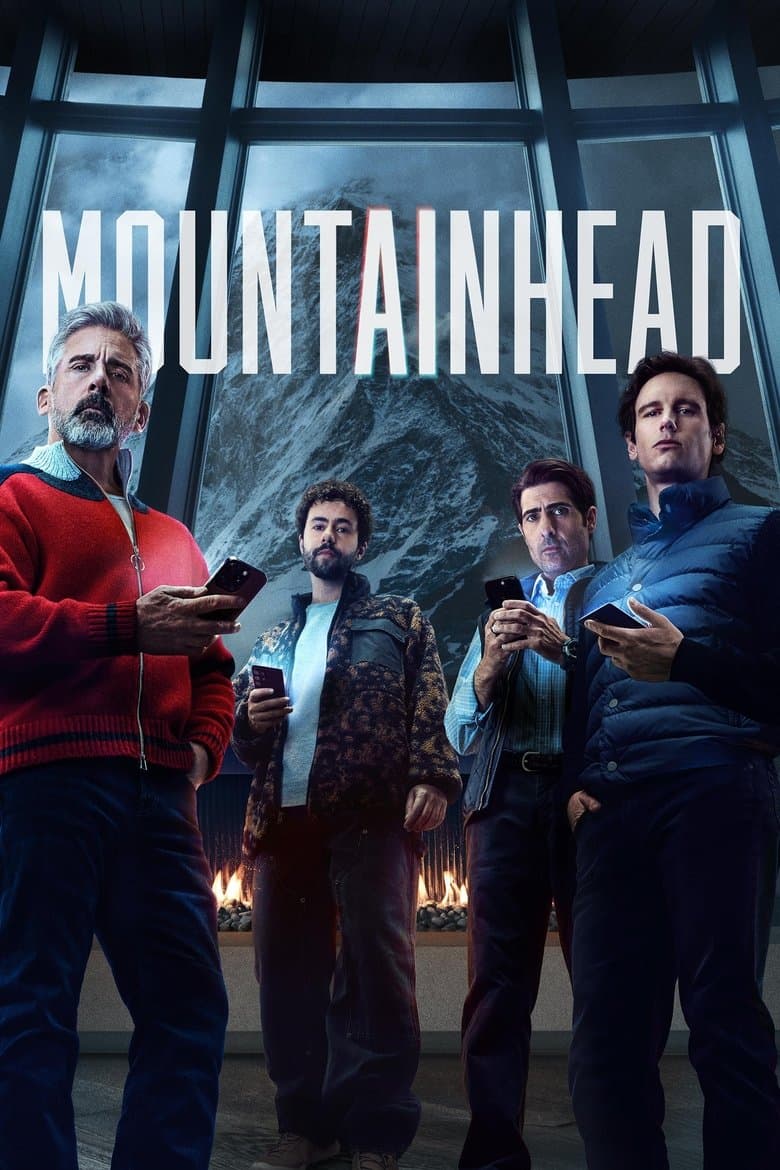
Mountainhead follows four old friends who became technology billionaires. Venis Parish owns a huge social media site, Jeff Abredazi runs an AI company, Randall Garrett serves as their older mentor, and Hugo “Souper” Van Yalk hosts them at his snowy Utah home. Venis has released deepfake tools that help trigger riots, attacks, and financial panic around the world. The men watch the disaster on their phones while they argue about money, power, illness, friendship, and who should control the future. The tone is dark, crude, and often absurd, and the plot turns from a rich men’s weekend into betrayal and attempted murder.
The movie clearly attacks the idea that private tech billionaires should guide nations or replace elected leaders. The men talk about buying countries, taking over the United States, building a corporate monarchy, and using AI to reach a post-human future. The story treats their wealth, male rivalry, and careless talk about mass death as dangerous, while the slightly more careful Jeff still protects his own fortune. Its strongest social message targets tech industry power, AI-driven lies, and the gap between rich decision makers and ordinary people.
Community feedback
Was our 40% Woke rating accurate?
Breakdown
These are the editorial factors and ratings behind our score for Mountainhead.
Woke representation / casting
Not present. The four main roles are three white men and Ramy Youssef, an actor of Egyptian heritage. The film does not frame this casting as a diversity or identity statement. Its small female roles are supporting staff or a girlfriend, but that imbalance belongs to the male tech-bro premise rather than a visible representation campaign.
0%
Woke political dialogue
The four men repeatedly discuss buying countries, replacing elected leaders, and staging a coup in the United States. Their talk also uses terms tied to race, religion, war, and the collapse of national economies. The film makes this talk part of the main crisis, but the selfish speakers are mocked rather than treated as guides. The material is political and anti-democratic, but it does not promote identity politics.
28%
Identity-driven story themes
Not present. The film shows racial and religious violence in fake news reports, but it does not center a race, gender, or sexual identity struggle. The main story follows wealth, power, male friendship, and AI.
0%
Western institutional / cultural critique
The film repeatedly shows unelected tech billionaires using private wealth to pressure the President, move markets, and shape public truth. The men discuss buying countries, replacing government, and building a corporate monarchy while ordinary people suffer. The story treats their profit-first view of AI and their contempt for public limits as dangerous. The critique is aimed at tech industry power and extreme wealth, not Christianity, family life, or traditional gender roles.
42%
Woke character or canon changes
Not relevant. The film is an original story with fictional characters. It does not change an established character, source, or real historical figure.
0%
Anti-woke backlash and complaints
A small number of online viewers called the movie woke, liberal, or a virtue signal because it mocks billionaires and treats their power as dangerous. One viewer described it as a liberal performance that pressures the audience to accept the right beliefs. A value-based review also labeled it woke and boring. The complaints are scattered and fringe, while most coverage debated the film’s quality and its negative view of tech leaders.
18%
Creator track record context
The stored context gives Jesse Armstrong a 46/100 woke score and links his work to political satire, wealth, media power, and right-wing populism. The stored producer context includes liberal media criticism from Frank Rich and feminist themes from Lucy Prebble. The remaining stored crew scores are mostly low to moderate and do not show a strong identity-activist pattern. This background supports a political power critique, but it does not point to a strong DEI or queer focus in this film.
42%
Production
Movie · 2017
Ingrid becomes obsessed with a social network star named Taylor Sloane who seemingly has a perfect life. But when Ingrid decides to drop everything and move west to be Taylor's…

Movie · 2025
1984; Michael Larson, an unemployed ice-cream truck driver from Ohio, steps onto the game show "Press Your Luck" harboring a secret: the key to endless amounts of money.

Movie · 2024
When a construction worker unexpectedly joins a local theater's production of Romeo and Juliet alongside his estranged teenage daughter, the drama onstage starts to mirror his own…
Movie · 2020
Scott has been a case of arrested development ever since his firefighter father died when he was seven. He's now reached his mid-20s having achieved little, chasing a dream of…

Movie · 2018
Vignettes weaving together the stories of six individuals in the old West at the end of the Civil War. Following the tales of a sharp-shooting songster, a wannabe bank robber, two…

Movie · 2023
Allison's life falls apart following her involvement in a fatal accident. The unlikely relationship she forms with her would-be father-in-law helps her live a life worth living.

Movie · 2025
Tenderly captures a year in the life of a family as the parents navigate their separation. Through both playful and heartfelt moments, the film portrays the bittersweet essence of…
Movie · 2022
Maurice Flitcroft, a dreamer and unrelenting optimist, managed to gain entry to The British Open Golf Championship qualifying in 1976 and subsequently shot the worst round in Open…
