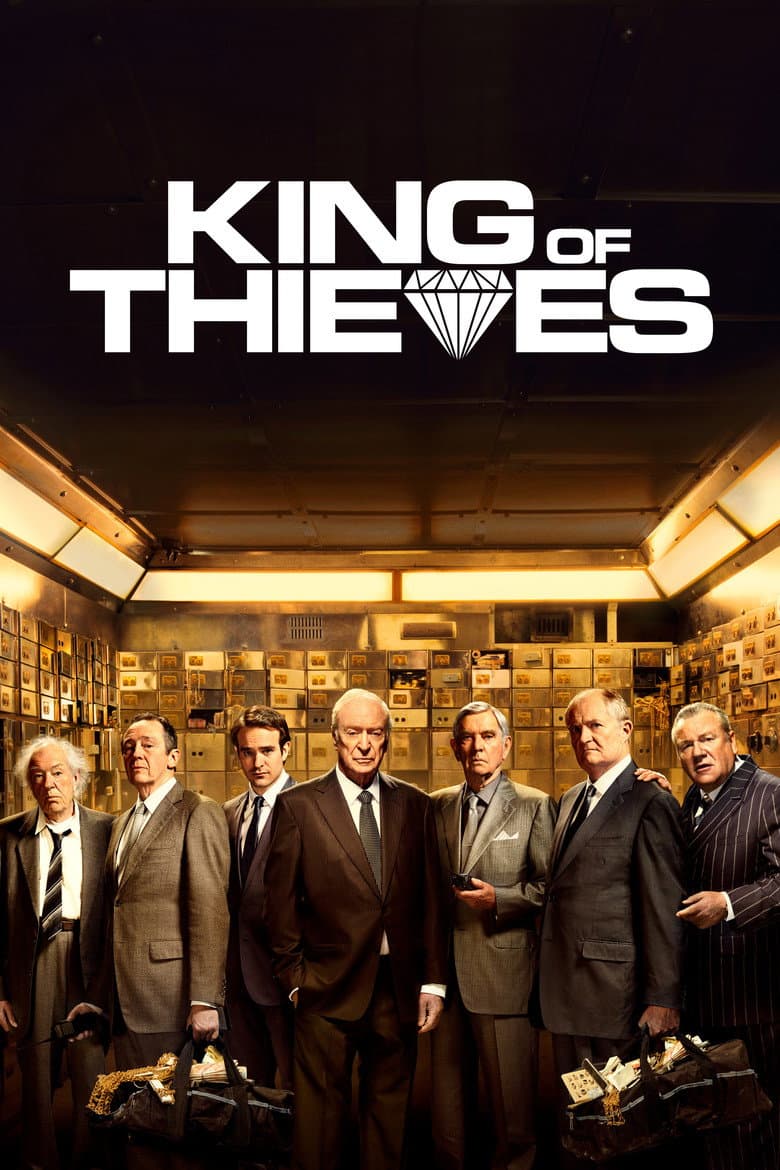
Brian Reader is a retired London thief who has lost his wife and lives a quiet life. His old friends pull him back into crime for one last job at the Hatton Garden safe deposit center in 2015. The gang drills through a thick wall and steals gold, jewels, and cash. The film starts as a rough crime comedy about old men and grows darker when greed and fear turn the thieves against each other.
The film focuses on older British criminals, their pride, their bodies, and their broken friendships. Most of the tension comes from the gang's selfishness and the way crime destroys trust. Brian's grief and wish to feel important push him back toward theft, while the others treat the job as a chance to prove that they still matter. The police close in after the gang's careless talk, and arguments over the stolen goods split them apart.
Community feedback
Was our 4% Woke rating accurate?
Breakdown
These are the editorial factors and ratings behind our score for King of Thieves.
Woke representation / casting
Not present. The main gang matches the real Hatton Garden group, which was made up mostly of older London men. Women appear in small roles tied to the plot, such as Brian's wife and a police lip-reader. The film does not frame these choices as a diversity message.
0%
Woke political dialogue
Not present. The dialogue centers on crime planning, insults, greed, aging, and betrayal. A news report jokes about foreign criminals and declining British skill, but it is not a modern activist debate.
0%
Identity-driven story themes
Not present. Brian is driven by grief, pride, and a wish to feel useful again. The gang's main themes are aging, greed, fear, and betrayal. Race, sex, sexuality, and identity do not shape the central conflict.
0%
Western institutional / cultural critique
Not present. The film shows the police tracking the gang and the criminals being arrested. It mocks the thieves' bodies, pride, and carelessness, but it does not build a modern activist critique of men, family, capitalism, religion, or Western institutions.
0%
Woke character or canon changes
Not relevant. The film dramatizes a real 2015 burglary rather than adapting a fictional character franchise. Changes and invented scenes serve the crime story, not an identity message.
0%
Anti-woke backlash and complaints
Not present. Reported complaints focused on crime glamorization, weak pacing, crude jokes, and heavy swearing. No meaningful complaint said the film pushed DEI, identity politics, or left-wing activism.
0%
Creator track record context
The key creators have a mild overall activist signal. James Marsh is mainly linked to documentary and prestige films, with little public activist work. Joe Penhall has some social-issue context through Mood Music, which examined power and abuse during the #MeToo era. Nina Gold has supported diversity in casting while stressing respect for source material, but the film does not turn that context into a strong identity message.
19%
Production
Movie · 2019
Pennsylvania, 1956. Frank Sheeran, a war veteran of Irish origin who works as a truck driver, accidentally meets mobster Russell Bufalino.
Movie · 2022
In the 1980s, a team of lawyers takes on the heads of Argentina's bloody military dictatorship in a battle against odds and a race against time.
Movie · 2021
When the aging Meyer Lansky is investigated one last time by the Feds who suspect he has stashed away millions of dollars over half a century, the retired gangster spins a…
Movie · 1994
Imprisoned in the 1940s for the double murder of his wife and her lover, upstanding banker Andy Dufresne begins a new life at the Shawshank prison, where he puts his accounting…
Movie · 2016
A student at a private school uses his connections to establish a drug trafficking network.

Movie · 2017
A newly-released prison gangster is forced by the leaders of his gang to orchestrate a major crime with a brutal rival gang on the streets of Southern California.
Movie · 2025
Amid the glittering casinos of Macau, a gambler running from his past—and his debts—becomes fascinated by an enigmatic woman at the baccarat table.

Movie · 2016
Based on the true story of two young men, David Packouz and Efraim Diveroli, who won a $300 million contract from the Pentagon to arm America's allies in Afghanistan.
