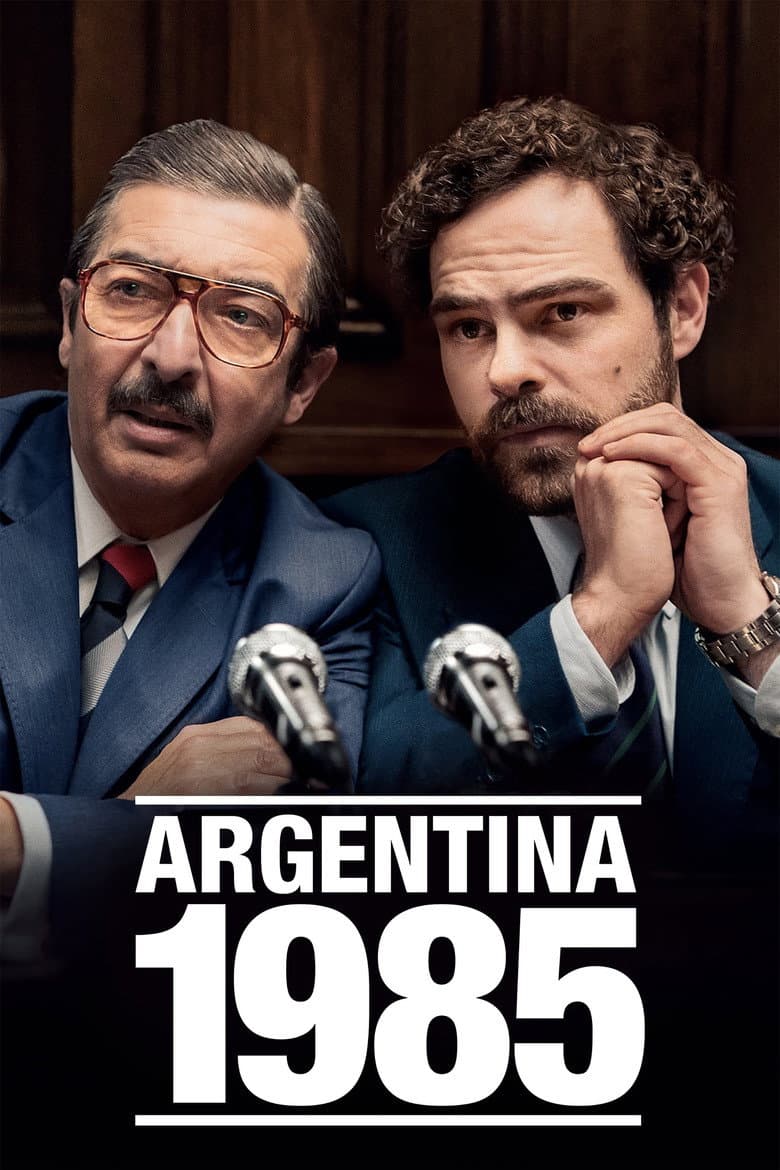
Argentina 1985 follows public prosecutor Julio César Strassera in Buenos Aires after Argentina returns to civilian rule. The new government orders him to prosecute the generals who ran the military dictatorship from 1976 to 1983. Strassera has only a few months to build a case while threats target him, his family, and his young legal team. The movie mixes tense courtroom drama with dry jokes, home life, and a hopeful but serious tone. It shows a tired official slowly accepting that his work can change his country.
The film makes the trial a story about democracy, truth, memory, and justice. Strassera and Luis Moreno Ocampo gather young lawyers because older lawyers fear the army or refuse to help. The team travels across the country and records victims who describe torture, kidnapping, murder, and a forced birth in captivity. Moreno Ocampo must also face a mother who supports the military because of her family ties. The final “Never again” speech turns the case into a warning that ordinary citizens must defend democracy.
Community feedback
Was our 14% Woke rating accurate?
Breakdown
These are the editorial factors and ratings behind our score for Argentina 1985.
Woke representation / casting
Not present. The cast uses Argentine performers for Argentine people in an Argentine historical setting. The movie does not make diversity or identity a subject of the story.
0%
Woke political dialogue
Not present. The speeches defend democracy and condemn dictatorship. Their political ideas belong to the historical trial and do not promote modern gender, DEI, or identity politics.
0%
Identity-driven story themes
Not present. The story centers on a real trial, state crimes, witness testimony, and democratic change. It does not make race, sex, gender, sexuality, or modern activist identity claims the main story.
0%
Western institutional / cultural critique
Not present. The film criticizes military rulers, police pressure, and officials who avoid the case in the 1980s. It does not attack modern family life, Christianity, capitalism, or normal Western social rules.
0%
Woke character or canon changes
Not relevant. The movie uses a few fictional or combined characters and changes some history for drama. Those changes do not alter race, gender, sexuality, or identity.
0%
Anti-woke backlash and complaints
Infobae reported that a few right-wing critics called the film Kirchnerist propaganda because it presents the dictatorship’s crimes and uses the figure of 30,000 disappeared people. The separate X research found only a handful of small Argentine accounts using woke or left-wing propaganda terms. A few Reddit posts made similar claims, but they had no clear large reach. Most public response praised the film or debated historical accuracy, so the anti-woke backlash remains fringe.
24%
Creator track record context
Director Santiago Mitre and writer Mariano Llinás have repeated records of work about politics, power, public institutions, and democracy. Mitre also links this film to democratic memory and concern about rising right-wing movements. Some producers have stronger social-rights or diversity records, while others have little activist history. The overall creator pattern is socially and politically aware, but it is not mainly built around race, gender, or queer identity.
44%
Production

Movie · 2019
In the wake of his dramatic escape from captivity, Jesse Pinkman must come to terms with his past in order to forge some kind of future.

Movie · 2022
After escaping a Michigan prison, a charming career criminal assumes a new identity in Canada and goes on to rob a record 59 banks and jewellery stores while being hunted by a…
Movie · 2025
Two of New York's most notorious organized crime bosses, Frank Costello and Vito Genovese, vie for control of the city's streets.

Movie · 1994
Imprisoned in the 1940s for the double murder of his wife and her lover, upstanding banker Andy Dufresne begins a new life at the Shawshank prison, where he puts his accounting…

Movie · 2018
On the night she plans on taking her own life, 17-year-old 'Lisa McVey' is kidnapped and finds herself fighting to stay alive and is raped.

Movie · 2019
A young agent is tasked with investigating a tangled web of corruption and fraud in New York.
Movie · 2019
In New York, former convict Pete Koslow, related to the Polish mafia, must deal with both Klimek the General, his ruthless boss, and the twisted ambitions of two federal agents…
Movie · 2016
A student at a private school uses his connections to establish a drug trafficking network.
