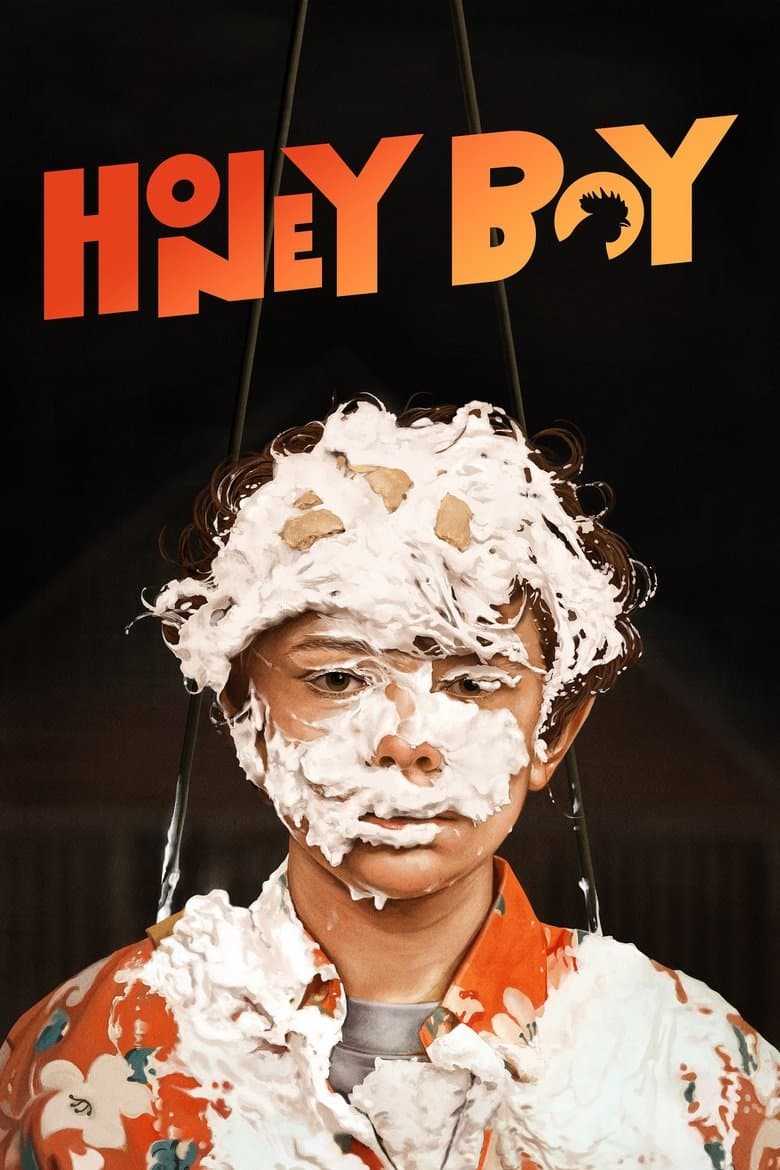
Honey Boy follows Otis Lort, a child actor who grows up on television sets and in a cheap motel with his father, James. James once worked as a rodeo clown, but he drinks, breaks the law, and uses Otis’s career to support them both. Years later, adult Otis crashes his car while drunk and enters court-ordered rehab, where a therapist pushes him to face his childhood. The film moves between 1995 and 2005 and uses harsh, sad, and dreamlike scenes to show a son trying to understand his father.
The film gives its strongest social message to the damage caused by male pride, anger, and control inside a family. James teaches Otis that toughness means shouting, fighting, smoking, and hiding fear, while Otis slowly sees how that lesson shaped his adult behavior. A short subplot gives Tom, a Mexican American mentor, a line about fighting discrimination. The film also presents Shy Girl, a young sex worker, as a caring friend to Otis. These parts are visible, but the story stays focused on addiction, abuse, guilt, forgiveness, and the hard work of breaking a family pattern.
Community feedback
Was our 42% Woke rating accurate?
Breakdown
These are the editorial factors and ratings behind our score for Honey Boy.
Woke representation / casting
Not present. The film uses a cast that fits its Los Angeles setting and does not make casting itself a political message. Tom is a Mexican American mentor and Shy Girl is a black female neighbor, but neither role is a clear casting mismatch or quota-style choice.
0%
Woke political dialogue
Tom says he is half Mexican and wants to fight discrimination in the city. James answers by asking whether Tom received a Spanish grant, and the scene treats the question as insulting. The film does not repeat this topic through the main story. The political dialogue is clear but limited.
25%
Identity-driven story themes
The film repeatedly shows male pride, anger, and control as a pattern that damages a father, a son, and their family. The story links James’s tough behavior to Otis’s drinking, rage, and trouble asking for help. The film gives Tom a short race-and-discrimination subplot and gives Shy Girl a caring role as a young sex worker. These ideas support the main trauma story, but they do not replace it with a broad identity campaign.
32%
Western institutional / cultural critique
James uses anger, threats, sexual control, and male entitlement to keep Otis dependent on him. The film shows Otis copying some of that behavior and then facing the damage it causes. Har’el described the story as showing toxic masculinity passed from father to son and questioning narrow ideas of what a man should be. The movie keeps the criticism inside one family and does not attack Western institutions as a whole.
38%
Woke character or canon changes
Not relevant. Honey Boy is a loose fictional version of LaBeouf’s childhood, not an established franchise or historical story. The changed names and events shape a personal drama rather than making a political identity statement.
0%
Anti-woke backlash and complaints
Not present. Reviewed audience posts and news focused on abuse, trauma, acting, and later questions about how truthful the story was. No clear anti-woke complaint about DEI, identity politics, or left-wing messaging appeared in that material.
0%
Creator track record context
Director Alma Har’el has a strong public record of feminist and diversity advocacy through Free the Bid and Free the Work. Writer and star Shia LaBeouf has a milder left-leaning record through the anti-Trump He Will Not Divide Us protest. Har’el’s title interviews also frame Honey Boy around toxic masculinity, male pressure, and trauma. The combined background is notable, but the film’s plot is a personal family drama rather than a diversity campaign.
56%
Production

Movie · 2016
After his older brother passes away, Lee Chandler is forced to return home to care for his 16-year-old nephew.
Movie · 2019
Richard Jewell thinks quick, works fast, and saves hundreds, perhaps thousands, of lives after a domestic terrorist plants several pipe bombs and they explode during a concert…
Movie · 2022
A quiet, neglected girl is sent away from her dysfunctional family to live with relatives for the summer. She blossoms in their care, but in this house where there are meant to be…
Movie · 2025
Diagnosed with Tourette Syndrome at 15, John Davidson navigates his way against the odds through troubled teenage years and into adulthood, finding inspiration in the kindness of…
Movie · 2016
WWII American Army Medic Desmond T. Doss, who served during the Battle of Okinawa, refuses to kill people and becomes the first Conscientious Objector in American history to…
Movie · 2017
In 1950, amidst the ravages of the Korean War, Sergeant Süleyman stumbles upon a a half-frozen little girl, with no parents and no help in sight and he risks his own life to save…
Movie · 2016
On 15 January 2009, the world witnessed the 'Miracle on the Hudson' when Captain 'Sully' Sullenberger glided his disabled plane onto the Hudson River, saving the lives of all 155…
Movie · 2016
In a desolate war zone where screams of the innocent echo, on the very line between disaster and valor, 7 Maroon Berets will dance with death.
