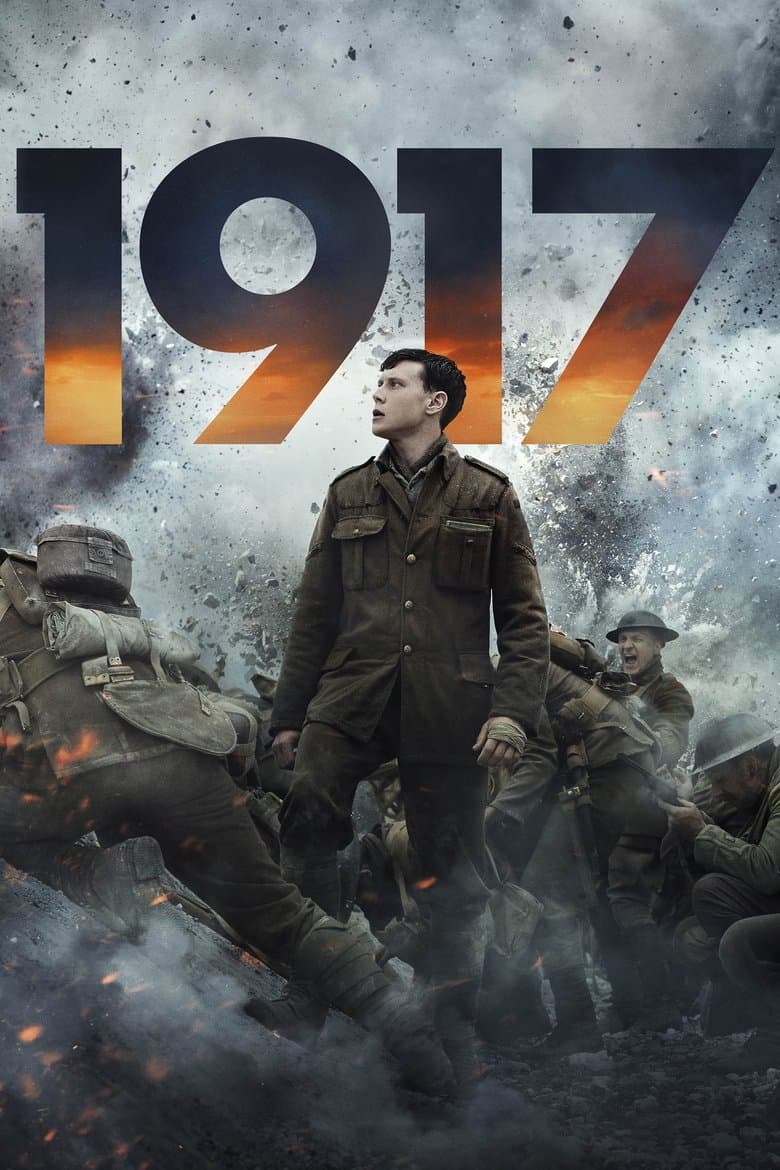
Set in northern France in April 1917, 1917 follows British lance corporals William Schofield and Tom Blake across trenches, bombed villages, fields, and enemy lines. A general sends them to deliver a message that can stop 1,600 British soldiers, including Blake’s brother, from walking into a German trap. Blake wants to save his brother, while Schofield carries the pain of earlier fighting and tries to keep the mission moving after Blake falls. The film feels tense, grim, violent, and focused on survival, duty, friendship, and the cost of war.
The film’s visible identity content is brief and sits outside the main story. A truck scene shows Sikh soldiers and a few other non-white troops among British forces, but none becomes a lead or carries a diversity message. A young French woman and a baby appear during Schofield’s passage through a ruined town, adding civilian loss and a short act of kindness rather than an identity plot. The story stays centered on two British men, military orders, family, sacrifice, and the horror of battle.
Community feedback
Was our 14% Woke rating accurate?
Breakdown
These are the editorial factors and ratings behind our score for 1917.
Woke representation / casting
Not present. The movie shows two lead British soldiers and mostly white British troops, with a brief group of Sikh soldiers and a few other non-white troops. The film gives them no special power or identity message, and their presence has a historical basis, even though the exact mixed truck scene has been debated.
0%
Woke political dialogue
Not present. The soldiers talk about orders, fear, duty, home, and the cost of battle. The movie does not use modern activist language about race, gender, sexuality, or politics.
0%
Identity-driven story themes
Not present. The main story follows a rescue mission, friendship, grief, courage, and the wish to return home. The French woman, baby, and Sikh soldiers appear in short parts and do not lead an identity-based plot.
0%
Western institutional / cultural critique
The story shows generals sending young men toward a deadly attack and calls war a tragedy. That is mainly a normal anti-war idea for a World War I film. In interviews, Mendes and Wilson-Cairns also said they wanted to push back against strong nationalism and nostalgia for standing alone. That gives the title a small modern political signal, but it is not a repeated plot theme.
12%
Woke character or canon changes
Not relevant. The two main soldiers are fictional characters inspired by stories from Mendes’s grandfather. The movie does not change a known fictional character or recast a named historical person around identity politics.
0%
Anti-woke backlash and complaints
Laurence Fox said the brief Sikh soldier scene looked like “forced diversity” and called the casting odd, then faced public criticism and later apologized. A few right-leaning voices also questioned Black or African soldiers and the film’s historical setting. Some Brexit-side critics attacked the film’s pro-Europe framing. The reaction was visible but short, with no sustained boycott or organized campaign.
32%
Creator track record context
The creator records place Sam Mendes at 16/100 and Krysty Wilson-Cairns at 12/100. The other listed creators have stored scores from 6 to 13. Their records show no clear pattern of activist or identity-driven work. The writers’ criticism of strong nationalism gives only a weak political context signal.
8%
Production
Movie · 2016
WWII American Army Medic Desmond T. Doss, who served during the Battle of Okinawa, refuses to kill people and becomes the first Conscientious Objector in American history to…
Movie · 2024
On the brink of the Second World War, a young Norwegian man's drive to resist the Nazis sets a new course for his future – and the future of his country.
Movie · 2022
London, 1953. Mr. Williams, a veteran civil servant, is an important cog within the city's bureaucracy as it struggles to rebuild in the aftermath of World War II.
Movie · 2026
While people across 1990s Iraq struggle to survive the war and food shortages, Saddam Hussein requires each school in the country to prepare a cake to celebrate his birthday.
Movie · 2017
Members of the Granite Mountain Hotshots battle deadly wildfires to save an Arizona town.
Movie · 2019
Richard Jewell thinks quick, works fast, and saves hundreds, perhaps thousands, of lives after a domestic terrorist plants several pipe bombs and they explode during a concert…
Movie · 2025
Diagnosed with Tourette Syndrome at 15, John Davidson navigates his way against the odds through troubled teenage years and into adulthood, finding inspiration in the kindness of…
Movie · 2016
On 15 January 2009, the world witnessed the 'Miracle on the Hudson' when Captain 'Sully' Sullenberger glided his disabled plane onto the Hudson River, saving the lives of all 155…
