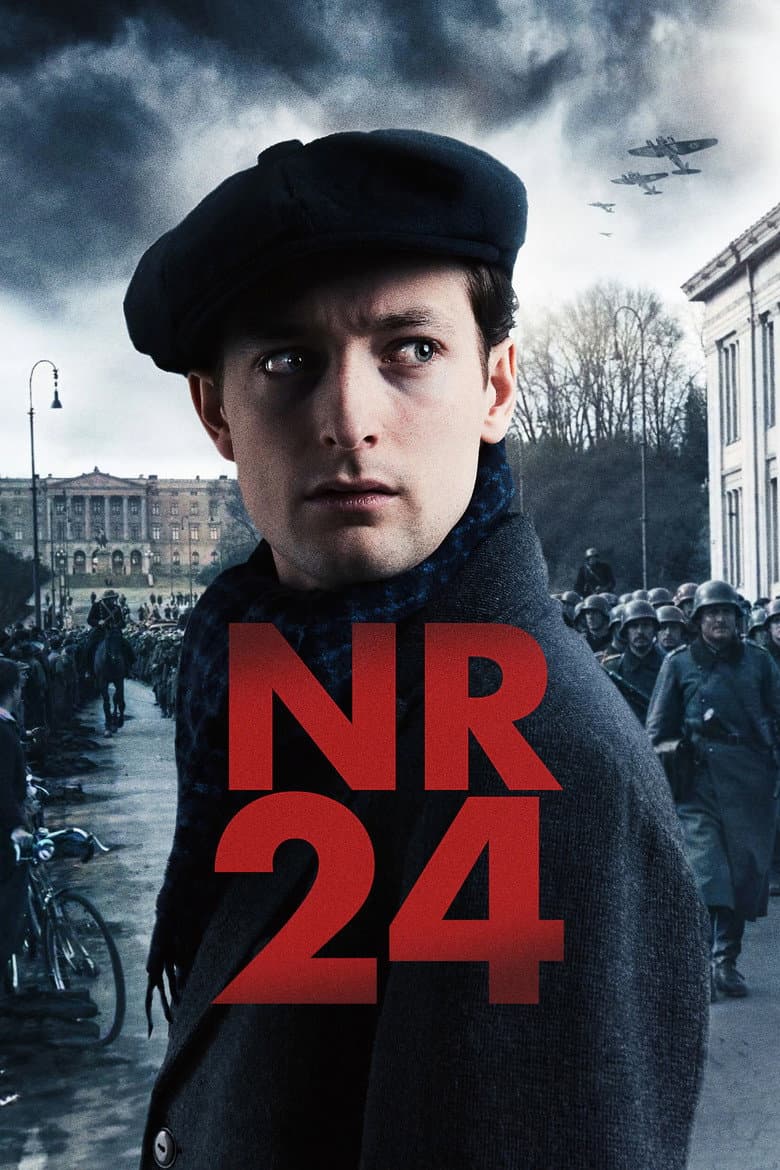
Number 24 follows Gunnar Sønsteby, a quiet young accountant in Oslo when Germany invades Norway in 1940. He joins the resistance, builds false identities, and helps lead the Oslo Gang in sabotage missions against German forces and Norwegian collaborators. The story moves between the war years and an older Gunnar speaking to students in Rjukan. The tone is tense and grim, with hard choices, torture, killings, and the lasting pain of war.
The film's main subject is freedom and the price people pay to defend it. A student asks Gunnar whether non-violence could have worked, and the film keeps asking whether killing enemies can be justified. Women such as Reidun Andersen and Gudrun Collett help the resistance, but the story stays centered on Gunnar and his male team. The ending links a young student's family loss to Gunnar's hardest wartime order and shows that victory did not erase guilt.
Community feedback
Was our 6% Woke rating accurate?
Breakdown
These are the editorial factors and ratings behind our score for Number 24.
Woke representation / casting
Not present. The film casts Norwegian actors as Norwegian resistance figures from the 1940s. Its main group is mostly white men because it follows a real Norwegian resistance story, while women appear in supporting roles. The film does not present the casting as a diversity or identity statement.
0%
Woke political dialogue
Not present. The film has political talk about Nazi rule, democracy, freedom, and the need to fight an invasion. That talk belongs to the wartime story and does not promote modern identity, DEI, gender, or activist politics.
0%
Identity-driven story themes
Not present. The story centers on resistance work, loyalty, violence, freedom, and guilt after war. It does not make race, gender, sexuality, or group identity a main source of conflict.
0%
Western institutional / cultural critique
Not present. The film condemns Nazi dictatorship and shows failures and hard choices during wartime. It does not attack modern family life, religion, men, women, capitalism, or Western institutions.
0%
Woke character or canon changes
Not relevant. The film uses a dramatized account of Gunnar Sønsteby and other real figures. It does not change their race, gender, sexuality, or main hero role.
0%
Anti-woke backlash and complaints
A few individual audience posts object to the female student who questions Gunnar's use of violence and brings up Gandhi. One Letterboxd review uses an insulting gender label for her, but no source shows that claim spreading. The supplied X pass found no anti-woke complaints, and no boycott, review-bombing, or major anti-woke campaign was reported. The main Norwegian dispute came from the opposite side, with criticism that the film gave women too little space.
8%
Creator track record context
Erlend Loe has a moderate creator track record because his work often questions social norms and discusses immigration and diversity. Vibeke Idsøe has a moderate track record because acceptance and people who feel different recur in her work. Andersen and most producers and casting directors have low stored scores and no clear activist profile. This mixed record gives mild creator track record context, while the film itself stays focused on war and freedom.
23%
Production
Movie · 2017
In 1950, amidst the ravages of the Korean War, Sergeant Süleyman stumbles upon a a half-frozen little girl, with no parents and no help in sight and he risks his own life to save…
Movie · 2016
On 15 January 2009, the world witnessed the 'Miracle on the Hudson' when Captain 'Sully' Sullenberger glided his disabled plane onto the Hudson River, saving the lives of all 155…
Movie · 2016
WWII American Army Medic Desmond T. Doss, who served during the Battle of Okinawa, refuses to kill people and becomes the first Conscientious Objector in American history to…
Movie · 2023
The story of J. Robert Oppenheimer's role in the development of the atomic bomb during World War II.
Movie · 2019
Richard Jewell thinks quick, works fast, and saves hundreds, perhaps thousands, of lives after a domestic terrorist plants several pipe bombs and they explode during a concert…
Movie · 2017
Members of the Granite Mountain Hotshots battle deadly wildfires to save an Arizona town.
Movie · 2022
Based on a true tragedy, the emotionally triggering film sheds light on the plight of Kashmiri Pandits (Hindus), a religious minority in the 1990s Kashmir valley, who were…
Movie · 2020
A man refuses all assistance from his daughter as he ages and, as he tries to make sense of his changing circumstances, he begins to doubt his loved ones, his own mind and even…
