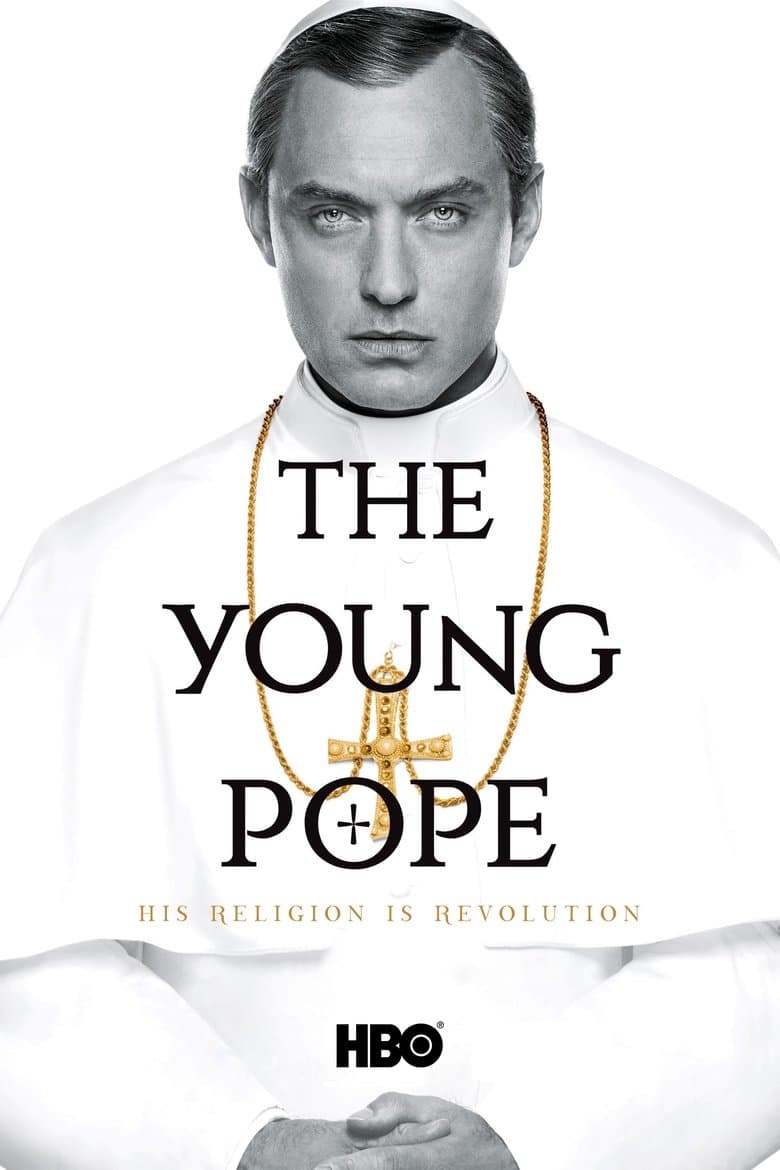
Started October 21, 2016 · Ended · Based on 1 season, 10 episodes through November 18, 2016 · TV-MA · 55 min · Italian
Lenny Belardo becomes Pope Pius XIII after older cardinals choose him as a compromise. He is a young American leader who hides his face, demands strict control, and shocks the Vatican with harsh rules. His power struggle with Cardinal Voiello and his former mentor, Cardinal Spencer, grows beside his search for the parents who abandoned him. The story moves through the Vatican, New York, Honduras, Africa, and Venice, and its tone mixes dark humor, sex, mystery, and serious questions about God.
The season's clearest identity content begins with a dream in which Pius praises abortion, contraception, gay marriage, married priests, and women saying Mass. The dream ends, and Pius later fights those changes, blocks gay men from entering the priesthood, and treats abortion as a crime. Gay Cardinal Gutierrez challenges that rule and becomes Pius's trusted secretary after Pius starts to soften. The season also attacks Church abuse and secret power, while its ending treats prayer, miracles, forgiveness, and faith as serious forces.
Community feedback
Was our 40% Woke rating accurate?
Breakdown
These are the editorial factors and ratings behind our score for The Young Pope.
Woke representation / casting
Not present. The main cast is mostly Italian, European, and American, which fits the Vatican setting and the invented story. Women hold visible roles as a nun, a marketing director, and a married laywoman, but the show does not frame those choices as a diversity message.
0%
Woke political dialogue
Pius's opening dream praises abortion, contraception, gay marriage, married priests, and women saying Mass. The story immediately reveals that this speech is only a dream, and Pius later argues for the opposite rules. The Italian prime minister briefly supports civil unions and research, but most later debate attacks modern liberal changes.
16%
Identity-driven story themes
The season repeatedly ties Church power to sex, marriage, abortion, and homosexuality. Pius blocks gay men from entering the priesthood, while Cardinal Gutierrez and Cardinal Dussolier show how the rule affects people close to him. Gutierrez says homosexuality must not be compared with child abuse, and Pius later admits his views are changing by making Gutierrez his secretary. The show also includes a protest over Pius's abortion rule, but it does not make modern identity activism the whole story.
43%
Western institutional / cultural critique
The Vatican is shown as a closed power machine where cardinals trade favors, use blackmail, and protect their jobs. The season treats the Church's handling of child abuse as a serious moral failure through the Kurtwell case. Pius's harsh rules also hurt people, including a young man denied entry to the seminary. The story still treats prayer, miracles, and faith as real possibilities, so its criticism is strong but mixed.
41%
Woke character or canon changes
Not relevant. The show uses an invented Pope and an original Vatican story. It does not change a known character, real historical figure, or established source character.
0%
Anti-woke backlash and complaints
Not present. No sustained anti-woke complaints were found in the X evidence or broader coverage. Right-leaning and Catholic viewers often praised the traditional pope, while other complaints focused on blasphemy, sex, smoking, or strange style.
0%
Creator track record context
Paolo Sorrentino has a mixed record and is better known for stories about faith, power, corruption, and public institutions than for DEI activism. His title interview described loneliness, solitude, and private pain inside a powerful Church, not a diversity campaign. The other credited writers and producers have mixed public records, with some social concerns and some queer-related work. This gives moderate context but not a strong activist signal.
31%
Production

TV Show · 2022
This sweeping saga chronicles the hopes and dreams of a Korean immigrant family across four generations as they leave their homeland in an indomitable quest to survive and thrive.

TV Show · 2024
Fascinated by cars since childhood, Brazilian racer Ayrton Senna became a sports legend — until tragedy struck, changing Formula 1 forever.
TV Show · 2024
The true story of one Jewish family separated at the start of World War II, determined to survive—and to reunite.
TV Show · 2023
The story of Bass Reeves, the legendary lawman of the wild West, is brought to life. Reeves worked in the post-Reconstruction era as a federal peace officer in the Indian…
TV Show · 2022
Oscar-winning producer Al Ruddy’s never before revealed experiences of making the iconic 1972 film The Godfather that Francis Ford Coppola directed and adapted with Mario Puzo.
TV Show · 2021
Inspired by the true story of Marty and the therapist who turned his life around...then took it over. When he first meets Dr. Ike, Marty just wants to get better at boundaries.
TV Show · 2026
Rip Wheeler and Beth Dutton gamble everything on a new life in South Texas, but the promise of building a future far from the ghosts of Yellowstone quickly collides with brutal…
TV Show · 2019
In the 1960s, Israeli clerk-turned-secret agent Eli Cohen goes deep undercover inside Syria on a perilous, years-long mission to spy for Mossad.
