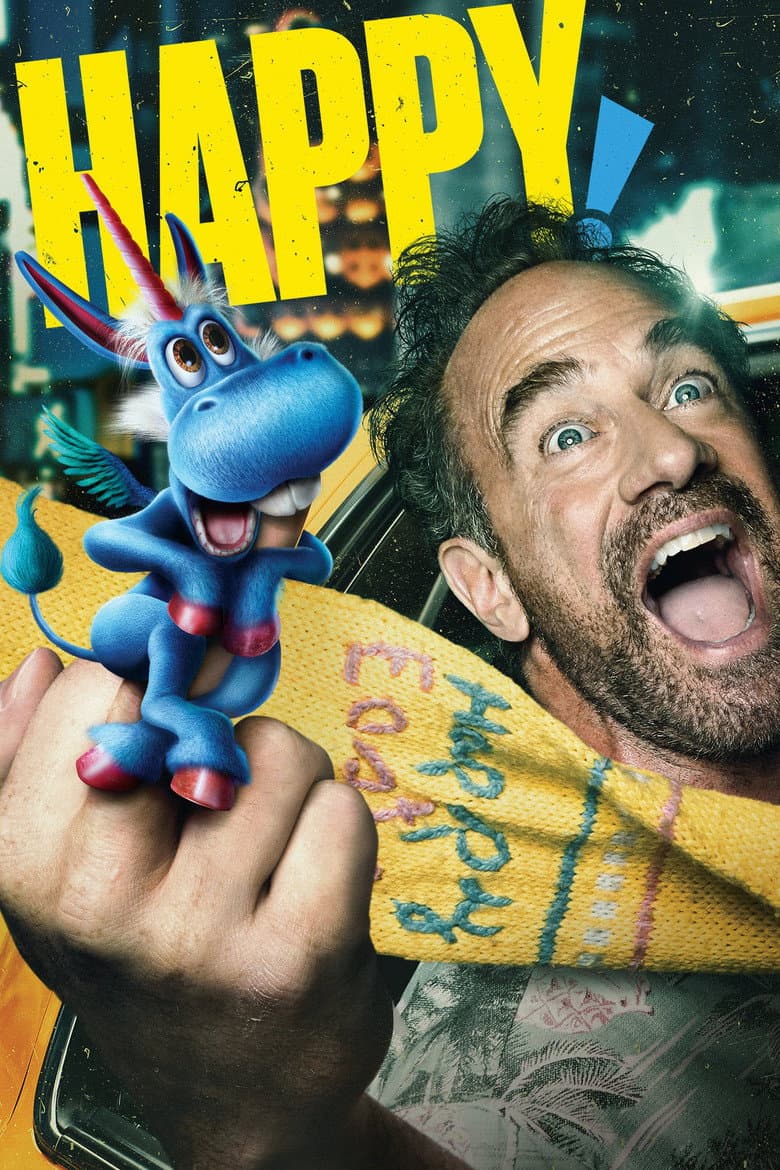
Started December 6, 2017 · Canceled · Based on 2 seasons, 18 episodes through May 29, 2019 · TV-MA · 42 min
Happy! follows Nick Sax, a disgraced New York cop who becomes a hitman and lives on alcohol, drugs, and anger. After a heart attack, Nick can see Happy, a small blue flying horse who is the imaginary friend of Nick’s kidnapped daughter, Hailey. Nick and Happy search for Hailey while they face criminals, child traffickers, a killer dressed as Santa, and strange supernatural forces. The show mixes bloody action, crude sex jokes, crime, fantasy, and very dark comedy across two seasons.
The clearest woke material appears in season 2, which makes the Catholic Church, Easter, and Christian belief part of a long comic attack. Exploding nuns, a Pope who accepts a plan to remake Easter, a Catholic school, and a faith-based pregnancy clinic all appear in the story. The finale presents God as an imaginary friend and treats prayer as something that does not change events. The show also gives crime boss Blue a male prison boyfriend, Big Pink, but that relationship is a small side plot and identity politics never becomes the main subject.
Community feedback
Was our 47% Woke rating accurate?
Breakdown
These are the editorial factors and ratings behind our score for HAPPY!.
Woke representation / casting
Not present. The show uses a mixed New York cast, but it does not present the casting as a diversity message. The prominent women and minority characters serve the crime and fantasy plot rather than a repeated representation-first pattern.
0%
Woke political dialogue
Sonny Shine repeatedly uses “Make Easter Great Again” as a slogan in season 2. The phrase mocks the MAGA slogan and presents Easter as a fake culture-war fight. The show also uses talk about a war on Easter and a plan to rebrand the holiday. This material supports the villain plot, but it stays inside broad, violent satire.
27%
Identity-driven story themes
Season 2 shows crime boss Blue in a male prison relationship with Big Pink. The pair’s bond leads to a major prison escape and suicide attempt. The show treats the relationship as part of the plot without making sexual identity a main issue. The series is not built around queer life or activism.
18%
Western institutional / cultural critique
The second season makes the Catholic Church and Easter a repeated target. The story uses exploding nuns, a Pope who approves Sonny’s holiday plan, a Catholic school, and a pregnancy clinic as sources of ridicule or danger. The finale presents God as an imaginary friend and says prayer does not change events. The show uses these ideas for shock comedy, but the attack on Christian belief runs through much of season 2.
45%
Woke character or canon changes
Not relevant. The series expands the short comic and lets Nick survive, while season 2 creates a new story. No established character is changed for a race, gender, or identity message.
0%
Anti-woke backlash and complaints
NewsBusters, a right-leaning outlet, said the show attacked Christianity and mocked Easter. The outlet also objected to the “Make Easter Great Again” joke and the finale’s treatment of God and prayer. The separate X research pass found no anti-woke reaction. The evidence is narrow rather than a broad public backlash.
18%
Creator track record context
Grant Morrison has a strong public history of gender-fluid and queer themes. Patrick Macmanus and Ashley Michel Hoban have public records supporting diversity and LGBTQ work. Darick Robertson, Brian Taylor, most other writers, and most directors have lower or mild activist profiles. The strongest creator signals add context, but the show itself is mostly violent crime and fantasy.
55%
Production
TV Show · 2016
In a world where superheroes have been real for decades, an accountant with zero powers comes to realize his city is owned by a super villain.
TV Show · 2022
An episodic anthology series focused on both new and established characters set in the world of "The Walking Dead."
TV Show · 2022
Denji has a simple dream—to live a happy and peaceful life, spending time with a girl he likes. This is a far cry from reality, however, as Denji is forced by the yakuza into…
TV Show · 2020
As humans turn into savage monsters and the world plunges into terror, a handful of survivors fight for their lives — and to hold on to their humanity.
TV Show · 2021
When a 34-year-old underachiever gets run over by a truck, his story doesn't end there. Reincarnated in a new world as an infant, Rudy will seize every opportunity to live the…
TV Show · 2019
One fateful day, all of humanity was petrified by a blinding flash of light. After several millennia, high schooler Taiju awakens and finds himself lost in a world of statues.
TV Show · 2023
A girl with extraordinary psychic abilities joins two gifted teen boys at a small ghost-hunting agency to fight the many deadly spirits haunting London.
TV Show · 2016
After a traffic accident, Kazuma Sato’s disappointingly brief life was supposed to be over, but he wakes up to see a beautiful girl before him.
