TV Show review
Started January 11, 2021 · Returning Series · Based on 3 seasons, 56 episodes through August 24, 2026 · TV-MA · 24 min · Japanese
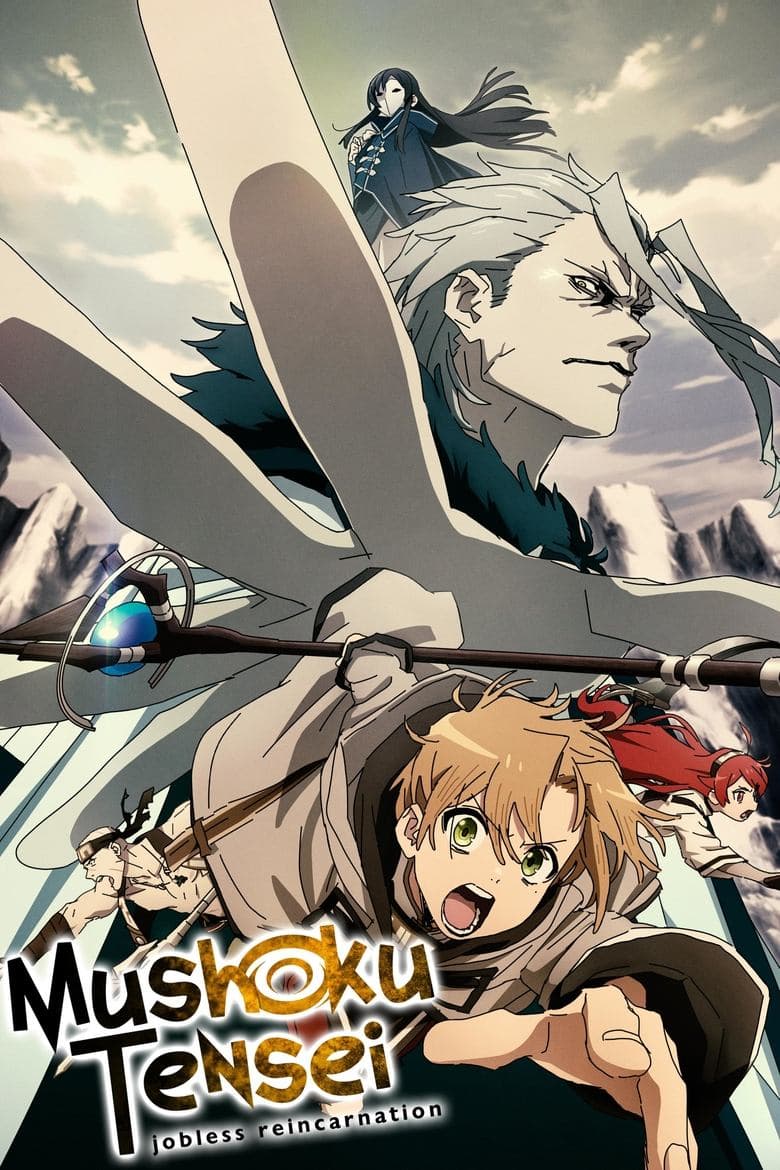
Rudeus Greyrat begins as a 34-year-old shut-in who dies while trying to save strangers. He is reborn as a baby in a world of magic, monsters, nobles, and several human-like races, but he keeps the memories of his old life. He grows into a gifted mage while traveling with Eris and Ruijerd, then studies at a magic university, marries Sylphiette, and searches for his missing mother. The tone moves from comic fantasy and adventure to grief, family drama, danger, and slow personal growth.
The story centers on Rudeus learning to face fear, loss, guilt, and the harm caused by his selfish habits. Season two gives more space to depression, sexual problems, marriage, slavery, and the rescue of his mother. Season three follows Eris training to become strong enough to stand beside Rudeus, while Rudeus builds a home with Sylphiette and Roxy. The show also includes a minor male character who is strongly hinted to be attracted to men, but romance, marriage, and family remain mostly heterosexual.
Community feedback
Was our 4% Woke rating accurate?
Breakdown
These are the editorial factors and ratings behind our score for Mushoku Tensei: Jobless Reincarnation.
Woke representation / casting
Not present. The show is animated and uses fantasy races rather than real-world casting choices. Its strong female characters fit the fantasy setting and are not framed as a diversity campaign.
0%
Woke political dialogue
Not present. The show has jokes and debates about sex, magic, fantasy groups, and social rank, but it does not use spoken lines to push modern DEI or activist ideas.
0%
Identity-driven story themes
The show hints that Talhand is attracted to men through Elinalise's jokes and a visual gag when he meets Rudeus. Talhand remains a side character, and his sexuality does not drive the plot. The main relationships and family story stay centered on heterosexual pairings and marriage to several women. The show does not connect this brief element to activist or identity politics.
8%
Western institutional / cultural critique
Not present. The show includes slavery, prejudice between fantasy groups, aristocratic abuse, and male infidelity. These events belong to the fantasy plot and are not framed as modern activist criticism of Western institutions or gender norms.
0%
Woke character or canon changes
Not relevant. The anime has no established race, gender, sexuality, or hero-role swap involving a known character or real person. Its cuts and changes from the novels are ordinary adaptation choices.
0%
Anti-woke backlash and complaints
Not present. The major complaints target Rudeus's sexual behavior, child sexual material, slavery, and censorship. Those complaints do not say that the show pushes woke, DEI, or identity politics.
0%
Creator track record context
Not present. The listed directors, writers, and producers have craft-focused careers with no documented activist or DEI pattern in the available record. Title-related interviews discuss second chances, character growth, adaptation, and production work rather than identity politics.
0%
Production
TV Show · 2016
Shigeo Kageyama, a.k.a. "Mob," is a boy who has trouble expressing himself, but who happens to be a powerful esper.
TV Show · 2019
After a demon attack leaves his family slain and his sister cursed, Tanjiro embarks upon a perilous journey to find a cure and avenge those he's lost.
TV Show · 2021
After encounters with a dragon and a princess on her own mission, a Dragon Knight becomes embroiled in events larger than he could have ever imagined.
TV Show · 2024
They say whatever doesn’t kill you makes you stronger, but that’s not the case for the world’s weakest hunter Sung Jinwoo.
TV Show · 2022
Denji has a simple dream—to live a happy and peaceful life, spending time with a girl he likes. This is a far cry from reality, however, as Denji is forced by the yakuza into…
TV Show · 2017
Located in the center of a remote island, the Abyss is the last unexplored region, a huge and treacherous fathomless hole inhabited by strange creatures where only the bravest…
TV Show · 2022
After losing his home to a powerful enemy, a hot-tempered fighter trains under his zealous grandfather while awaiting his chance for revenge.
TV Show · 2021
Two siblings - an idealistic teenage boy and his naive younger sister - are forced to pilot an abandoned Jaeger across a hostile landscape in a desperate attempt to find their…
