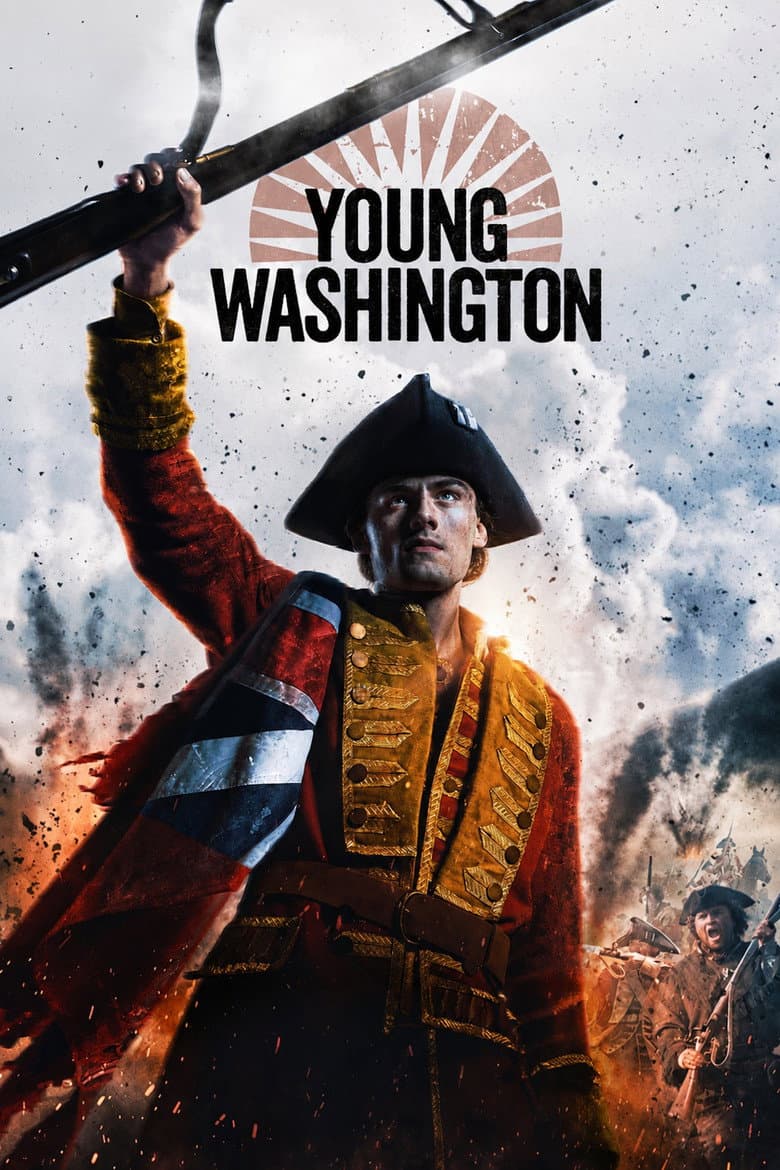
Young Washington follows George Washington from his father’s death to his first major military command in the 1750s. He starts as an ambitious Virginia surveyor who wants education, status, and a place in the British army. George faces class barriers, failed missions, heavy losses, and pressure from British officers during the French and Indian War. The film uses muddy battles, family drama, romance, and a serious patriotic tone to show how failure changes him into a more responsible leader.
The movie gives a real story role to Tanacharison, a Seneca leader who first helps George deal with the French and later tells him that the Creator protected him. That scene presents Washington as a chosen white hero, but it is a short part of a larger war story and is tied to an old legend rather than a modern campaign. Sally Cary talks about dowries, fathers who choose daughters’ futures, and the unfair rules of elite society. Those lines give the film a small challenge to old gender and class rules, while the main message stays focused on duty, faith, courage, failure, and service.
Community feedback
Was our 21% Woke rating accurate?
Breakdown
These are the editorial factors and ratings behind our score for Young Washington.
Woke representation / casting
Not present. The main cast and setting fit a mostly white colonial Virginia and British military world. Indigenous and black characters are in supporting roles, but no diversity-first casting message is confirmed.
0%
Woke political dialogue
Not present. The film includes short arguments about equal pay, fairness, freedom, and women’s arranged marriage choices. These lines belong to the period story and do not form a modern identity or activist message.
0%
Identity-driven story themes
The film gives Tanacharison, a Seneca leader, a meaningful role in George’s early war story. The Half-King later says the Creator protected George and that he walks in destiny, which presents a white hero as specially chosen by Native spiritual authority. Sally Cary also questions dowries and fathers who choose a daughter’s future. These elements are noticeable, but they are brief and the main arc is about failure, duty, faith, and military leadership.
24%
Western institutional / cultural critique
The film shows British officers and colonial elites blocking George because of rank, wealth, and family status. George and Sally speak against dowries and fathers who choose daughters’ futures. The story treats those old rules as unfair, but it does not connect them to present-day patriarchy, capitalism, or current politics. The critique stays tied to George’s period class struggle.
18%
Woke character or canon changes
Not relevant. The movie uses some disputed legends and changes some history for drama, including the timing of George’s romance and the Indian Prophecy. No race, gender, sexuality, or leadership swap involving an established character or historical figure is confirmed.
0%
Anti-woke backlash and complaints
X posts repeatedly praised the film as a way to avoid woke Hollywood and as a patriotic alternative, with notable but unorganized reach. Right-leaning web coverage also used it against DEI classes and progressive views of the Founders. One viewer claimed the Native friendship was added for DEI, while a rumor of a graphic gay scene was checked and found false. No coordinated boycott or large review-bombing campaign was found.
7%
Creator track record context
Most available creator summaries give Jon Erwin, the writers, and the producers low woke scores and show no sustained identity-activist record. Donna Eperon has a higher stored score because of social issue work and DEI judging. Ben Howard has a high stored score because of queer-centered films, but no public coverage links that focus to this movie. Erwin’s interviews frame the film as a love letter to America and a story about servant leadership.
15%
Production
Movie · 2017
Members of the Granite Mountain Hotshots battle deadly wildfires to save an Arizona town.
Movie · 2022
A quiet, neglected girl is sent away from her dysfunctional family to live with relatives for the summer. She blossoms in their care, but in this house where there are meant to be…
Movie · 2020
A man refuses all assistance from his daughter as he ages and, as he tries to make sense of his changing circumstances, he begins to doubt his loved ones, his own mind and even…
Movie · 2026
While people across 1990s Iraq struggle to survive the war and food shortages, Saddam Hussein requires each school in the country to prepare a cake to celebrate his birthday.
Movie · 2022
London, 1953. Mr. Williams, a veteran civil servant, is an important cog within the city's bureaucracy as it struggles to rebuild in the aftermath of World War II.
Movie · 2025
A logger leads a life of quiet grace as he experiences love and loss during an era of monumental change in early 20th-century America.
Movie · 2017
In 1950, amidst the ravages of the Korean War, Sergeant Süleyman stumbles upon a a half-frozen little girl, with no parents and no help in sight and he risks his own life to save…
Movie · 2016
In a desolate war zone where screams of the innocent echo, on the very line between disaster and valor, 7 Maroon Berets will dance with death.
