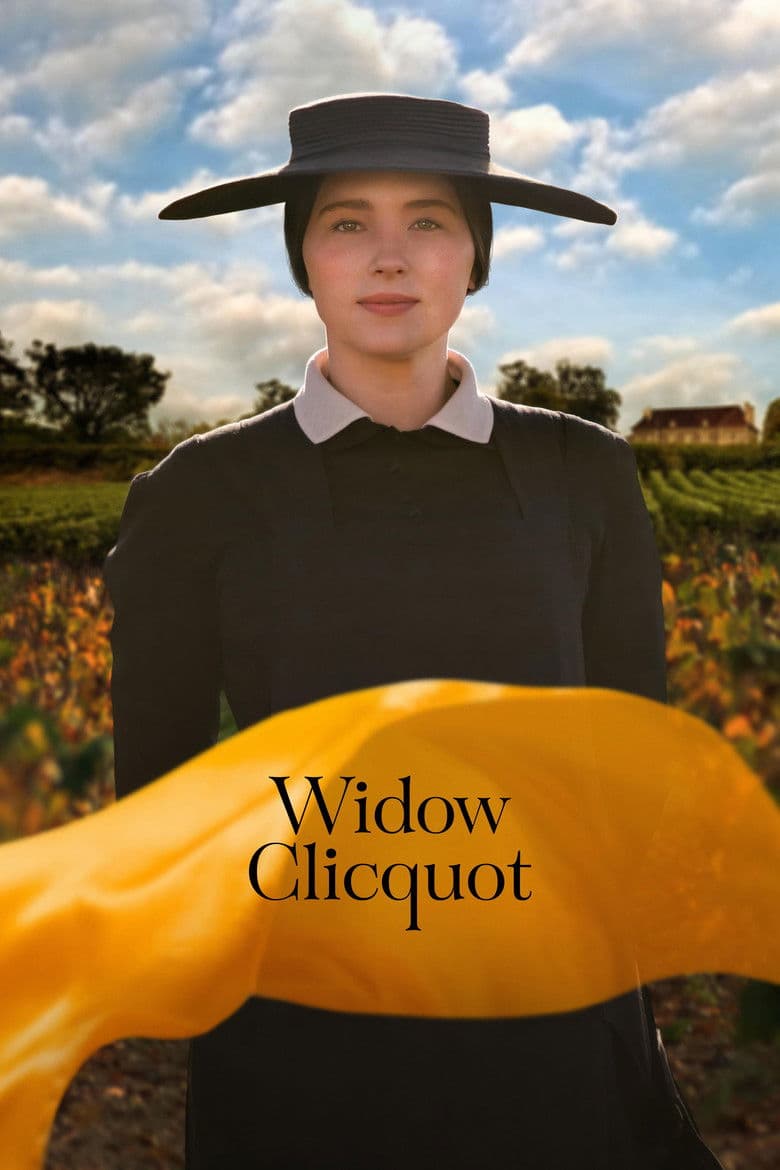
Barbe-Nicole Ponsardin Clicquot becomes a young widow in France during the Napoleonic Wars. After her husband François dies, she tries to keep his vineyard and wine business instead of letting her father-in-law sell it to a rival. She faces war, debt, bad harvests, and men who doubt that a woman can run a company. The film moves between her loving marriage and her lonely work in the house, cellar, and fields, so the story feels dark, dreamy, romantic, and sad.
Barbe-Nicole is shown as a determined woman who develops new ways to make and sell champagne while she fights to keep control of the company. The film treats her rise as a story about female strength, independence, and freedom from old rules. It also presents her choice to remain a widow as part of protecting her work and becoming her own person. These ideas shape the main conflict, but the film gives similar attention to grief, love, mental illness, winemaking, war, and the long building of the Veuve Clicquot name.
Community feedback
Was our 53% Woke rating accurate?
Breakdown
These are the editorial factors and ratings behind our score for Widow Clicquot.
Woke representation / casting
Barbe-Nicole is presented as the main female business leader against male wine makers and officials. The casting fits the real person and the French setting, so it does not show a race-based or quota-style pattern. Interview coverage frames the lead as a female-driven and female-empowerment choice. That public framing gives this factor a mild score.
34%
Woke political dialogue
Barbe-Nicole questions whether men’s certainty comes from knowledge or from confidence in themselves. The courtroom scene uses her challenge to question male authority over her work. Other lines connect struggle with becoming stronger and more independent. The dialogue is present, but the film is not built around speeches or slogans.
32%
Identity-driven story themes
Barbe-Nicole takes control of a company in a society that blocks women from running businesses. The story repeatedly shows male rivals, relatives, and officials doubting her ability. The film presents her choice to remain unmarried as part of keeping control of her work and becoming her own person. Grief, marriage, mental illness, and winemaking take up much of the running time, so the identity-driven message is strong but not the whole movie.
56%
Western institutional / cultural critique
The film shows French rules and male wine makers treating a widow as unable to lead. The courtroom scene turns that fight into a direct attack on old gender limits and male certainty. The film also makes her husband’s illness, drug use, and erratic behavior part of the burden she must survive. The story stays inside the period setting and does not make a broad attack on Christianity, capitalism, or modern Western life.
43%
Woke character or canon changes
Not relevant. The movie changes some life details, including François’s death and a marriage proposal, but those changes do not alter race, gender, sexuality, or the lead role.
0%
Anti-woke backlash and complaints
Not present. No clear anti-woke or right-leaning complaints were found. Public criticism focused on pacing, thin storytelling, historical changes, and the small amount of detail about winemaking.
0%
Creator track record context
Thomas Napper has made documentaries about social issues and people living on the margins. Haley Bennett has spoken about women’s agency and helped produce this film. Joe Wright has expressed progressive views about gender and used opposition to fascism in other projects. The other listed writers and producers do not show a strong activist record. This gives the title mild creator track record context.
31%
Production

Movie · 2023
The story of J. Robert Oppenheimer's role in the development of the atomic bomb during World War II.
Movie · 2016
WWII American Army Medic Desmond T. Doss, who served during the Battle of Okinawa, refuses to kill people and becomes the first Conscientious Objector in American history to…
Movie · 2025
Diagnosed with Tourette Syndrome at 15, John Davidson navigates his way against the odds through troubled teenage years and into adulthood, finding inspiration in the kindness of…
Movie · 2023
American ballet dancer Joy Womack is accepted into Moscow's infamously tough Bolshoi Ballet Academy, with the dream of becoming a great ballerina.
Movie · 2026
While people across 1990s Iraq struggle to survive the war and food shortages, Saddam Hussein requires each school in the country to prepare a cake to celebrate his birthday.
Movie · 2016
On 15 January 2009, the world witnessed the 'Miracle on the Hudson' when Captain 'Sully' Sullenberger glided his disabled plane onto the Hudson River, saving the lives of all 155…
Movie · 2023
The true story of the inseparable Von Erich brothers, who made history in the intensely competitive world of professional wrestling in the early 1980s.
Movie · 2017
Members of the Granite Mountain Hotshots battle deadly wildfires to save an Arizona town.
