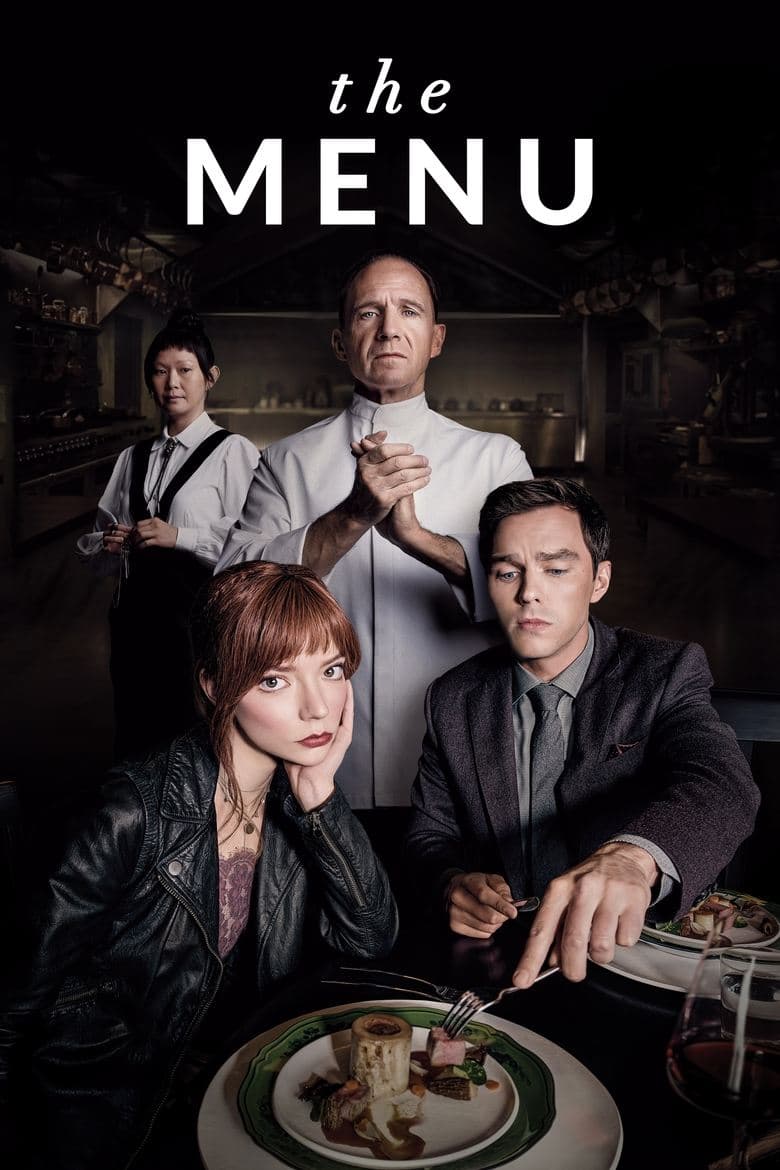
A young woman named Margot goes with a food-obsessed date, Tyler, to a very fancy restaurant on a private island. Famous chef Julian Slowik serves a long, pricey tasting menu to rich guests. As the courses go on, the night turns dark, violent, and deadly. The tone mixes dark jokes with horror and tight suspense.
The movie mainly attacks rich snobs, empty “foodie” status games, and people who treat cooks and servers like tools. The chef’s plan is a revenge feast against guests he thinks ruined his joy in cooking. Viewers also get a clear side beat where a woman worker stabs the chef over past sexual harassment, and the men are sent out to fail at escaping while looking weak. Margot, who works as an escort and knows service life, is the one who walks away by asking for a simple cheeseburger instead of fancy art food. There is no queer storyline and no race-or-gender rewrite of a known hero. What a normal viewer notices is class anger, “eat the rich” vibes, and some male-ego humiliation—not a full identity-politics lecture.
Community feedback
Was our 44% Woke rating accurate?
Breakdown
These are the editorial factors and ratings behind our score for The Menu.
Woke representation / casting
Modern luxury setting with several non-white supporting roles (Hong Chau, Leguizamo, Yang, Castro, Carrero). Leads are mostly white. Diversity fits a rich restaurant crowd and is not sold as a diversity lesson. Elsa was once scripted as Scandinavian and cast with Chau, but the movie never makes her race the point.
18%
Woke political dialogue
Lots of talk about class, entitlement, and how rich guests use cooks and servers. One course and related talk cover the chef’s sexual harassment of a woman staffer. Viewers hear clear anti-snob, anti-rich lines. Not race or LGBTQ identity lectures.
30%
Identity-driven story themes
Core story is class revenge and fake food status, not race or queer identity. A clear side beat punishes male harassment and splits men and women for one course. Margot’s win is framed as service-worker honesty beating rich pretension. Noticeable class politics; light gender/harassment edge.
25%
Western institutional / cultural critique
Easy to see: rich elites, critics, finance bros, and empty high-end culture get torn down. Staff and artists are shown as burned out by money and fans. Tyler’s male foodie ego is crushed. Strong class and labor satire with #MeToo-adjacent and male-entitlement beats, not a race or colonial-guilt sermon.
45%
Woke character or canon changes
Not present in this title.
0%
Anti-woke backlash and complaints
Some anti-woke reviews and video essays call the class politics heavy-handed or “woke.” No major mass boycott or constant mainstream culture-war storm. Complaints that count here target left-leaning class messaging, not “not diverse enough” critiques.
20%
Creator track record context
Stored scores for key creatives are mostly low to mild. Writers come from progressive satire comedy; the director is prestige-drama focused, not an activist brand. Producer and casting signals are mild industry-left, not a hard DEI activist package for this film.
18%
Production

Movie · 2023
Having grown sick and tired of his centuries as Dracula's lackey, Renfield finds a new lease on life — and maybe even redemption — when he falls for feisty, perennially angry…

Movie · 2019
Columbus, Tallahassee, Wichita, and Little Rock move to the American heartland as they face off against evolved zombies, fellow survivors, and the growing pains of the snarky…

Movie · 2022
Legendary rock band Foo Fighters move into an Encino mansion steeped in grisly rock and roll history to record their much anticipated 10th album.
Movie · 2017
Real zombies arrive and terrorize the crew of a zombie film being shot in an abandoned warehouse, said to be the site of military experiments on humans.

Movie · 2020
Two years after defeating a satanic cult led by his babysitter Bee, Cole's trying to forget his past and focus on surviving high school.
Movie · 2026
After breaking the mysterious "One Wish Willow" to win his crush's heart, a hopeless romantic finds himself getting exactly what he asked for but soon discovers that some desires…

Movie · 2022
A college reunion goes awry when Pete suspects his friends may be out to get him... As their weekend getaway grows more and more uncomfortable, should Pete be worried about his…

Movie · 2017
Ten years ago, over forty people were brutally torn to pieces in Louisiana’s Honey Island Swamp. Over the past decade, lone survivor Andrew’s claims that local legend Victor…
