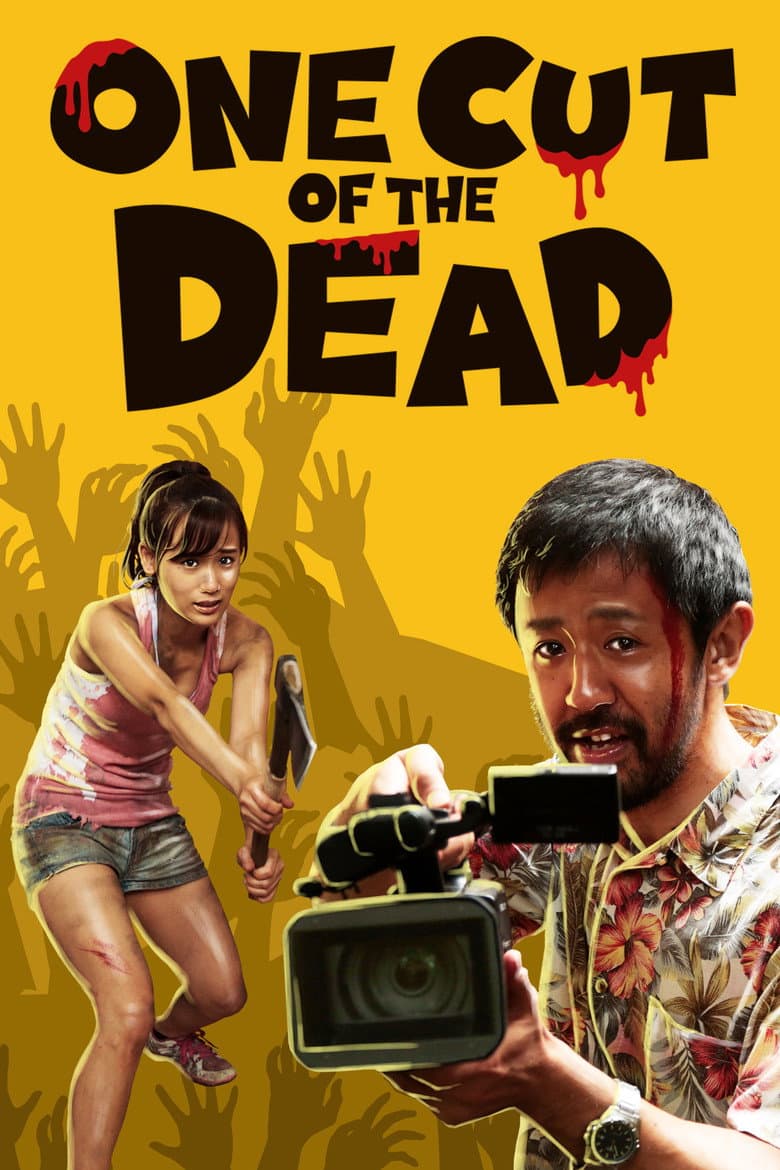
Takayuki Higurashi is a tired director who accepts a strange job from a new zombie television channel. He must film a zombie story in one unbroken shot at an abandoned water plant where people once claimed that military experiments brought the dead back to life. When real zombies appear, Higurashi keeps the camera running while the actors and crew try to survive. The film starts as rough, bloody horror and then turns into a warm, fast comedy about how the shoot was made.
The story later shows Higurashi trying to reconnect with his daughter Mao, who wants to direct films, while his former actress wife Nao joins the cast at the last moment. Nao's self-defense hobby makes her overpower other performers when she gets too deeply lost in her role. Mao helps solve a major camera problem. A brief joke says the zombie story hides a racial or social-justice theme, but another character mocks the claim. The film treats these points as comedy inside a wider story about family, teamwork, creative problem solving, and making entertainment together.
Community feedback
Was our 12% Woke rating accurate?
Breakdown
These are the editorial factors and ratings behind our score for One Cut of the Dead.
Woke representation / casting
Not present. The Japanese cast fits the Japanese film crew and setting. The roles include a male director, a female makeup artist, and a young female film worker without a diversity-first pattern. No identity-based casting statement is tied to the film.
0%
Woke political dialogue
One character says that the zombie story hides a racism or social-justice theme. Another character asks where that idea appears, and the exchange makes fun of forced subtext. The line is brief and does not lead to a speech or a political plot. No other modern identity message drives the dialogue.
12%
Identity-driven story themes
Nao is a former actress and makeup worker who has trained in self-defense. Nao uses that skill to overpower several men when she gets too deeply lost in her zombie role. Mao is a young aspiring director who helps solve the broken camera problem. The film plays these moments as family and workplace comedy, so the gender element is brief and not the main story.
18%
Western institutional / cultural critique
Not present. Television executives create a cheap and unsafe production, but the film treats this as a broad workplace joke. The story does not turn that conflict into modern activist criticism of Western institutions, religion, capitalism, or traditional family life.
0%
Woke character or canon changes
Not relevant. The film has no established franchise characters or real historical figures whose identities are changed. The reported link to the stage play Ghost in the Box concerns story credit, not a race, gender, or sexuality change.
0%
Anti-woke backlash and complaints
Not present. No anti-woke complaints were found in the reviewed news, audience, and social discussion. The supplied X pass found no anti-woke reaction, and the reported public dispute concerned stage-play credit rather than woke content.
0%
Creator track record context
Not present. Ueda’s supplied record centers on independent entertainment and audience enjoyment. Ichihashi’s supplied record centers on independent film and training. The supplied creator scores are 0, with no clear activist, DEI, or identity-first pattern.
0%
Production
Movie · 2019
Columbus, Tallahassee, Wichita, and Little Rock move to the American heartland as they face off against evolved zombies, fellow survivors, and the growing pains of the snarky…
Movie · 2018
The story of a heartbroken man who attends a spiritual retreat, only to discover that the course releases more than everyday toxins and traumatic experiences.
Movie · 2020
At the height of the Cold War, a Soviet spacecraft crash lands after a mission gone awry, leaving the commander as its only survivor.
Movie · 2018
After suspecting that their police officer neighbor is a serial killer, a group of teenage friends spend their summer spying on him and gathering evidence, but as they get closer…
Movie · 2023
On the day of his scheduled execution, a convicted serial killer gets a psychiatric evaluation during which he claims he is a demon, and further claims that before their time is…
Movie · 2024
After a family tragedy, three generations of the Deetz family return home to Winter River. Still haunted by Betelgeuse, Lydia's life is turned upside down when her teenage…
Movie · 2017
In a small town in Maine, seven children known as The Losers Club come face to face with life problems, bullies and a monster that takes the shape of a clown called Pennywise.
Movie · 2017
A supernatural love story that centers on two parents whose life together falls apart after their son dies. The man, now a successful lawyer, and the woman, now married and an…
