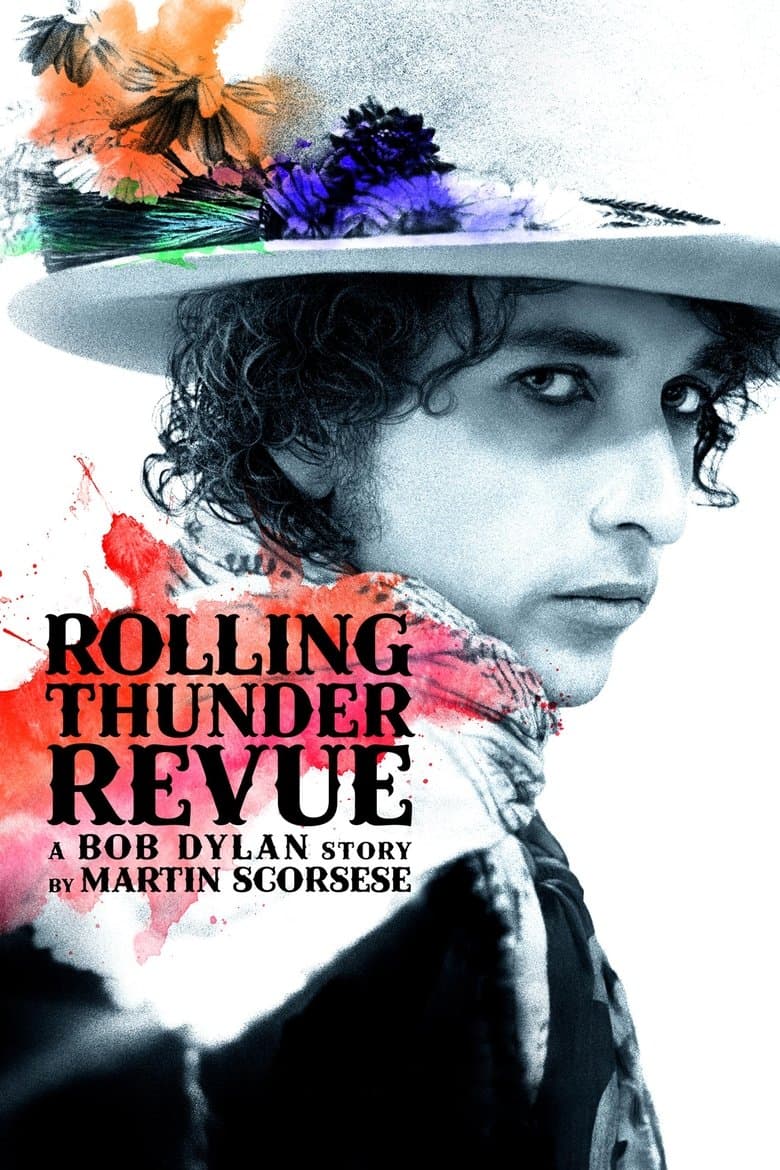
Movie review
June 11, 2019 · 142 min · R · Documentary
Bob Dylan leads a traveling group of singers, musicians, poets, and friends on the 1975 Rolling Thunder Revue tour. The group moves through small halls and towns in the United States and Canada as America faces the aftermath of Vietnam, Watergate, and the coming 200th birthday of the United States. Dylan tries to control his image while the tour mixes concerts, backstage scenes, old film, and made-up stories. The tone is loud, playful, restless, and often unclear about what really happened.
The film gives a major section to Rubin Carter, a black boxer who says he was wrongly jailed for murder, and Dylan’s protest song “Hurricane.” It also visits a Tuscarora reservation and connects native history to “The Ballad of Ira Hayes.” The film discusses Allen Ginsberg’s attraction to straight teenage boys, while Joan Baez and Joni Mitchell receive strong musical moments. These scenes about race, native people, and same-sex attraction appear in a few clear parts, while the larger story stays focused on music, friendship, freedom, and Dylan’s love of mystery.
Community feedback
Was our 31% Woke rating accurate?
Breakdown
These are the editorial factors and ratings behind our score for Rolling Thunder Revue: A Bob Dylan Story by Martin Scorsese.
Woke representation / casting
Not present. The film uses real performers and real people from the 1975 tour. It does not build a diversity-first cast or make identity-based casting part of its message.
0%
Woke political dialogue
The film includes political speech about Vietnam, Watergate, and the broken promise of America. A Tuscarora speaker says settlers took Native land, children, and women and left native people poor in their own country. Rubin Carter’s case and the song “Hurricane” add a direct attack on racial injustice. These points return in separate parts of the film, but they stay tied to 1970s history rather than a modern DEI campaign.
38%
Identity-driven story themes
The film makes race and native history visible in separate sections. Rubin Carter speaks about his imprisonment, while a Tuscarora visit leads to a song about stolen land and the treatment of Ira Hayes. The film also discusses Allen Ginsberg’s attraction to straight teenage boys. These themes are clear but sit beside a much larger story about music, friendship, and mythmaking.
33%
Western institutional / cultural critique
The film shows Vietnam, Watergate, the justice system, and the theft of Native land as signs of a country that has broken its promises. It contrasts Dylan’s small-hall tour with a promoter who wants larger, more profitable shows. These points criticize government, law, colonial history, and big business, but they are framed as 1970s history and counterculture rather than a constant modern attack on Western society.
27%
Woke character or canon changes
Not relevant. The film reshapes real footage with invented interviews, but it does not change anyone’s race, gender, sexuality, or identity. It does not alter an established character or historical figure for an identity message.
0%
Anti-woke backlash and complaints
Not present. The X research pass found no anti-woke complaints. Web and Reddit discussion focused on fake interviews, confusing fact and fiction, and the amount of concert footage. No clear complaint said the film pushed DEI, identity politics, or activist messaging.
0%
Creator track record context
Not present. The cached creator notes give the director, producers, and casting director low woke scores. Their known work centers on crime stories, music, film history, and preservation, with no strong activist or DEI pattern.
0%
Production
Movie · 2018
A documentary about World War I with never-before-seen footage to commemorate the centennial of Armistice Day, and the end of the war.
Movie · 2022
In candid conversations with actor Jonah Hill, leading psychiatrist Phil Stutz explores his early life experiences and unique, visual model of therapy.
Movie · 2016
After being denied access to the Church of Scientology's headquarters, documentarian Louis Theroux teams up with ex-Scientology official Marty Rathbun to stage re-enactments of…
Movie · 2022
After years in the limelight, Selena Gomez achieves unimaginable stardom. But just as she reaches a new peak, an unexpected turn pulls her into darkness.
Movie · 2022
Follows the man who survived an assassination attempt by poisoning with a lethal nerve agent in August 2020. During his months-long recovery, he makes shocking discoveries about…
Movie · 2019
An Iraqi journalist joins an army of uneasy allies and unforgettable characters in the epic battle to liberate the city of Mosul from the Islamic State.
Movie · 2018
As his life comes to its end, famous Hollywood director Orson Welles puts it all on the line at the chance for renewed success with the film The Other Side of the Wind.
Movie · 2016
With never-before seen home video, this film recounts the paranoid downward spiral of John E. du Pont and the murder of Olympic wrestler Dave Schultz.
