Movie review
December 6, 2023 · 102 min · NR · Spanish · Sci-Fi · Animation · Comedy · Drama
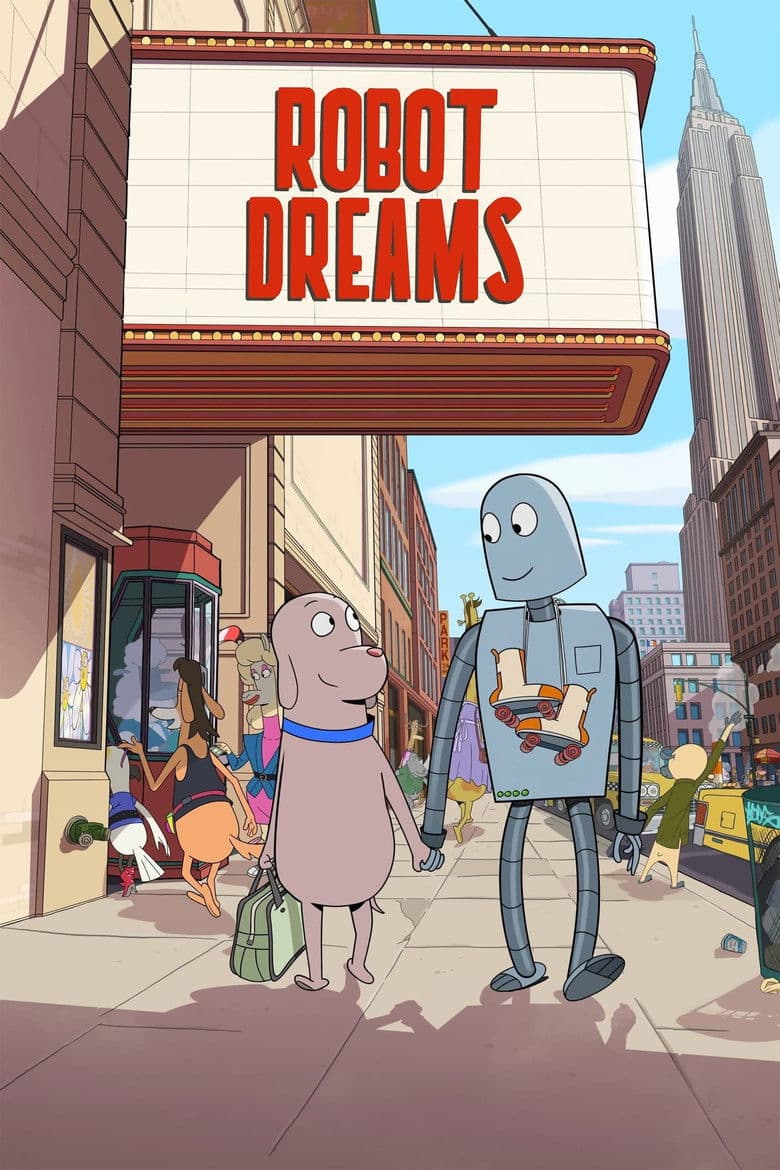
Dog lives alone in 1980s New York, in a world full of animal people. He buys a robot so he will not feel so lonely. They become close friends and share fun days in the city. After a beach trip, Robot freezes with rust, and Dog has to leave him behind. The rest of the story follows both of them as they miss each other, try new bonds, and learn how hard it is to move on. The tone is soft, funny, and very sad, with no spoken words.
The movie is mainly about loneliness, friendship, and letting go. Dog and Robot act very close—they hold hands, dance, and share daily life—and many adults read their bond as romantic. The characters have no clear gender, and director Pablo Berger has said he is happy when people see queer meaning in the film. Some press even framed it as a story of queer love in the big city. Still, the film never spells out race, gender politics, or activist speeches. Younger viewers often just see a friend story. A normal viewer mainly notices a quiet heartbreak tale about love, loss, and memory, with identity readings left open rather than pushed as a lecture.
Community feedback
Was our 28% Woke rating accurate?
Breakdown
These are the editorial factors and ratings behind our score for Robot Dreams.
Woke representation / casting
Cast is animal people and robots, not human race or quota casting. Characters are kept without clear gender, a choice Berger later linked to open gender readings. That is a mild identity-open design choice, not star-powered DEI casting in human roles. Most viewers see cartoon animals first.
18%
Woke political dialogue
The film has no spoken dialogue. There are no activist speeches, slogans, or identity lectures. Story is told with pictures, music, and action only.
0%
Identity-driven story themes
Main themes are loneliness, friendship, loss, memory, and moving on. Dog and Robot’s close, couple-like bond and genderless design lead many adults and some press to a queer romance reading; Berger has said he is happy about those readings. That identity layer is real and noticeable to some, but the plot itself is not built as a coming-out or identity-politics story. Queer coding adds weight without making identity the whole movie.
44%
Western institutional / cultural critique
Obstacles are mostly personal and plot-based (rust, a closed beach, junkyard luck), not a modern activist attack on Western institutions, family norms, faith, or “whiteness.” Thin allegory readings exist in some reviews; the film itself does not preach systemic identity critique.
0%
Woke character or canon changes
Not relevant. The film expands Varon’s friendship tale into a fuller 1980s New York, but genderless leads and the core bond come from the source spirit. Changes read as ordinary adaptation, not identity-driven rewrites of known human characters or history.
0%
Anti-woke backlash and complaints
No clear wave of anti-woke or right-leaning complaints that the film pushes DEI or identity politics. Coverage is mostly praise. Scattered “it’s a gay movie” jokes are not a serious backlash campaign.
0%
Creator track record context
Stored profiles for key directors, writers, and producers score near zero for activist or DEI campaigning. Berger’s comments welcoming queer and gender-open readings for this film are mild title-related context, not a long public activist career.
5%
Production
Movie · 2022
In 1998, Beavis and Butt-Head are sentenced to Space Camp by a “creative” judge. Their obsession with a docking simulator (huh huh) leads to a trip on the Space Shuttle, with…
Movie · 2024
Popular, outgoing Fujino is celebrated by her classmates for her funny comics in the class newspaper. One day, her teacher asks her to share the space with Kyomoto, a truant…
Movie · 2024
In 1985, the murder of a government-sponsored superhero draws his outlawed colleagues out of retirement and into a mystery that threatens to upend their personal lives and the…
Movie · 2017
A young man arrives at the last hometown of painter Vincent van Gogh to deliver the troubled artist's final letter and ends up investigating his final days there.

Movie · 2017
Thirty years after the events of the first film, a new blade runner, LAPD Officer K, unearths a long-buried secret that has the potential to plunge what's left of society into…

Movie · 2023
After it's discovered that a teacher at South Park Elementary has an OnlyFans page, Randy is compelled to take a closer look at the seedy underbelly of the world of online…
Movie · 2026
When their plan to book a show at the Rivoli goes horribly wrong, Matt and Jay accidentally travel back to the year 2008.
Movie · 2024
A colossal-sized omnibus film bringing together the last two episodes of Attack on Titan in the franchise's first-ever theatrical experience.
