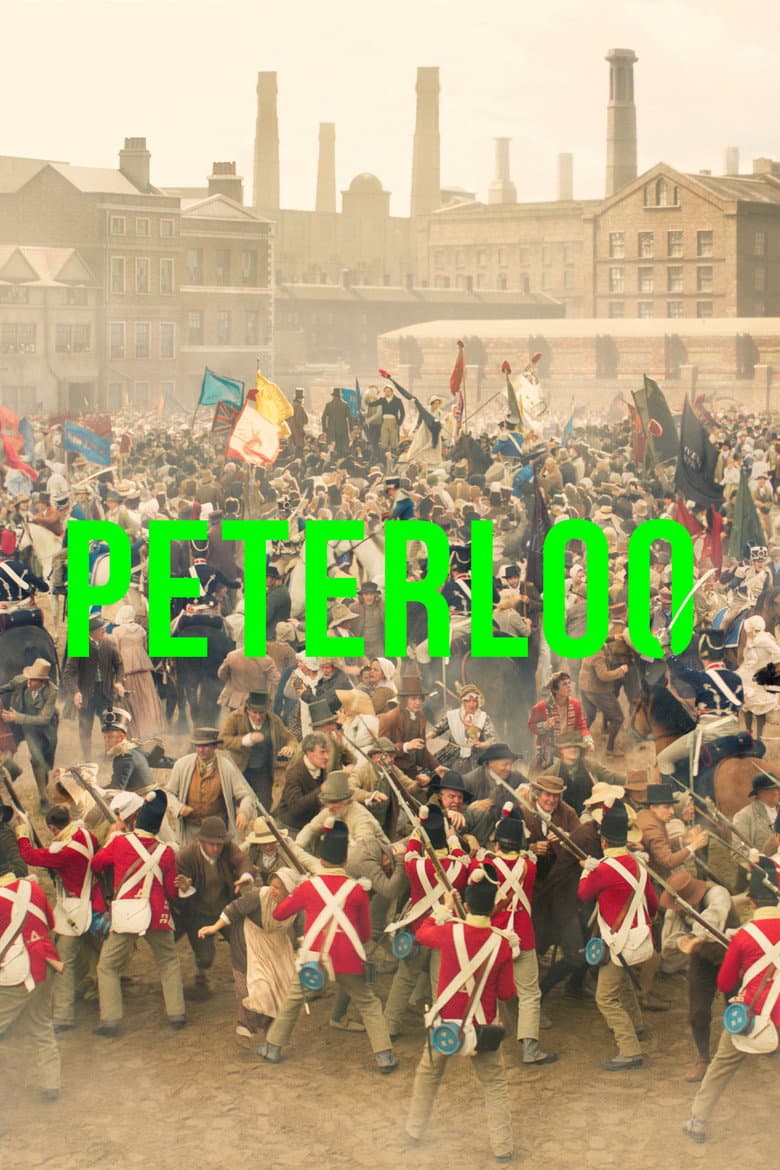
Peterloo follows Joseph, a young bugler who returns from the Battle of Waterloo to a poor family in Manchester in 1819. His mother Nellie sells meat pies while the family struggles with low wages, high food prices, and little political power. Reformers such as Henry Hunt and Samuel Bamford try to bring workers together for a peaceful meeting. The meeting at St Peter’s Field becomes a massacre when soldiers and local officials attack the crowd. The film is serious, slow, and grim, with long speeches before a sudden burst of violence.
The film gives strong attention to the working poor and treats their demand for a vote and fair treatment as just. It shows women joining the reform movement through the Manchester Female Reform Society and places their speeches beside the men's speeches. It repeatedly contrasts hungry families with wealthy rulers, landowners, and factory interests. It also shows officials using spies, harsh laws, and false claims to protect their power. These ideas are central to the story, but they come from the period's class and voting conflict rather than modern race or sexuality politics.
Community feedback
Was our 46% Woke rating accurate?
Breakdown
These are the editorial factors and ratings behind our score for Peterloo.
Woke representation / casting
Not present. The cast mostly shows white British characters in 1819 Manchester, and women appear in documented reform roles. The film does not present those choices as a modern diversity statement.
0%
Woke political dialogue
Reformers repeatedly speak about universal male suffrage, yearly elections, parliamentary representation, cheap bread, and free speech. Women in the Manchester Female Reform Society also give a public address about political reform. The film treats these speeches as serious and presents the crowd’s cause as rightful. The language comes from the 1819 reform movement, so it is classical left politics rather than modern identity slogans, but political talk fills much of the film.
46%
Identity-driven story themes
The film repeatedly presents working people as a shared class blocked by wealthy landowners, factory owners, and government leaders. Reform groups treat workers as a political group that deserves a voice. Women also appear as organized reformers through the Manchester Female Reform Society, while the family story links poverty to political power. The film does not center race, sexuality, or modern gender identity, so its identity-driven material is mainly class-based and historical.
40%
Western institutional / cultural critique
Richard Carlile says reform should include freedom from the tyranny of the Church and the destruction of monarchy. The film also shows Parliament, courts, magistrates, and the military as serving wealthy interests. The film frames this through the 1819 conflict, and women reformers also use Christian language. The modern Western institutional / cultural critique is brief and not a main message.
22%
Woke character or canon changes
Not relevant. The film compresses some events and adds a fictional family, but no race, gender, sexuality, or leadership swap changes a known person or event.
0%
Anti-woke backlash and complaints
National Review called the film a Marxist movie and said Leigh wanted to stir workers, then attacked its speeches and one-sided class message. Patriotic Alternative called it a socialist-realist version that used the massacre to promote Leigh’s politics. Reddit users also called it propaganda or complained about the noble-worker and evil-aristocrat split, but most discussion focused on pacing. The X research pass found no anti-woke reaction, boycott, or campaign, so the backlash is small and mixed.
18%
Creator track record context
Mike Leigh has a left-leaning record of working-class social dramas, and his cached score is 26/100. Title interviews show Leigh stressing class, power, poverty, and the film’s relevance to life today. The cached producer scores are mostly low to moderate, although Georgina Lowe has a stronger record of social and queer-themed work. This context gives the film a mild progressive signal, not a strong identity-first or DEI pattern.
30%
Production
Movie · 2026
While people across 1990s Iraq struggle to survive the war and food shortages, Saddam Hussein requires each school in the country to prepare a cake to celebrate his birthday.
Movie · 2017
Members of the Granite Mountain Hotshots battle deadly wildfires to save an Arizona town.
Movie · 2025
Diagnosed with Tourette Syndrome at 15, John Davidson navigates his way against the odds through troubled teenage years and into adulthood, finding inspiration in the kindness of…
Movie · 2025
A logger leads a life of quiet grace as he experiences love and loss during an era of monumental change in early 20th-century America.
Movie · 2019
Richard Jewell thinks quick, works fast, and saves hundreds, perhaps thousands, of lives after a domestic terrorist plants several pipe bombs and they explode during a concert…
Movie · 2016
In a desolate war zone where screams of the innocent echo, on the very line between disaster and valor, 7 Maroon Berets will dance with death.

Movie · 2023
The true story of the inseparable Von Erich brothers, who made history in the intensely competitive world of professional wrestling in the early 1980s.
Movie · 2022
Based on a true tragedy, the emotionally triggering film sheds light on the plight of Kashmiri Pandits (Hindus), a religious minority in the 1990s Kashmir valley, who were…
