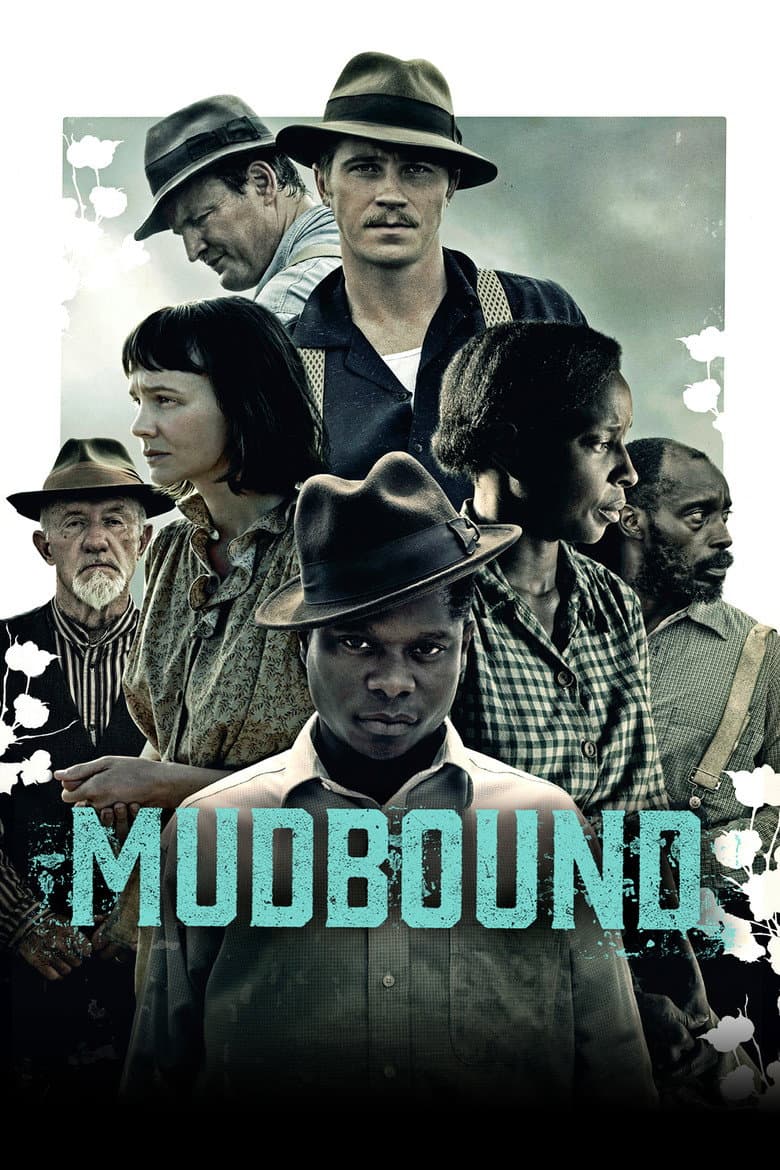
Mudbound follows two families living on the same farm in rural Mississippi after World War II. Laura McAllan is a white wife pulled from Memphis into a hard life beside the Jacksons, a black family who work the land as tenants. The story follows Jamie McAllan and Ronsel Jackson when both men return from the war and become friends despite the town’s racial rules. Their bond brings them into danger as war wounds, family anger, poverty, and hatred close around them. The film is slow, bleak, tense, and sometimes hopeful.
The film makes race the main force shaping work, travel, friendship, family life, and safety. Ronsel returns as a decorated soldier, but local white men still demand that he use the back door and treat him as less than a citizen. The story shows racist violence through the doctor, the town, Pappy McAllan, and a Klan attack, while Jamie’s friendship with Ronsel challenges that order. Laura and Florence also live under men who control money, land, work, and daily choices, although both women keep their families going. The film treats the Jackson family’s suffering and the bond between the two veterans as serious moral questions, with little humor and no easy victory.
Community feedback
Was our 59% Woke rating accurate?
Breakdown
These are the editorial factors and ratings behind our score for Mudbound.
Woke representation / casting
The film gives a black sharecropping family the same broad story weight as the white family. The cast matches the Mississippi setting and the novel’s characters, so there is no clear casting mismatch. Director Dee Rees said she wanted the black family to have an equal inner life and to correct the usual white view of World War II stories.
25%
Woke political dialogue
Not present. The characters speak about war, racism, family duty, and survival in period language. The film has no repeated modern DEI, activist, or current identity-politics speech.
0%
Identity-driven story themes
The story centers on black and white families whose lives are shaped by race and power. Ronsel’s return and friendship with Jamie challenge the local racial order. The film shows Klan violence, separated public life, unequal medical care, and farm debt as parts of that order. The story asks viewers to share the Jackson family’s pain while showing some white characters resist or protect the system.
70%
Western institutional / cultural critique
The film shows a local system that keeps Black tenants poor, blocks their movement, and protects white power. The film also shows Laura pushed into a wife’s role and Florence forced to serve another family’s children. These critiques stay tied to the 1940s setting, and the story does not attack Christianity or all Western institutions.
25%
Woke character or canon changes
Not relevant. The film keeps the novel’s black Jackson family and white McAllan family. Its changed ending adds a hopeful future for Ronsel, but it does not change a character’s race, sex, or sexuality.
0%
Anti-woke backlash and complaints
A few small X accounts called the film “liberal emotional porn” or said it may be too woke for viewers who want history filtered. The complaints targeted its race-focused view of 1940s America, but the accounts had little reach. No large boycott, review-bombing effort, or major anti-woke campaign appeared in the research.
15%
Creator track record context
Dee Rees, Virgil Williams, and Hillary Jordan have recurring work about race, identity, gender, and social justice. Jordan’s novels also address abortion politics, public shame, and authoritarian religion. Poppy Hanks and Charles D. King have built careers around films that center black and other people of color, while most other producers have no strong activist record. This background supports the film’s race-centered approach but does not prove extra content by itself.
55%
Production

Movie · 2016
After his older brother passes away, Lee Chandler is forced to return home to care for his 16-year-old nephew.
Movie · 2025
Diagnosed with Tourette Syndrome at 15, John Davidson navigates his way against the odds through troubled teenage years and into adulthood, finding inspiration in the kindness of…
Movie · 2017
In 1950, amidst the ravages of the Korean War, Sergeant Süleyman stumbles upon a a half-frozen little girl, with no parents and no help in sight and he risks his own life to save…
Movie · 2026
While people across 1990s Iraq struggle to survive the war and food shortages, Saddam Hussein requires each school in the country to prepare a cake to celebrate his birthday.
Movie · 2020
A man refuses all assistance from his daughter as he ages and, as he tries to make sense of his changing circumstances, he begins to doubt his loved ones, his own mind and even…

Movie · 2024
On the brink of the Second World War, a young Norwegian man's drive to resist the Nazis sets a new course for his future – and the future of his country.
Movie · 2025
A logger leads a life of quiet grace as he experiences love and loss during an era of monumental change in early 20th-century America.
Movie · 2023
American ballet dancer Joy Womack is accepted into Moscow's infamously tough Bolshoi Ballet Academy, with the dream of becoming a great ballerina.
