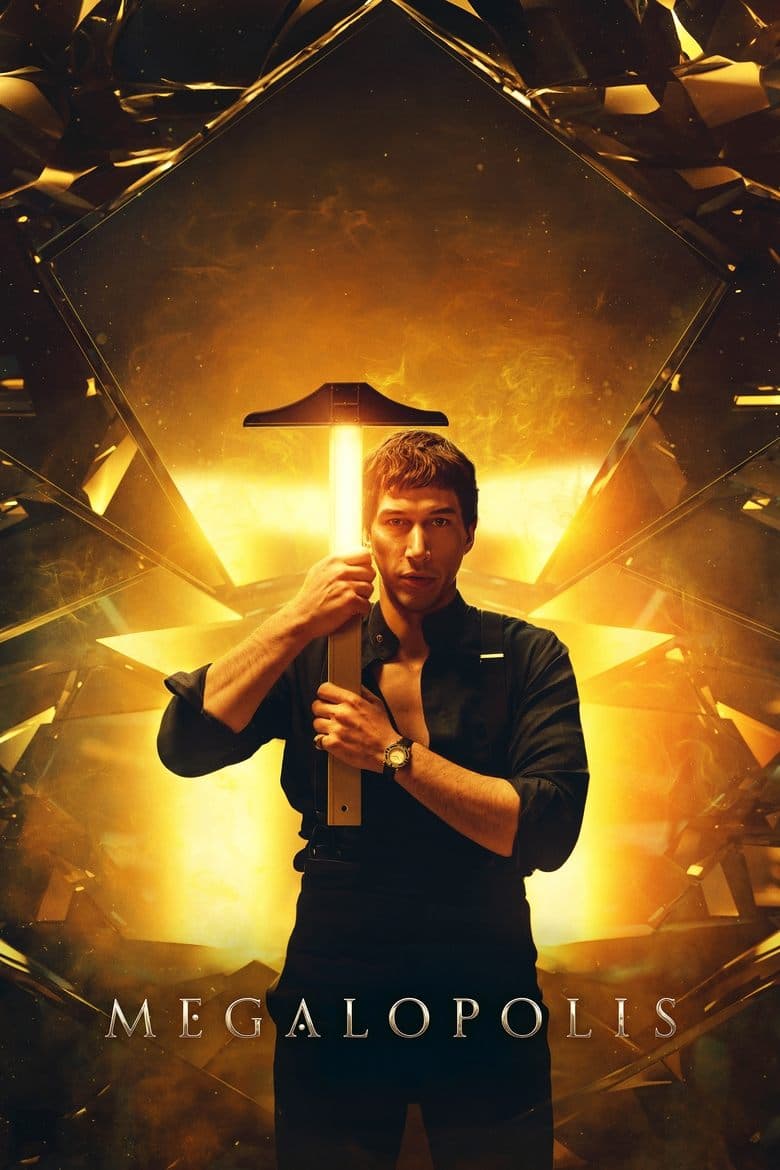
Megalopolis takes place in New Rome, a future version of New York that mixes Roman history with modern life. Cesar Catilina is a gifted architect who can stop time and wants to build a new city from a strange material called Megalon. Mayor Franklyn Cicero protects the old system because he wants control, profit, and a safe path for the city. Cesar’s romance with Julia, the mayor’s daughter, pulls her between her father and a risky dream, while a cruel cousin tries to use public anger to gain power. The film feels grand, strange, romantic, and often playful, with sudden violence and serious speeches.
The film places a mixed-race woman in a major love role and a black man as the powerful mayor, but it does not make race a subject of the story. Julia is smart and helps shape Cesar’s plan, yet the story later places her mainly beside Cesar and their future family. Party scenes include a woman kissing women, a man using drag, and a pop star whose public image shifts from pure to rebellious. The main message is about power, money, art, family, public debate, and the danger of leaders who use public anger. It is not built around a focused DEI or identity campaign.
Community feedback
Was our 33% Woke rating accurate?
Breakdown
These are the editorial factors and ratings behind our score for Megalopolis.
Woke representation / casting
The film places a mixed-race woman, Julia, in the main love role and a black man, Cicero, in the powerful mayor role. Laurence Fishburne also plays Cesar’s Black driver and narrator. These are clear audience-visible identity choices, but the movie does not make race a subject or present a diversity-first message. The pattern is noticeable but limited, so the score stays low.
12%
Woke political dialogue
Cesar argues for a new future, while Cicero defends order and Clodio uses public anger to gain power. The film compares New Rome with modern America and treats fake news, fascist-style politics, and the loss of the republic as serious dangers. The film also presents open debate and artists as ways to repair society. This is recurring political dialogue, but it is broad civic and anti-authoritarian politics rather than a focused DEI message.
34%
Identity-driven story themes
Clodia is shown kissing women at parties, and Clodio uses drag during his schemes. Vesta’s plot plays with the public image of a pure young star who later becomes rebellious. These moments connect sex and gender performance to the film’s party culture and political disorder. The central story remains about power, art, romance, and family, so queer and identity-driven themes stay limited.
18%
Western institutional / cultural critique
The film presents the old mayor as a defender of a failing system tied to corruption and profit. It shows a banker and a news business putting money and attention ahead of the public good. It treats Clodio’s crowd politics and fascist-style power grab as threats to the republic. This critique runs through the plot, but it does not center on race, gender, religion, or an attack on ordinary family life.
30%
Woke character or canon changes
Not relevant. The film is an original futuristic fable that borrows names and ideas from Roman history. It does not make an identity-driven or DEI change to an established character or real event.
0%
Anti-woke backlash and complaints
A few small right-leaning accounts called the film “woke trash” or progressive-but-not-woke. Other niche accounts praised Coppola for rejecting “woke Hollywood,” but they were reacting mainly to his casting stance. No meaningful boycott, review-bomb push, or organized campaign over identity politics appeared. The anti-woke reaction was fringe and had little reach.
10%
Creator track record context
The cached context gives Francis Ford Coppola a woke score of 15/100. It notes his support for Democratic candidates and criticism of far-right and fascist politics. The listed casting directors and producers have low cached scores and no clear record of identity activism. Coppola’s interviews about this film stress civic debate and the danger of losing the republic, while his casting comments reject a woke Hollywood production. This is mild supporting context, not a strong creator pattern.
15%
Production

Movie · 2025
In this extraordinary story of an ordinary man, Charles 'Chuck' Krantz experiences the wonder of love, the heartbreak of loss, and the multitudes contained in all of us.

Movie · 2019
Decades after serving in WWII and assassinating Adolf Hitler, a legendary American war veteran must now hunt down the fabled Bigfoot.
Movie · 2021
In the near future, Cameron Turner is diagnosed with a terminal illness. Presented with an experimental solution to shield his wife and son from grief, he grapples with altering…
Movie · 2021
A bureaucrat interviews five souls to decide which of them will be given a life on Earth. But he soon faces an existential challenge of his own.
Movie · 2022
Known as America’s Poet, Henry Wadsworth Longfellow leads an idyllic life – until the day his world is shattered by tragedy.

Movie · 2017
Thirty years after the events of the first film, a new blade runner, LAPD Officer K, unearths a long-buried secret that has the potential to plunge what's left of society into…

Movie · 2024
A mother and her teenage daughter must confront Death when it arrives in the form of an astonishing talking bird.

Movie · 2025
When a raging flood traps a researcher and her young son, a call to a crucial mission puts their escape — and the future of humanity — on the line.
