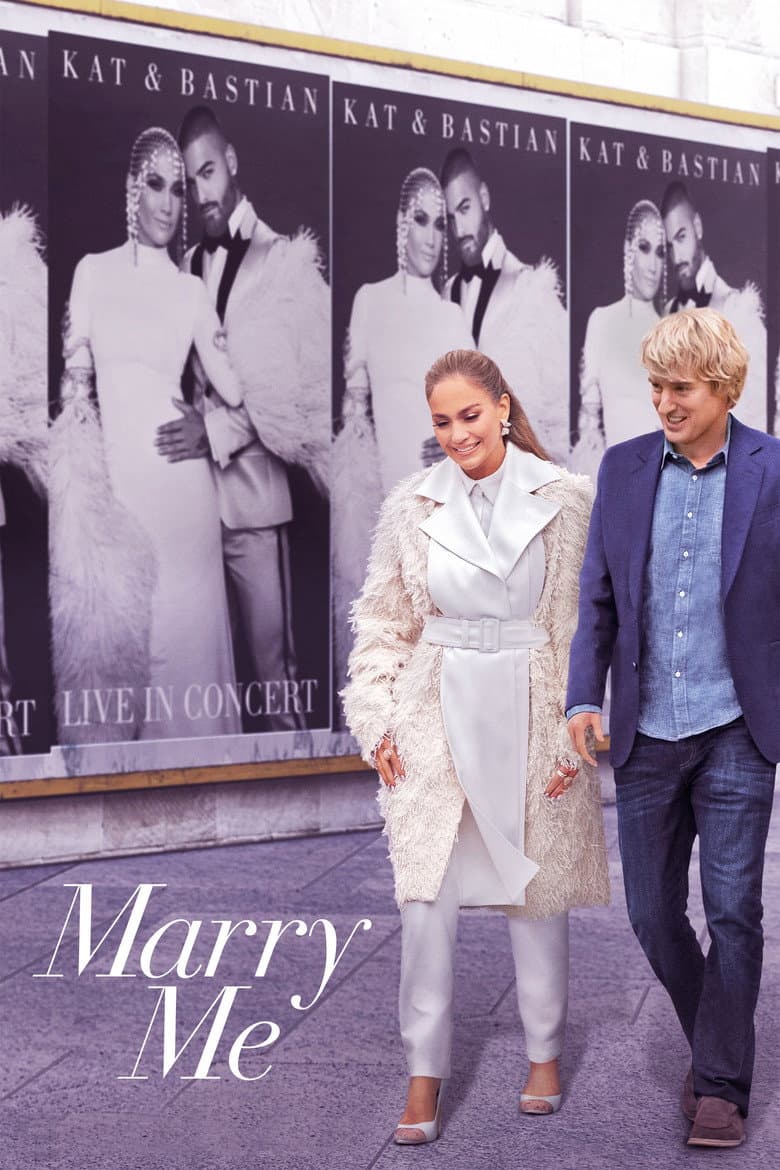
Marry Me follows Kat Valdez, a famous pop singer whose wedding is about to stream to millions of fans. She learns that her fiancé Bastian has cheated on her, so she points to a stranger in the crowd and marries him instead. Charlie is a divorced math teacher and a caring father who lives far from Kat’s bright, busy world. The couple keeps the marriage as a public deal, but time together turns the stunt into real love. The movie has a glossy, cheerful, music-heavy tone with jokes about fame, phones, and celebrity life.
The film makes Kat and Bastian Latino pop stars, and they sing and speak Spanish in several scenes. The casting makes Latino identity part of the movie’s main music world, while a white male lead, a biracial daughter, and a lesbian friend add more visible identity choices. Kat also follows a woman-led path as she finds her own voice, writes a hit song, and makes the final proposal herself. Parker has a short relationship subplot with another woman, and other same-sex couples appear in school and end-credit scenes. These elements give the movie a mild representation and identity message, but the main story remains a standard heterosexual romance.
Community feedback
Was our 49% Woke rating accurate?
Breakdown
These are the editorial factors and ratings behind our score for Marry Me.
Woke representation / casting
The film casts Jennifer Lopez as a Latina pop star and Maluma as a Colombian pop star in the two most visible music roles. Lopez said choosing a Latin artist and using English and Spanish were priorities. The director also highlighted showing a glamorous 52-year-old Latina and an older woman with a younger man. The choices fit a modern New York music world, but the repeated Latin identity and age framing are clear audience-visible parts of the film.
39%
Woke political dialogue
Kat asks why women must wait for men to propose and says women should choose the man and keep their names. The line directly challenges traditional relationship roles. The idea appears in one short media scene and is not repeated as a political debate across the movie.
18%
Identity-driven story themes
Kat’s story keeps returning to female independence and self-definition. She leaves the failed public romance, writes the song that defines her career, and makes the final marriage proposal herself. The director described the film as a story about a woman finding her voice as well as a love story. Parker’s lesbian relationship and other same-sex couples add smaller identity themes, but they do not drive the main romance.
38%
Western institutional / cultural critique
The film uses one musical number called “Church” with provocative nun outfits and cross imagery. The sequence treats Christian symbols as sexy stage decoration, which can read as a brief attack on a Western religious tradition. The movie does not return to this idea or argue against Christianity in its main story.
14%
Woke character or canon changes
The source graphic novel used a white pop princess and a white love interest, while the movie uses Latina and Latino leads. The change affects the two central romantic roles and is presented with bilingual music and Spanish dialogue. This is a clear identity-based adaptation choice, but it is one change in a single story rather than a wider canon dispute.
32%
Anti-woke backlash and complaints
The Federalist criticized the film’s feminist language and objected to Kat saying women should choose the man and keep their names. A conservative Reddit thread called the movie “super woke,” but gave no detailed reason. These are clear but limited right-leaning complaints. Other negative reviews focused on weak romance, acting, or product placement instead of woke content.
22%
Creator track record context
Director Kat Coiro is listed at 58/100 because of earlier public comments about gender and the treatment of women’s bodies. Producer Jennifer Lopez is listed at 41/100 for feminist and representation-focused public work. The listed writers range from 0 to 27/100, and the other producers show no strong activist pattern. Coiro and Lopez also framed this film around a woman’s voice, Latin casting, and bilingual music, which matches the movie’s visible choices.
27%
Production

Movie · 2019
No beau? No problem! To earn money for college, a high schooler creates a dating app that lets him act as a stand-in boyfriend.

Movie · 2024
Fresh off an almost career-ending accident, stuntman Colt Seavers has to track down a missing movie star, solve a conspiracy and try to win back the love of his life while still…

Movie · 2024
Ana is an ambitious intern dreaming of a career in the art world while trying to impress her demanding boss Claire.
Movie · 2020
An on-the-lam punk rocker and a young woman obsessed with a local band go on an unexpected and epic journey together through the decaying suburbs of the American Midwest.
Movie · 2023
Michelle and Allen, who have reached the point in their relationship where they are considering next steps, decide to invite their parents to finally meet and to offer some…
Movie · 2016
From Jane Austen’s novella, the beautiful and cunning Lady Susan Vernon visits the estate of her in-laws to wait out colorful rumors of her dalliances and to find husbands for…
Movie · 2023
Two romantic burnouts, Jane and Will, are immediately drawn to each other at a mutual friend’s wedding. After a disastrous hookup in the coatroom, the two spend the next 24 hours…
Movie · 2024
Fran likes to think about dying. It brings sensation to her quiet life. When she makes the new guy at work laugh, it leads to more: a date, a slice of pie, a conversation, a…
