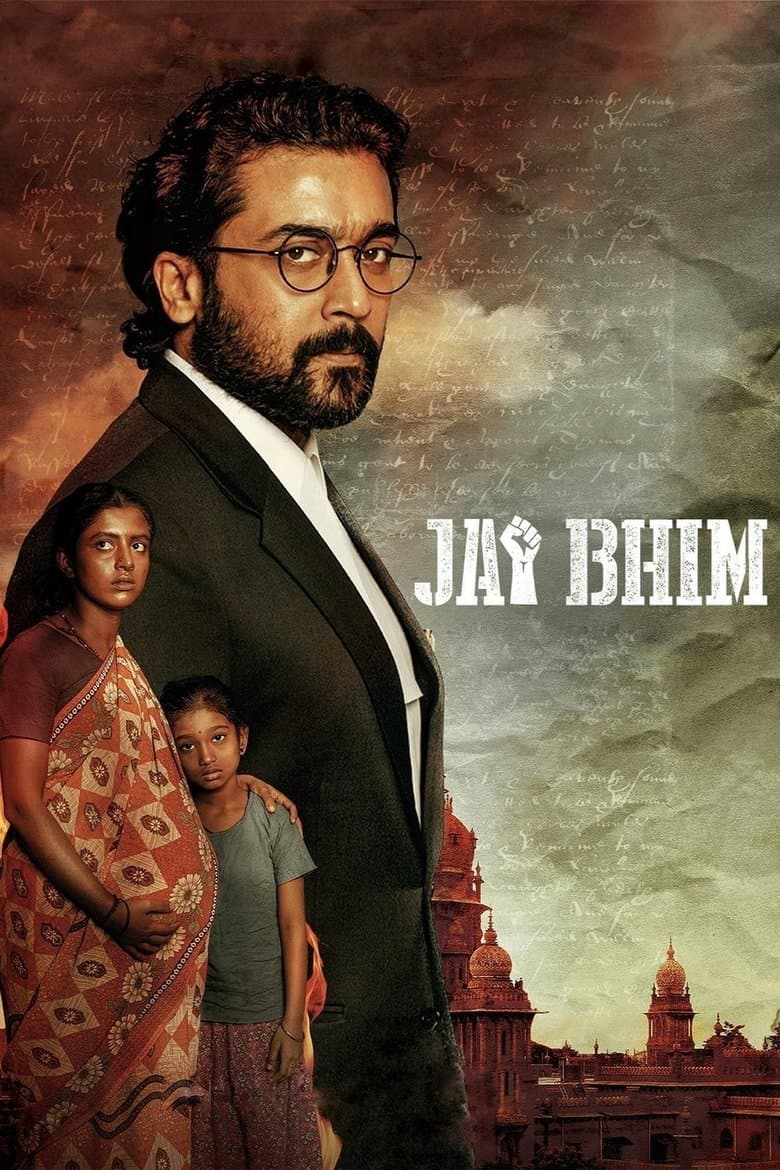
Jai Bhim is a Tamil crime and courtroom drama set in the early 1990s in Tamil Nadu. Sengeni, a pregnant woman from the Irula tribal community, searches for her husband Rajakannu after police take him away on a false theft charge. Lawyer Chandru takes her case and tries to uncover what happened inside the police station. The film moves from village life to police rooms and the High Court, and its tone is tense, painful, and serious.
The story puts caste identity, tribal poverty, police abuse, and equal treatment at the center. The police sort prisoners by caste, treat Irula people as likely thieves, and hide the truth after Rajakannu dies in custody. Sengeni refuses a quiet payment and demands justice, while Chandru uses the law to defend her and other people who were wrongly arrested. The film also supports education, worker action, and public pressure against unfair power. A communist and Ambedkar-based outlook is visible through Chandru, protest scenes, and the film’s repeated call to stand with oppressed people.
Community feedback
Was our 89% Woke rating accurate?
Breakdown
These are the editorial factors and ratings behind our score for Jai Bhim.
Woke representation / casting
Not present. The principal roles fit the Tamil setting and the real case, including the Irula couple and the lawyer. The film does not present its casting as a broad diversity campaign.
0%
Woke political dialogue
The film repeats direct language about caste, false cases, land rights, bonded work, equal rights, and human rights. Lawyers and protesters call for police accountability and say that every affected person deserves justice. Chandru also says law is a powerful weapon and asks who it protects. A brief scene has an officer hit a Hindi-speaking pawnbroker and tell him to speak Tamil, adding a language-politics message.
64%
Identity-driven story themes
Caste and tribal identity drive the whole plot. The film shows Irula people being treated as natural thieves, denied land papers, trapped in bonded work, and abused in police custody. Sengeni rejects money from the people who killed her husband and demands justice, while Chandru fights for her and other wrongly arrested people. The ending links justice with literacy, public action, and equal treatment. The film clearly presents anti-caste reform as its main message.
88%
Western institutional / cultural critique
Not present. The film criticizes Tamil Nadu police, local caste power, and some public offices, not Western institutions. It does not attack Christianity, family life, traditional gender roles, or conservative relationships.
0%
Woke character or canon changes
The film changes the real case in identity-related ways. It presents Rajakannu and Sengeni as Irula, while reports about the real case identify the couple as Kurava and Parvathi. The director said he chose Irula because the community faced deeper hardship. The film also replaces the real officer's reported Christian name, Anthonysamy, with Gurumoorthy and shows a Vanniyar symbol in his home.
63%
Anti-woke backlash and complaints
Vanniyar Sangam and PMK figures repeatedly said the film pushed caste politics by linking its brutal police villain to the Vanniyar community. The dispute led to legal notices, a court case, threats against Suriya, and police protection. BJP supporters and some Hindi-speaking viewers also called the Hindi slap scene anti-Hindi, while recurring X posts called the movie communist or social-justice propaganda. The High Court later quashed an FIR, and no organized boycott or review-bomb campaign was found.
58%
Creator track record context
Gnanavel is scored at 62/100, Suriya at 58/100, and Jyothika at 64/100 in the creator records. Gnanavel's work often centers on caste, social exclusion, and institutional abuse. Suriya and Jyothika have backed education, welfare, women-centered, and social-issue films. This title closely matches that reform-focused pattern.
62%
Production

Movie · 2018
A picture-perfect family is torn apart after Tyler finds a cache of disturbing images in his father's possession.
Movie · 2018
Young and disenchanted Sam meets a mysterious and beautiful woman who's swimming in his building's pool one night.
Movie · 2016
Denmark, 2016. A blurred note is found in a bottle that has traveled across the ocean for a long time. After deciphering the cryptic note, Department Q follow a sinister trail…
Movie · 2018
A former American G.I. joins a yakuza family after his release from prison in post-World War II Osaka.

Movie · 2024
Roy Freeman, an ex-homicide detective with a fractured memory, is forced to revisit a case he can't remember.
Movie · 2023
Following the brutal murder of a young real estate agent, a hardened detective attempts to uncover the truth in a case where nothing is as it seems, and by doing so dismantles the…
Movie · 2022
Leonard is an English tailor who used to craft suits on London’s world-famous Savile Row. After a personal tragedy, he’s ended up in Chicago, operating a small tailor shop in a…

Movie · 2022
Suspicious that her colleague is responsible for a series of mysterious patient deaths, a nurse risks her own life to uncover the truth.
