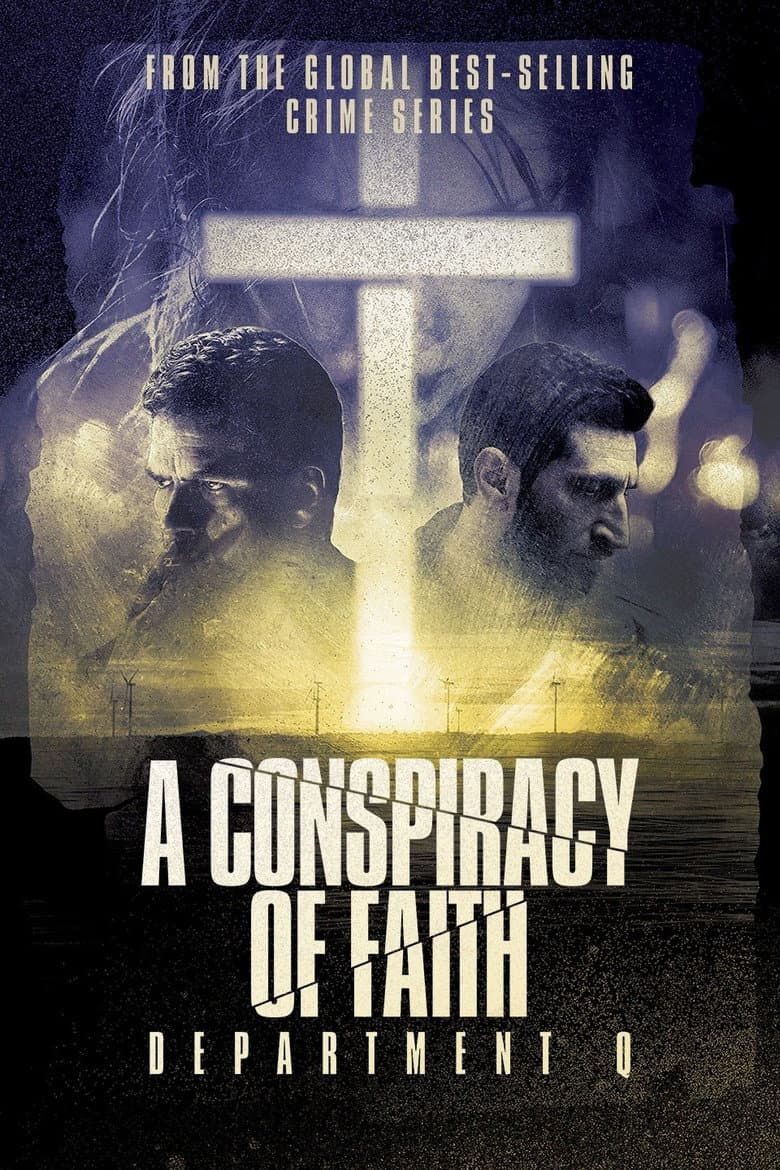
Movie review
March 3, 2016 · 108 min · NR · Danish · Crime · Mystery · Thriller · Drama
A Conspiracy of Faith follows Carl Mørck, a tired Copenhagen detective who works on old cases in Department Q. A message written in blood arrives in a bottle after years at sea. Carl and his Muslim partner Assad link the message to missing children from a closed religious community in rural Denmark. They race to stop Johannes, a cruel killer who has kidnapped children for years. The film has a bleak, tense, and sometimes violent crime-thriller tone.
Faith is the film’s main extra layer. Carl is an atheist, while Assad believes in God, so their case leads to repeated talks about belief, doubt, and the meaning of life. The Christian sect is shown as secretive and dangerous, and one father’s distrust of Assad adds a small anti-Muslim thread. The film also shows that faith can offer comfort, and Carl is moved by a hymn near the end. These ideas shape the case and the partners’ bond, but they do not become a modern campaign about race, gender, sexuality, or DEI.
Community feedback
Was our 19% Woke rating accurate?
Breakdown
These are the editorial factors and ratings behind our score for A Conspiracy of Faith.
Woke representation / casting
Not present. The cast does not show a clear diversity-first pattern. Assad is a Muslim detective, but the film presents him as an established Department Q character whose faith matters to the case.
0%
Woke political dialogue
Not present. The detectives discuss God, atheism, and belief. The film does not use modern identity, DEI, or activist speeches.
0%
Identity-driven story themes
The film repeatedly contrasts Carl’s atheism with Assad’s Muslim faith. Assad uses his beliefs to guide his work with the families. A devout father treats Assad with suspicion because he is Muslim. The story gives these points real space, but it keeps them tied to the murder case and the question of faith.
18%
Western institutional / cultural critique
The film places a child-killer inside a closed Christian sect. The sect uses obedience, silence, and religious trust to hide crimes. The story also presents faith as a source of comfort, and Carl is moved by a hymn. The film questions religious extremism, but it does not turn that question into a broad attack on Christianity or Western institutions.
18%
Woke character or canon changes
Not relevant. The film follows established Department Q characters from Adler-Olsen’s novel. No identity-related race, gender, sexuality, or historical-character change is reported.
0%
Anti-woke backlash and complaints
One Aftenposten reviewer said the film awkwardly makes Christian extremists seem as dangerous as Muslims. The complaint reads the film as part of a modern blame-sharing trend in Western culture. The review did not lead to a boycott, review-bombing, or wider news cycle. The supplied X pass found no anti-woke complaints.
10%
Creator track record context
Moland has made one political film about Norway’s 1970s Marxist movement. Arcel and Adler-Olsen are mainly linked to crime stories and historical dramas. The available record shows no sustained DEI, identity-politics, or activist profile among the key creators. This gives mild background context, but it does not drive this film’s crime plot.
14%
Production
Movie · 2019
After a mass shooting at a police funeral, reclusive ex-cop Gannon finds himself unwittingly forced out of retirement when he realizes that the killer belongs to the same militia…
Movie · 2024
A middle-class bank clerk who longs to trade stability for adventure gets more than he bargained for when he unexpectedly becomes a wealthy man.

Movie · 2019
A charismatic New York City jeweler always on the lookout for the next big score makes a series of high-stakes bets that could lead to the windfall of a lifetime.
Movie · 2024
While awaiting the next fuel truck at a middle-of-nowhere Arizona rest stop, a traveling young knife salesman is thrust into a high-stakes hostage situation by the arrival of two…

Movie · 2019
In 1934, Frank Hamer and Manny Gault, two former Texas Rangers, are commissioned to put an end to the wave of vicious crimes perpetrated by Bonnie Parker and Clyde Barrow, a…
Movie · 2021
When the aging Meyer Lansky is investigated one last time by the Feds who suspect he has stashed away millions of dollars over half a century, the retired gangster spins a…
Movie · 2017
Jin-seok, 21-year-old, moves into a new house with his family. He suffers from a slight schizophrenia but he carries an ordinary life under the warm care of the family.
Movie · 2022
7 years after the case related to Vijay Salgaonkar and his family was closed, a series of unexpected events bring truth to light that threatens to change everything for the…
