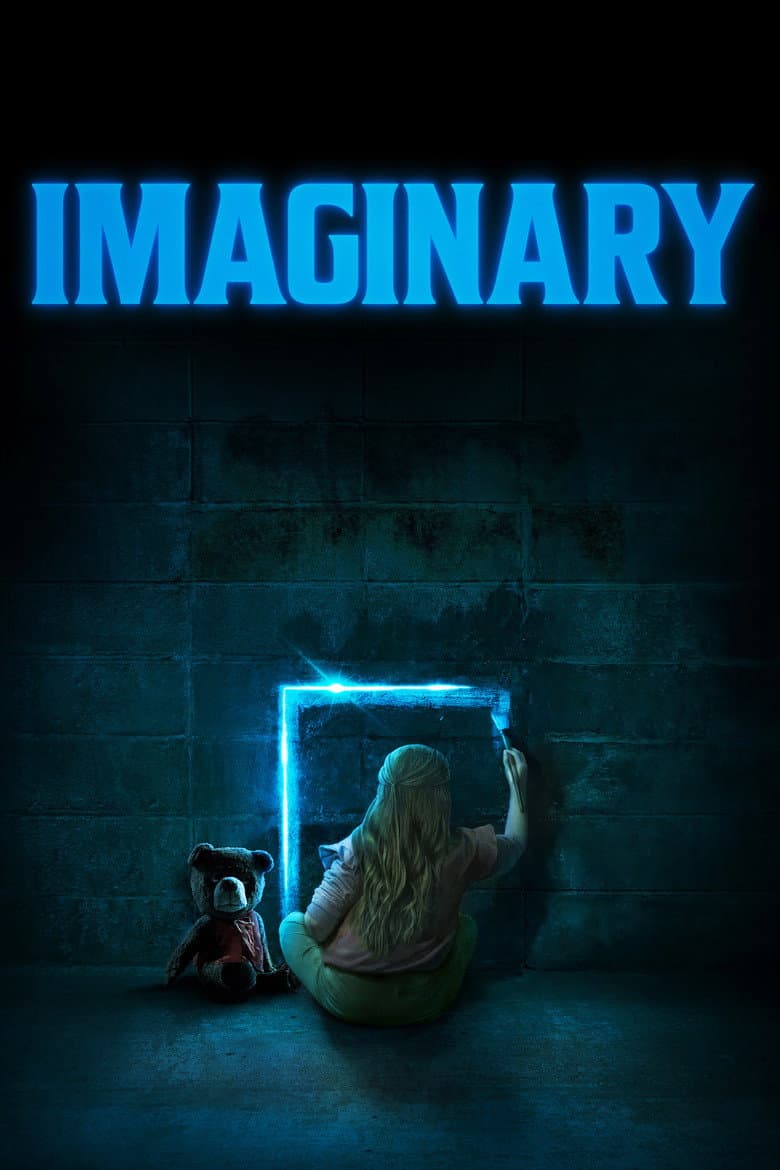
Jessica is a children’s book writer who moves with her husband, Max, and his two daughters into the house where she grew up. The younger girl, Alice, finds a teddy bear named Chauncey and treats him as an imaginary friend. The games soon lead Alice toward dangerous acts, strange visions, and a hidden world called the Never-Ever. Jessica must face memories from her childhood and protect Alice and Taylor from the bear’s hunger. The film uses a dark, jump-scare horror tone mixed with family drama and fantasy.
Jessica is a black stepmother who leads the effort to save Alice, while Taylor and Alice also carry much of the action. The family includes a white father, two white daughters, Jessica’s black father, and a Mexican-born child therapist in a key scene. This creates a visible woman-led and mixed-race cast, but the story does not make race or gender a political subject. The main themes are childhood pain, family trust, the fear of being left behind, and the danger of a friend who turns controlling. The story gives the family’s final escape to Jessica, Taylor, and Alice rather than to the father or another adult man.
Community feedback
Was our 17% Woke rating accurate?
Breakdown
These are the editorial factors and ratings behind our score for Imaginary.
Woke representation / casting
Jessica is a black woman and the story’s main protector. Taylor and Alice also drive the rescue, and a Mexican-born therapist has a key role. This gives the film a visible woman-led and mixed-race cast in several important roles. The modern setting and original characters do not create a clear mismatch with the story world.
24%
Woke political dialogue
Not present. The characters talk about family fear, childhood trauma, mental health, and imaginary friends. They do not discuss elections, public policy, or activist causes.
0%
Identity-driven story themes
Not present. The story centers on childhood pain, family trust, and an evil imaginary friend. Jessica’s role as a stepmother shapes the plot, but the film does not turn race, gender, or sexuality into the main message.
0%
Western institutional / cultural critique
Not present. The film shows a therapist, a troubled family, and damaged parents as parts of the horror plot. It does not attack family life, men, Christianity, or Western institutions.
0%
Woke character or canon changes
Not relevant. The film uses original characters and is not based on a named book, historical event, or established fictional canon.
0%
Anti-woke backlash and complaints
Not present. Public complaints mostly target weak scares, confusing world-building, and poor writing. No strong title-specific backlash says that the film pushes DEI or identity politics.
0%
Creator track record context
The writers and casting directors have mainly genre-focused careers with little public activist work. Jason Blum has some political and inclusion-related context, but he is mainly a commercial horror producer. DeWanda Wise and Cynthia Francillon have stronger race and gender-focused work in their public careers. The wider creative group gives a mild supporting signal.
23%
Production
Movie · 2021
A lone drifter suffering from partial memory loss accepts a job to look after a psychologically troubled woman in an abandoned house on an isolated island.
Movie · 2018
The crew of a horror web series travels to an abandoned asylum for a live broadcast, but they encounter much more than expected as they move deeper inside the nightmarish old…
Movie · 2016
A young American woman takes a job as a nanny in a remote English village, soon discovering that the family's eight-year-old son is a life-sized doll that comes with a list of…
Movie · 2020
Inside the halls of an elite arts academy, a timid music student begins to outshine her more accomplished and outgoing twin sister when she discovers a mysterious notebook…
Movie · 2021
Reeling from the unexpected death of her husband, Beth is left alone in the lakeside home he built for her. Soon she begins to uncover her recently deceased husband's disturbing…
Movie · 2020
A man providing overnight watch to a deceased member of his former Orthodox Jewish community finds himself opposite a malevolent entity.
Movie · 2021
A young girl finds solace in her artist father and the ghost of her dead mother.
Movie · 2022
Every parent's worst nightmare is just the beginning for Rachel's ordeal as in the aftermath of a tragic accident, she and her husband Anthony decide to move to the other side of…
