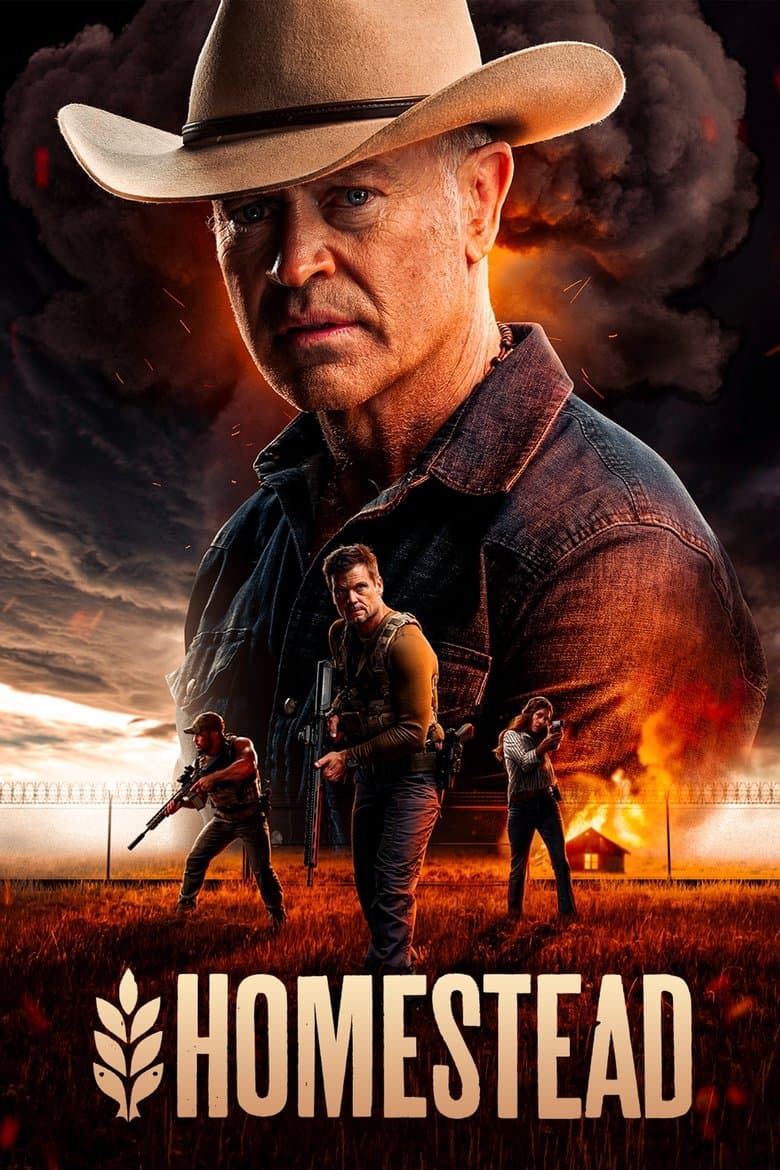
Homestead follows Jeff Eriksson, a former Green Beret who brings his wife, children, and other survivors to a guarded mountain compound after a nuclear blast hits Los Angeles. Ian Ross owns the compound and has stored food, water, weapons, seeds, and power for a collapse. The group must face armed outsiders, a hostile local government, fear inside the gates, and the cost of protecting a small group while others go hungry. The tone is tense and violent, but it also turns toward family, prayer, mercy, and hope.
The clearest woke-coded material comes from the argument over refugees outside the gates. Jenna Ross and Tara Eriksson are among the film’s most trusted and capable adults, and Jenna becomes the person who chooses compassion over a hard security plan. The film gives women repeated moral and practical authority while several men are shown as angry, narrow, or too focused on guns and control. The story also shows a black female Army veteran in a leading family and an interracial marriage, but it does not make diversity or queer identity a stated goal. These elements matter to the film’s moral ending, yet the movie remains mainly a Christian survival story rather than an identity-politics drama.
Community feedback
Was our 43% Woke rating accurate?
Breakdown
These are the editorial factors and ratings behind our score for Homestead.
Woke representation / casting
The Eriksson family includes a black mother, a white father, mixed-race children, and an adopted white daughter. Tara is a Black Army veteran in a major family, and Jenna becomes the main decision-maker at the compound. The film also includes Latino men in the bombing opening. The story does not sell these choices as a diversity campaign, so the visible pattern is noticeable but limited.
26%
Woke political dialogue
The film calls the outsiders “refugees” and argues that strangers should be helped. The film says that women should train with the men. The film also has a short line about healing the planet through farming. These points are brief and fit the film’s faith and survival plot, but they still give the story a mild modern social message.
18%
Identity-driven story themes
The film makes the choice between a fortress and an open refuge the main moral problem. Jenna decides to admit the people outside after Ian is shot, and the ending treats her choice as the better path. Tara is shown as a skilled Army veteran, while several men are angry, rigid, or focused only on force. Women repeatedly carry the film’s moral and practical authority, which gives the girlboss-style pattern a meaningful role in the story.
54%
Western institutional / cultural critique
Not present. The film shows government officials, FEMA, and police as weak or threatening during the collapse. It does not tie that conflict to identity politics or attacks on Western culture, patriarchy, or Christianity.
0%
Woke character or canon changes
Not relevant. The film adapts the Black Autumn books, but no identity-based change to an established character or real person is confirmed. The main cast and roles are presented as part of this fictional setting.
0%
Anti-woke backlash and complaints
A small but visible group of right-leaning viewers objected to the film’s message that Christians should admit refugees and help outsiders. Reddit comments said that the refugee message clashed with the compound’s survival logic, and some viewers wanted the gates kept closed. A few X posts called the women’s writing girlboss-style or called the cast a DEI mix. Other viewers praised Angel Studios as woke-free, and no boycott, review-bombing, or organized campaign appeared.
31%
Creator track record context
The director and writer are mainly linked to Christian, preparedness, and faith-based work. Most producers also have low or zero stored woke scores. Producer Sam Sheridan has a higher stored score because of earlier work about race and mixed-race identity, but that work is not a stated part of Homestead. The team gives little support for a woke reading of this title.
5%
Production

Movie · 2026
While people across 1990s Iraq struggle to survive the war and food shortages, Saddam Hussein requires each school in the country to prepare a cake to celebrate his birthday.
Movie · 2016
On 15 January 2009, the world witnessed the 'Miracle on the Hudson' when Captain 'Sully' Sullenberger glided his disabled plane onto the Hudson River, saving the lives of all 155…
Movie · 2017
Members of the Granite Mountain Hotshots battle deadly wildfires to save an Arizona town.
Movie · 2022
London, 1953. Mr. Williams, a veteran civil servant, is an important cog within the city's bureaucracy as it struggles to rebuild in the aftermath of World War II.
Movie · 2025
A logger leads a life of quiet grace as he experiences love and loss during an era of monumental change in early 20th-century America.

Movie · 2023
The true story of the inseparable Von Erich brothers, who made history in the intensely competitive world of professional wrestling in the early 1980s.
Movie · 2022
A quiet, neglected girl is sent away from her dysfunctional family to live with relatives for the summer. She blossoms in their care, but in this house where there are meant to be…
Movie · 2019
Richard Jewell thinks quick, works fast, and saves hundreds, perhaps thousands, of lives after a domestic terrorist plants several pipe bombs and they explode during a concert…
