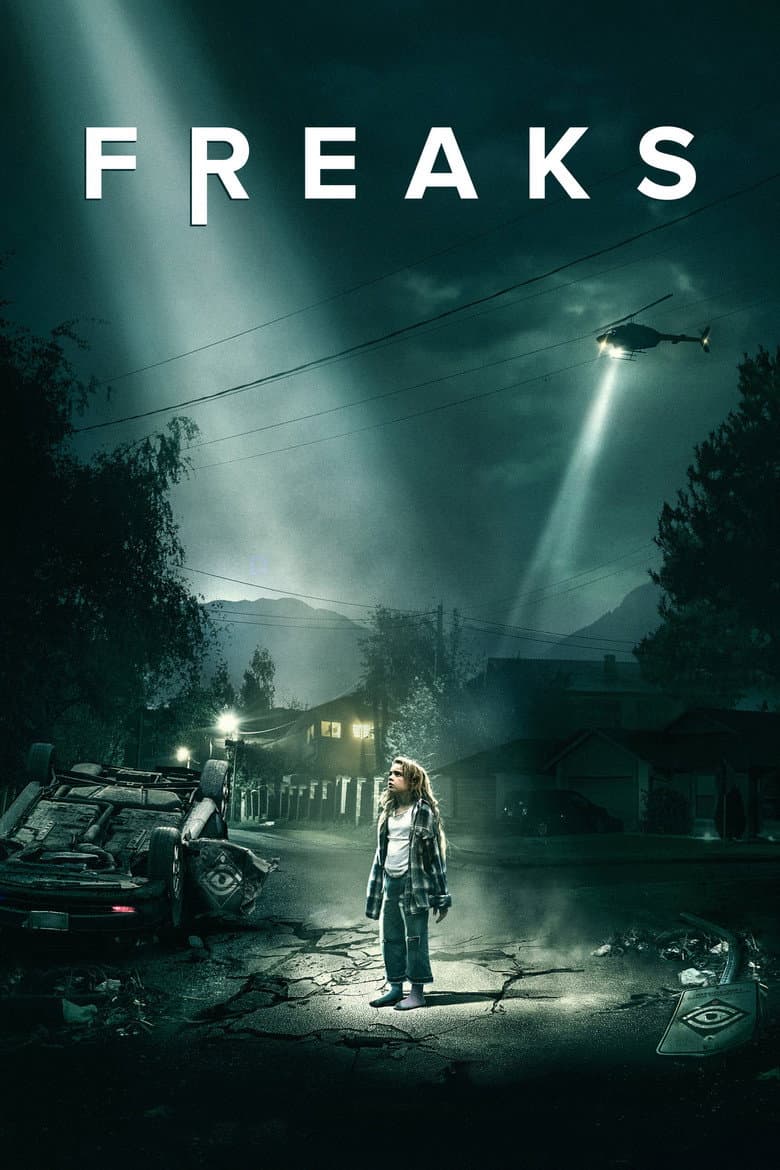
Freaks follows seven-year-old Chloe, who has spent her whole life inside a dark, locked house with her father, Henry. Henry says the outside world will kill them, so Chloe learns to fear people, streets, and even simple sounds. An ice cream truck driver named Mr. Snowcone tempts her to leave, and Chloe slowly learns that her family has unusual powers. The story changes from a tense home drama into a violent science fiction thriller as Chloe searches for her mother and a safe place.
The film calls people with powers “freaks” or “abnormals” and shows them as hunted, jailed, and separated from their families. The government and news reports present them as dangerous outsiders, while the story asks whether fear and harsh control create more violence. The film links this conflict to persecution of people seen as different, and its message favors freedom, family, and acceptance over forced control. These ideas are central to the plot, but the movie keeps its characters morally mixed and focuses more on Chloe’s fear and survival than on long political speeches.
Community feedback
Was our 56% Woke rating accurate?
Breakdown
These are the editorial factors and ratings behind our score for Freaks.
Woke representation / casting
Not present. Chloe, her parents, and Mr. Snowcone are cast for the family and mutant roles, not as a stated diversity message. The film does not show a repeated identity-based casting pattern.
0%
Woke political dialogue
Government reports call powered people dangerous and illegal. A news report warns about illegal people running loose, which gives the film a modern immigration link. Government threats and warnings return as Chloe learns about prisons and raids. Most scenes use action and family conflict instead of long political speeches.
30%
Identity-driven story themes
The story centers on people with powers being called freaks and hunted because they are different. The government imprisons them, separates children from parents, and treats them as a danger to normal people. The directors linked this story to xenophobia, immigration, residential schools, and children held in camps. Chloe’s family also shows how fear and persecution can create more violence. These themes shape the main conflict from beginning to end.
66%
Western institutional / cultural critique
The film presents government agencies as major drivers of fear and control. Officials use public danger stories to justify tracking, prisons, and forced separation. The directors said the film was shaped by Trump-era xenophobia and family separation. The story also shows that fear can grow on both sides, so it does not present every ordinary person as evil. This is clear criticism of state power, but the film remains a mutant thriller rather than a full political drama.
52%
Woke character or canon changes
Not relevant. Freaks is an original story and does not change established characters, canon, or real historical figures.
0%
Anti-woke backlash and complaints
Not present. No anti-woke reaction was found on X or in the broader search. Available audience discussion mainly focused on pacing, plot twists, and acting.
0%
Creator track record context
Zach Lipovsky has a mild pattern of using political allegory in genre stories. Freaks is his clearest example because he linked its fear of outsiders to Trump-era xenophobia and family separation. Adam B. Stein has no known activist pattern. The creator context adds a mild signal.
24%
Production
Movie · 2018
A brutal mugging leaves Grey Trace paralyzed in the hospital and his beloved wife dead. A billionaire inventor soon offers Trace a cure — an artificial intelligence implant called…
Movie · 2020
2038: George Almore is working on a true human-equivalent AI, and his latest prototype is almost ready. This sensitive phase is also the riskiest as he has a goal that must be…
Movie · 2017
Jimmy is a committed child psychologist who uses his own playbook, but when he is brought in to work with Ellie, he is completely unprepared for his subject—a 9-year-old…

Movie · 2022
A prisoner in a state-of-the-art penitentiary begins to question the purpose of the emotion-controlling drugs he's testing for a pharmaceutical genius.
Movie · 2024
After an experimental drug trial goes awry, the test subjects face a terrifying side effect: if you fall asleep you die.
Movie · 2024
With his wife out sick, a struggling father brings home a lifelike AI, only to have his self-aware new help want everything her new family has to offer...
Movie · 2024
An elite trio of astronauts aboard a years-long, possibly compromised mission to Saturn's moon, Titan, gears up for a highly dangerous slingshot manoeuvre that will either…
Movie · 2017
This in-world short film takes place in the year 2036 and revolves around Jared Leto’s character, Niander Wallace.
