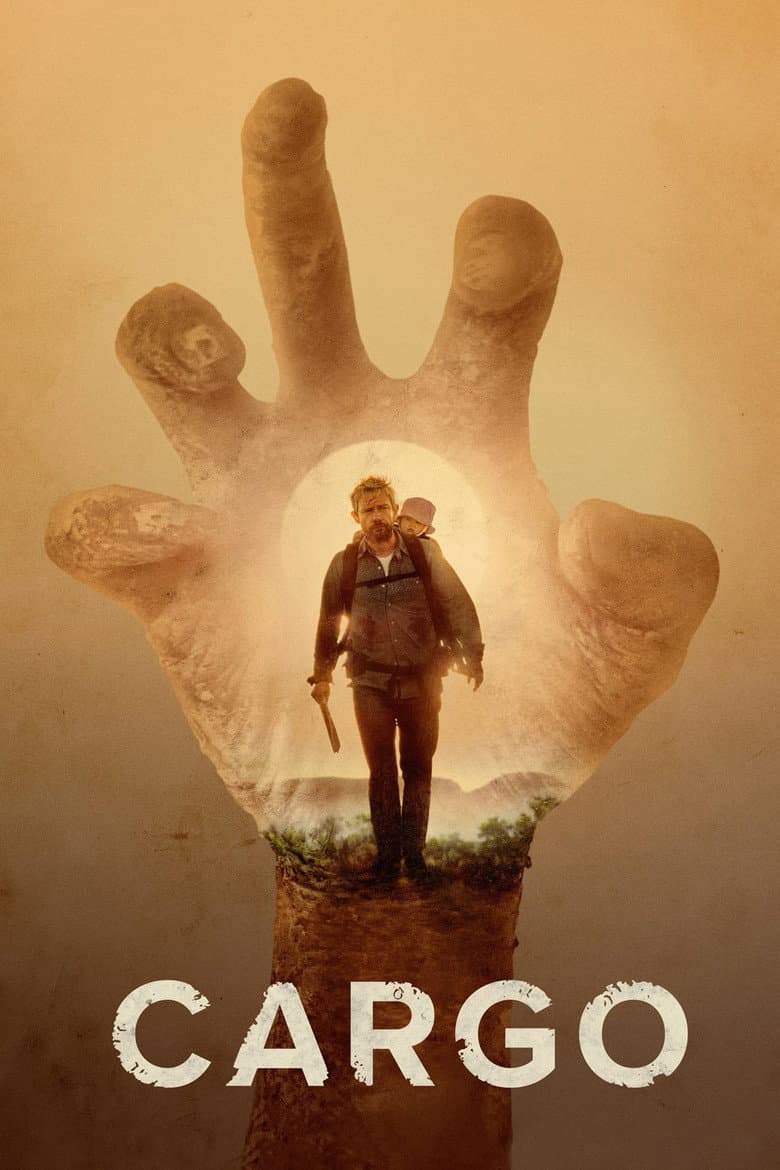
Cargo follows Andy Rose, a father who carries his baby daughter Rosie through the Australian outback after a virus turns people into violent infected creatures. Andy has been bitten, so he has about 48 hours to find Rosie a safe home before he loses control. He meets Thoomi, a young Indigenous girl who is trying to protect her infected father and guide Andy through the land. The film is a slow, bleak, and emotional survival story that uses horror to focus on love, grief, and human choices.
The film gives a large part of its story to Thoomi and her Indigenous community, which survives by working together and caring for the land. The story contrasts that community with white survivors who isolate themselves, hoard supplies, use people as bait, and treat land and power as property. Brief lines link the sickness to poisoned land and say that people who return to older ways are doing better than the rest of society. Andy and Thoomi must learn from each other, and the ending presents Rosie joining her community as a hopeful step toward two cultures living together.
Community feedback
Was our 64% Woke rating accurate?
Breakdown
These are the editorial factors and ratings behind our score for Cargo.
Woke representation / casting
The film gives major roles to Indigenous actors, especially Simone Landers as Thoomi and David Gulpilil as the Clever Man. Thoomi is a key survivor who knows the land and guides Andy toward her people. The Australian setting makes this casting story-linked rather than random. The film still makes Indigenous representation a clear part of its design.
35%
Woke political dialogue
The film includes brief lines about school funding cuts, poisoned land, and people returning to older ways. Thoomi calls Andy a whitefella, while Vic talks about controlling the market, power, and gas after society returns to normal. These lines connect the disaster to identity, land, and power. The ideas appear in several scenes, but the film does not stop for a long political speech.
34%
Identity-driven story themes
The film makes the Indigenous community a major part of Andy’s journey. Thoomi knows the land better than Andy and leads him toward people who can care for Rosie. The story presents shared community life and care for the land as better answers than isolation, ownership, and control. The ending links Rosie joining Thoomi’s people with peace between white and Indigenous families. These themes recur through the second half and shape the ending.
58%
Western institutional / cultural critique
The film criticizes a school left without enough funding and a government that gives people plastic kits for killing or dying after infection. The story links the sickness to poisoned land and digging up resources. Vic hoards gas, cages people, and plans to profit when markets return. The film contrasts his lonely ownership with Indigenous care for the land and group survival. The critique is strong, but it stays inside the horror story.
54%
Woke character or canon changes
The feature expands the 2013 short by adding Thoomi, her family, and a large Indigenous community. The added story makes Indigenous culture and colonial history central to the feature’s ending. Andy does not rescue Thoomi alone, because she guides him and her people take Rosie in. This is a major identity-focused change to the source short, but it does not alter a famous franchise character.
45%
Anti-woke backlash and complaints
Not present. The supplied X pass found no anti-woke reaction, and the reviewed coverage did not show a real anti-woke campaign or complaint.
0%
Creator track record context
Available creator profiles describe Howling and Ramke as horror filmmakers without a public activist record. Most of the producers have low or business-focused profiles. Some cached profiles mention socially relevant or Indigenous-centered work, and one producer has an LGBTQ-focused documentary credit. That gives the film mild supporting context, not a strong activist pattern.
20%
Production
Movie · 2021
While exploring the neighboring woods, 13-year-old John discovers an unfinished bunker — a deep hole in the ground.
Movie · 2020
When an outbreak hits, Aidan barricades himself inside his apartment and starts rationing food. His complex is overrun by infected Screamers, and with the world falling apart into…
Movie · 2020
Chloe, a teenager who is confined to a wheelchair, is homeschooled by her mother, Diane. Chloe soon becomes suspicious of her mother and begins to suspect that she may be…

Movie · 2019
Newlywed Jennifer is brutally attacked at a dark rest stop. While healing from her injuries, she can’t recall anything from her past, including the ordeal.
Movie · 2018
A teenager's quest to launch Norwegian Black Metal in Oslo in the 1990s results in a very violent outcome.
Movie · 2021
In the late 19th century, a brutal land baron slaughters a Roma clan, unleashing a curse on his family and village.
Movie · 2021
A teenage girl living with schizophrenia begins to suspect her neighbor has kidnapped a child. Her parents try desperately to help her live a normal life, without exposing their…
Movie · 2016
A struggling painter is possessed by satanic forces after he and his young family move into their dream home in rural Texas.
