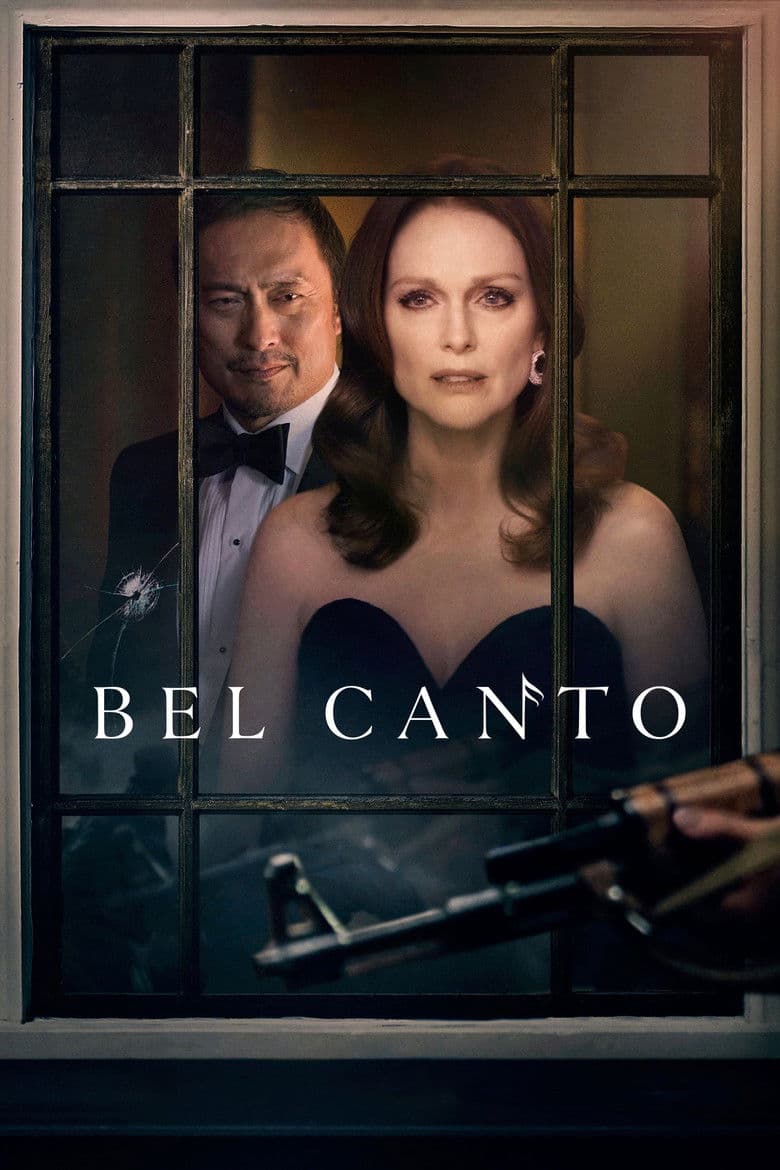
Bel Canto follows Roxane Coss, a famous American opera singer who travels to an unnamed South American country for a private party. The party honors Katsumi Hosokawa, a wealthy Japanese businessman, but guerrilla fighters storm the house and take the guests hostage. The rebels want political prisoners released, while a Red Cross negotiator tries to keep the crisis from turning into a massacre. As the siege lasts for months, music, translation, fear, and romance turn the mansion into a strange shared home.
The film gives much of its attention to people from different nations, classes, and languages learning to trust each other. Roxane becomes close to Hosokawa, while his translator Gen falls in love with Carmen, a young rebel who asks him to teach her to read and speak. The story presents the rebels as violent captors but also gives their leader a speech about centuries of people being forced to give up, which adds an identity and oppression message. It also treats opera and human empathy as forces that can cross national and social divisions, though the final attack rejects the hope that this peace can last.
Community feedback
Was our 45% Woke rating accurate?
Breakdown
These are the editorial factors and ratings behind our score for Bel Canto.
Woke representation / casting
The film places people from many nations in major roles, including an American opera singer, two Japanese male leads, European diplomats, and Mexican and Indigenous Central American rebels. Carmen is a young local rebel who becomes a major love interest, and her language and background are part of her character. The international party and South American hostage setting explain much of the cast mix, so it is not a simple mismatch with the story world. The prominent use of national and ethnic difference still makes representation a visible part of the film’s design.
48%
Woke political dialogue
The rebel leaders repeatedly demand the release of political prisoners. Benjamin says his people have spent 500 years giving things up, which links the conflict to long-term group oppression. The film also shows the government using the crisis for its own political gain. These ideas matter to the hostage plot, but the activist-style language appears in a few key moments rather than throughout the film.
34%
Identity-driven story themes
The film’s main idea is that music and close contact can make captors and captives see each other as human. The story repeatedly crosses lines of nation, language, class, and power through the two romances and the growing friendship inside the mansion. Carmen’s local background and the rebels’ demand for their imprisoned people add an identity and oppression layer. The message is central to the ending, but it is framed as broad human empathy more than a modern DEI campaign.
40%
Western institutional / cultural critique
Not present. The film shows a fictional military government and wealthy elites acting selfishly during a hostage crisis. It does not make a modern activist critique of Western institutions, Christianity, family roles, or conservative culture.
0%
Woke character or canon changes
Not relevant. The film adapts Ann Patchett’s novel and keeps the main identities and relationships. It cuts and shortens story material, but no race, gender, sexuality, or hero-role change is clearly reported.
0%
Anti-woke backlash and complaints
Not present. No clear anti-woke complaint appears in news, audience discussion, or the separate X pass. Reported complaints focus on slow pacing, weak romance, and whether the film makes the rebels too sympathetic.
0%
Creator track record context
Paul Weitz has a stored moderate score because Grandma centers on abortion and female solidarity. Weitz also described this film’s multinational casting and female-initiated romances as political choices. Ann Patchett and Anthony Weintraub have low stored scores and no strong identity-politics pattern. Avy Kaufman has a moderate stored score, while the listed producers have mostly low scores.
31%
Production

Movie · 2018
German artist Kurt Barnert has escaped East Germany and now lives in West Germany, but is tormented by his childhood under the Nazis and the GDR regime.

Movie · 2016
Writer and Adderall enthusiast Stephen Elliott reaches a low point when his estranged father resurfaces, claiming that Stephen has fabricated much of the dark childhood that that…

Movie · 2017
Verena is a nurse who arrives at an old mansion in Italy to help a young boy who has fallen silent since the sudden passing of his mother.

Movie · 2024
Remi and Barnes, two very different teenagers, meet by chance in the winter of their senior year, then spend four days together over the course of a year that will change their…

Movie · 2018
A man and a woman meet in the ruins of post-war Poland. With vastly different backgrounds and temperaments, they are fatally mismatched and yet drawn to each other.

Movie · 2016
In 1942, an intelligence officer in North Africa encounters a female French Resistance fighter on a deadly mission behind enemy lines.

Movie · 2023
Noah must leave her city, boyfriend, and friends to move into William Leister's mansion, the flashy and wealthy husband of her mother Rafaela.

Movie · 2017
In 1950s London, a renowned dressmaker's meticulous lifestyle begins drastically changing as his relationship with his young muse intensifies.
