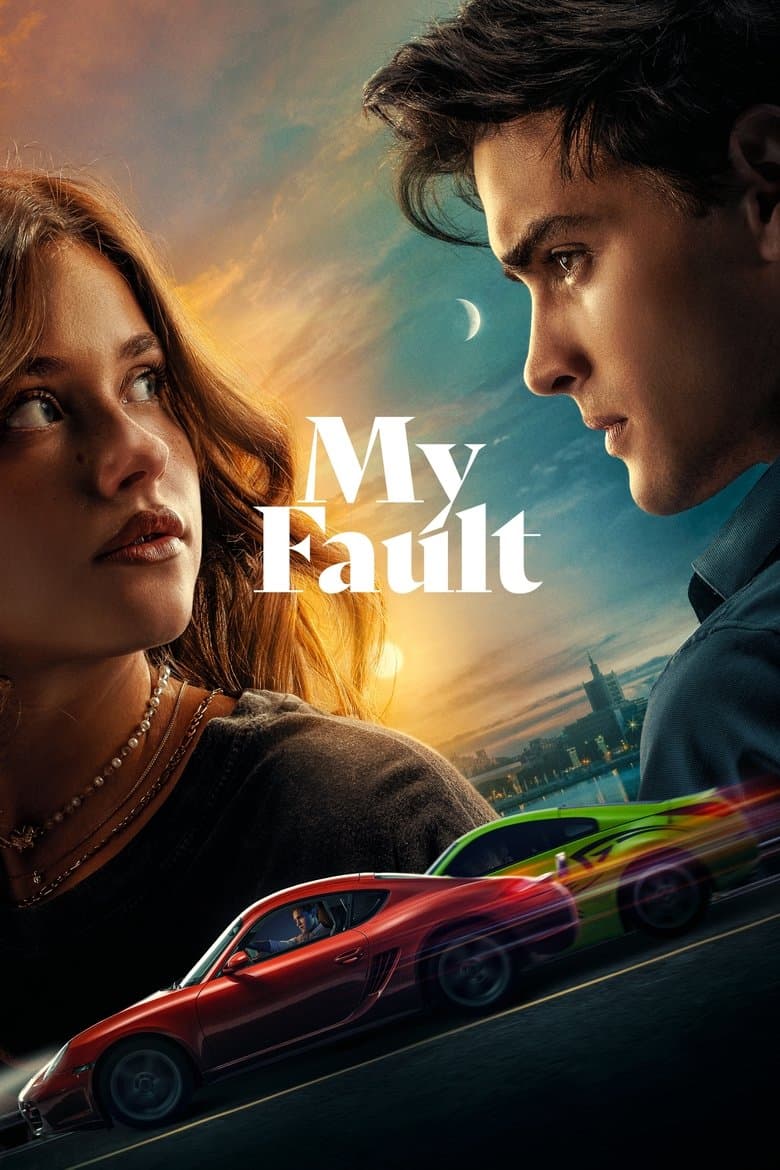
My Fault is a Spanish teen drama about Noah, a proud 17-year-old who leaves her old home after her mother marries the rich William Leister. Noah moves into William’s large mansion and meets Nick, his 21-year-old son and her new stepbrother. Their early fights turn into a secret romance that the family tries to stop. Nick hides a life of illegal car races, gambling, and underground fights, while Noah faces the return of her abusive father. The movie mixes glossy romance with danger, family pain, and fast action.
The main audience-visible identity element is a strong female lead who refuses to accept control from men. Noah can drive well because her father taught her, and she beats a male rival in a major race. She also leaves Nick after seeing him use violence and makes her own choice about the relationship. The film includes two black friends, Jenna and Lion, but it does not make their identity a story point. These elements are limited compared with the main romance, which centers on attraction, trauma, family conflict, and crime.
Community feedback
Was our 13% Woke rating accurate?
Breakdown
These are the editorial factors and ratings behind our score for My Fault.
Woke representation / casting
Not present. The film includes black friends in the main youth group, but their identities are not used as a message. The cast fits a modern Spanish setting and no diversity-first casting claim was found.
0%
Woke political dialogue
Not present. The spoken conflict centers on family, trust, sex, violence, and romance. The film does not use modern identity, DEI, or activist speeches.
0%
Identity-driven story themes
The film gives Noah a strong and independent role. Noah uses her driving skill to beat a male rival in a major race, and the rival reacts badly to losing to a woman. Noah also rejects Nick after she sees him use violence in a fight. The film treats these moments as part of a personal romance and trauma story, so the identity message stays limited.
22%
Western institutional / cultural critique
Not present. The film shows an abusive father, violent crime, and rich family conflict. It does not turn those events into a wider attack on men, family life, capitalism, religion, or Western institutions.
0%
Woke character or canon changes
Not relevant. The film adapts Mercedes Ron’s novel, but no identity-based change to a known character, real person, or established historical event was found. Setting the story in Spain and shortening book scenes are ordinary adaptation choices.
0%
Anti-woke backlash and complaints
Not present. Reports and audience reviews focus on the taboo romance, sexual content, violence, and adaptation choices. No credible complaint that the movie pushes DEI, queer politics, identity politics, or left-wing activism was found.
0%
Creator track record context
Most cached key creators have very low woke scores and no clear activist record. Producer Araceli Pérez-Rastrilla has supported women-led genre work and spoken about women using horror to address women’s problems. That gives mild female-focused context, but no title-specific diversity or social-justice campaign was found.
10%
Production
Movie · 2025
18-year-old Noah moves from America to London, with her mother who's recently fallen in love with William, a wealthy British businessman.

Movie · 2024
Remi and Barnes, two very different teenagers, meet by chance in the winter of their senior year, then spend four days together over the course of a year that will change their…
Movie · 2020
Young musician Zach Sobiech discovers his cancer has spread, leaving him just a few months to live. With limited time, he follows his dream and makes an album, unaware that it…

Movie · 2016
Lou Clark, a directionless 26-year-old from the English countryside, takes a job at the local castle as a caregiver and companion to a wealthy young banker, Will Traynor.

Movie · 2018
A man and a woman meet in the ruins of post-war Poland. With vastly different backgrounds and temperaments, they are fatally mismatched and yet drawn to each other.
Movie · 2018
While James More is held captive by terrorists in Somalia, thousands of miles away on the Greenland Sea, his lover Danny Flinders prepares to dive herself in a submersible into…

Movie · 2025
Two artistic souls find harmony through music despite their contrasting worlds. As feelings deepen, age and circumstances challenge their undeniable bond.

Movie · 2023
Hadley and Oliver begin falling in love on a flight from New York to London, but when they lose each other at customs, can they defy all odds to reunite?
