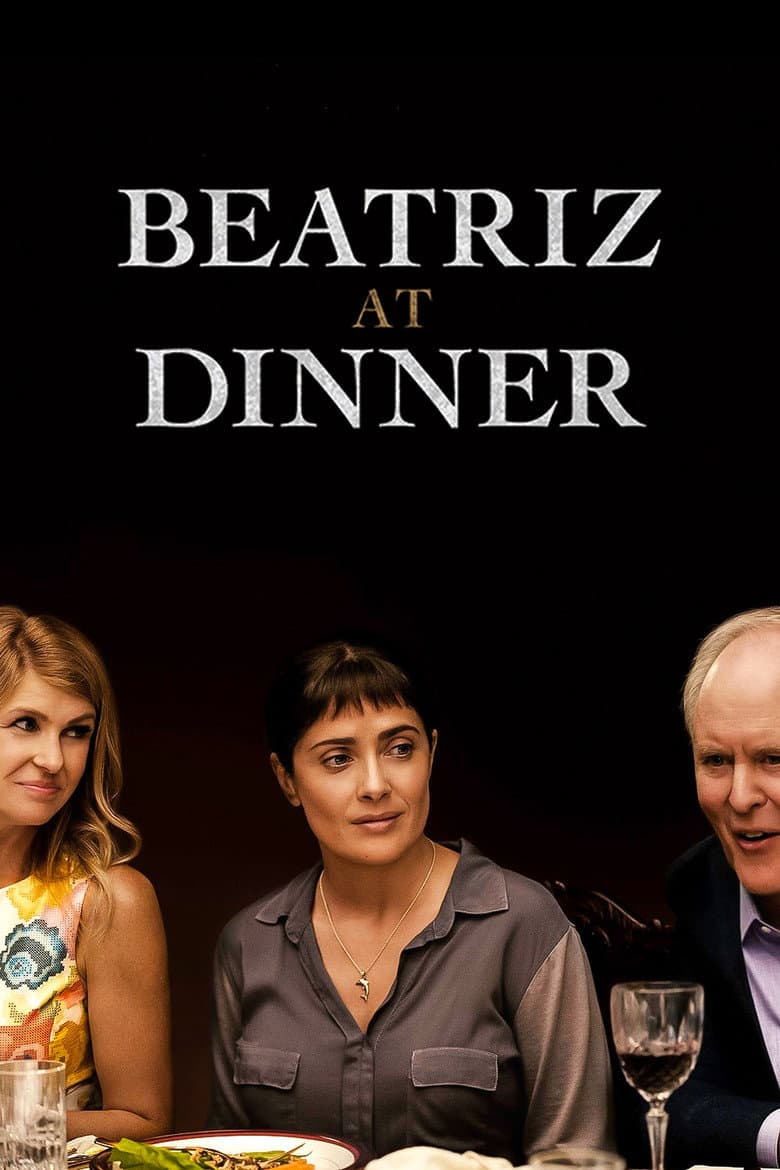
Beatriz is a Mexican immigrant who works as a massage therapist and healer in Southern California. After her car breaks down at a wealthy client's home, the client invites her to stay for a dinner with rich business guests. Beatriz soon clashes with Doug Strutt, a billionaire real estate builder who boasts about hunting animals and treating life as a chance to take what he can. The movie uses awkward jokes, long silences, and a dark final turn to show a dinner that grows from polite discomfort into grief and anger.
The film puts immigration, race, class, and money at the center of the dinner. Doug asks Beatriz if she came to the United States legally, while the other guests treat her as a helpful worker instead of an equal guest. Beatriz's hometown was damaged by a resort project, so the wealthy developer's business talk becomes personal and ties money to lost homes, damaged land, and broken trust. The story favors Beatriz's care for people, animals, and nature over Doug's selfish view, while also showing that polite rich people can hide behind good manners and that Beatriz's anger leaves her with no clear way forward.
Community feedback
Was our 73% Woke rating accurate?
Breakdown
These are the editorial factors and ratings behind our score for Beatriz at Dinner.
Woke representation / casting
Salma Hayek plays Beatriz as a Mexican immigrant, and her background matters to the story. The wealthy dinner guests are mostly white, so the film makes her identity visible in the room. The casting fits the character and the Southern California setting. The film does not present the cast as a diversity campaign or use a repeated identity-first pattern.
15%
Woke political dialogue
Beatriz talks about immigration, racism, lost homes, animal killing, and the damage caused by rich developers. Doug asks if she came legally, and he argues that people should enjoy life even while the world is dying. The guests also argue about privilege, compassion, and who gets to decide what progress means. These ideas appear through much of the dinner and drive the main conflict.
52%
Identity-driven story themes
Beatriz's immigrant identity and outsider status shape the whole dinner. The film shows wealthy white guests treating her as a worker, asking about her legal status, and failing to see her as an equal. Her Mexican hometown was damaged by a resort project, which links race and class to lost homes and damaged land. The story clearly favors her care and shared human worth over Doug's wealthy, self-protective worldview.
64%
Western institutional / cultural critique
The film attacks a world built around billionaires, real estate deals, and endless buying. Doug treats animal killing and damaged communities as acceptable costs of making money. The story also shows polite rich liberals who claim to care but turn back to comfort when Beatriz challenges them. The critique is strong and repeated, although the film also questions Beatriz's judgment and does not give a simple political solution.
57%
Woke character or canon changes
Not relevant. The movie is an original story with no established character or real historical event being reworked.
0%
Anti-woke backlash and complaints
Several small reviews called the film a liberal fantasy, a liberal wet dream, or a heavy-handed political message. A family-oriented review objected to its politically correct handling of racism and its environmental and anti-wealth message. Some Letterboxd users also called it liberal preaching and a pure polemic. The supplied X pass found two tiny accounts calling it woke, but no boycott, campaign, or review-bombing appeared.
38%
Creator track record context
Miguel Arteta has a low stored score, and Mike White has a low to moderate stored score. White and Arteta gave this film a clear focus on racism, immigration, social division, and economic inequality. Christine Vachon and Pamela Koffler bring a strong queer and social justice history, while the other producers are mixed. The overall record gives the film a progressive production context, but it does not make the movie queer-centered.
45%
Production

Movie · 2018
Thirteen-year-old Kayla endures the tidal wave of contemporary suburban adolescence as she makes her way through the last week of middle school — the end of her thus far…

Movie · 2024
In 2008, during the last month of summer before high school begins, an impressionable 13-year-old Taiwanese American boy learns what his family can't teach him: how to skate, how…

Movie · 2017
When dictator Joseph Stalin dies, his parasitic cronies square off in a frantic power struggle to become the next Soviet leader.

Movie · 2016
Two high school girls are best friends until one dates the other's older brother, who is totally his sister's nemesis.

Movie · 2025
Tenderly captures a year in the life of a family as the parents navigate their separation. Through both playful and heartfelt moments, the film portrays the bittersweet essence of…

Movie · 2017
An aspiring actor in Hollywood meets an enigmatic stranger by the name of Tommy Wiseau, the meeting leads the actor down a path nobody could have predicted; creating the worst…

Movie · 2020
Scott has been a case of arrested development ever since his firefighter father died when he was seven. He's now reached his mid-20s having achieved little, chasing a dream of…

Movie · 2017
Ingrid becomes obsessed with a social network star named Taylor Sloane who seemingly has a perfect life. But when Ingrid decides to drop everything and move west to be Taylor's…
