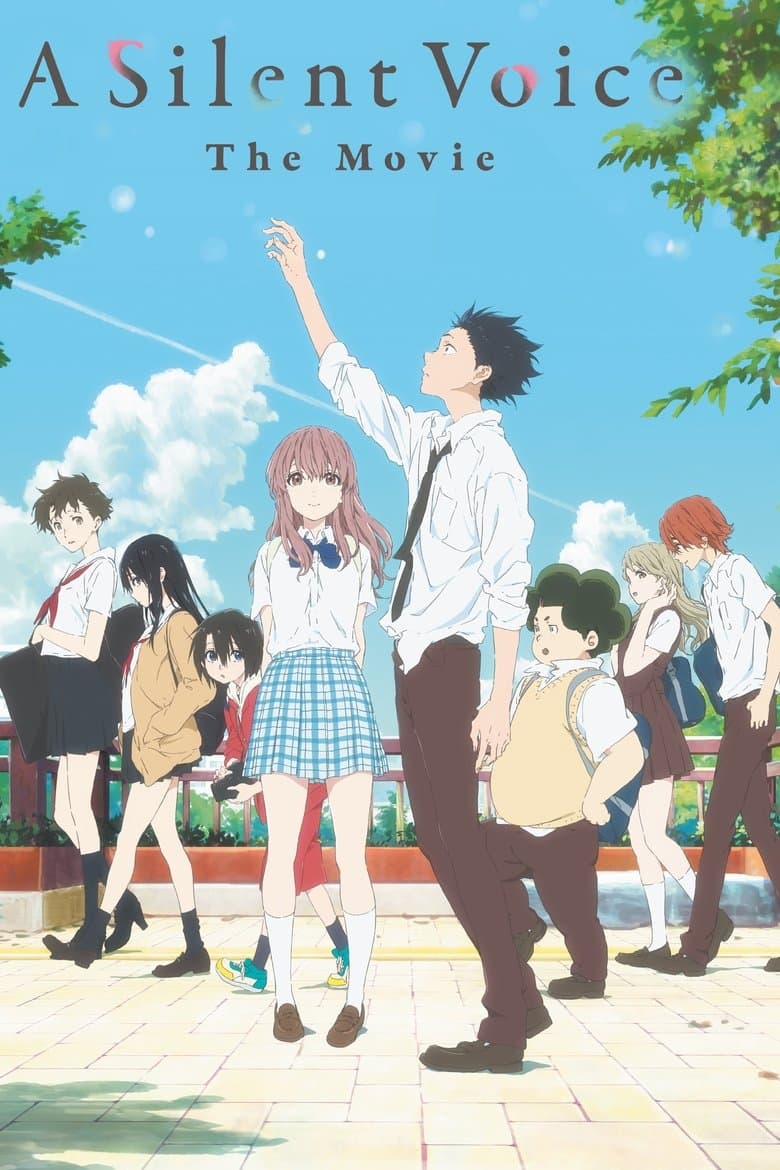
Movie review
September 17, 2016 · 129 min · NR · Japanese · Animation · Romance · Drama
Shoya Ishida is a noisy sixth-grade boy who bullies Shoko Nishimiya after she joins his class. Shoko is deaf, and her hearing aids and sign language make her stand out to classmates who do not understand her. When the adults let the trouble grow, Shoya becomes the target of the same class and later lives as a lonely high school student. He finds Shoko again, faces his guilt, and tries to repair the harm he caused in a serious story about bullying, regret, suicide, forgiveness, and friendship.
The film makes disability and social exclusion part of the main conflict, not a side detail. It shows Shoko being mocked, having her hearing aids damaged, and blaming herself for the pain around her. It also follows Shoya as he learns sign language and tries to rebuild trust after bullying her. These identity-driven themes support empathy, communication, and inclusion, but the film presents them through personal guilt and friendship instead of a political program.
Community feedback
Was our 40% Woke rating accurate?
Breakdown
These are the editorial factors and ratings behind our score for A Silent Voice: The Movie.
Woke representation / casting
Not present. The film uses Japanese characters in a Japanese setting, and Shoko’s deafness is part of the story rather than a public casting message. The animated film does not present a visible diversity lineup or a representation-first casting campaign.
0%
Woke political dialogue
Not present. The film has cruel lines about deafness, but they show the bullying rather than promote modern identity politics. The characters do not give DEI or activist speeches.
0%
Identity-driven story themes
Shoko’s deafness and the way others treat her drive the main conflict. The film repeatedly shows bullying, social exclusion, self-blame, and the need to use sign language. Shoya’s redemption depends on accepting responsibility and learning to understand her. The message favors empathy, communication, and inclusion, so the identity-driven material is central even though the film avoids political speeches.
58%
Western institutional / cultural critique
Not present. The teacher and classmates fail Shoko, but the story treats this as a school and group failure. It does not attack Western culture, religion, family, capitalism, or traditional social norms.
0%
Woke character or canon changes
Not relevant. The film keeps the manga’s main character identities and roles. Its changes mainly shorten side stories and character history.
0%
Anti-woke backlash and complaints
Not present. Public criticism focused on pacing, the redemption plot, romance, or the handling of deafness. No clear complaint said the film pushed DEI, identity politics, or activist messaging.
0%
Creator track record context
The director often centers girls, feelings, friendship, and emotional openness. The screenwriter often writes female-led stories and close relationships. The original creator repeatedly writes about disability, bullying, isolation, and empathy. The producers mainly have mainstream commercial careers with no clear activist public image.
55%
Production
Movie · 2019
The summer of his high school freshman year, Hodaka runs away from his remote island home to Tokyo, and quickly finds himself pushed to his financial and personal limits.
Movie · 2024
Popular, outgoing Fujino is celebrated by her classmates for her funny comics in the class newspaper. One day, her teacher asks her to share the space with Kyomoto, a truant…

Movie · 2017
A young man arrives at the last hometown of painter Vincent van Gogh to deliver the troubled artist's final letter and ends up investigating his final days there.
Movie · 2023
After decades apart, childhood friends Nora and Hae Sung are reunited in New York for one fateful weekend as they confront notions of destiny, love, and the choices that make a…

Movie · 2016
Lou Clark, a directionless 26-year-old from the English countryside, takes a job at the local castle as a caregiver and companion to a wealthy young banker, Will Traynor.

Movie · 2023
Set in 1889 France, Dodin Bouffant is a chef living with his personal cook and lover Eugénie. They share a long history of gastronomy and love but Eugénie refuses to marry Dodin…

Movie · 2016
Set during the last days of the Ottoman Empire, a love triangle develops between Mikael, a brilliant medical student, the beautiful and sophisticated artist Ana, and Chris, a…
Movie · 2024
A colossal-sized omnibus film bringing together the last two episodes of Attack on Titan in the franchise's first-ever theatrical experience.
