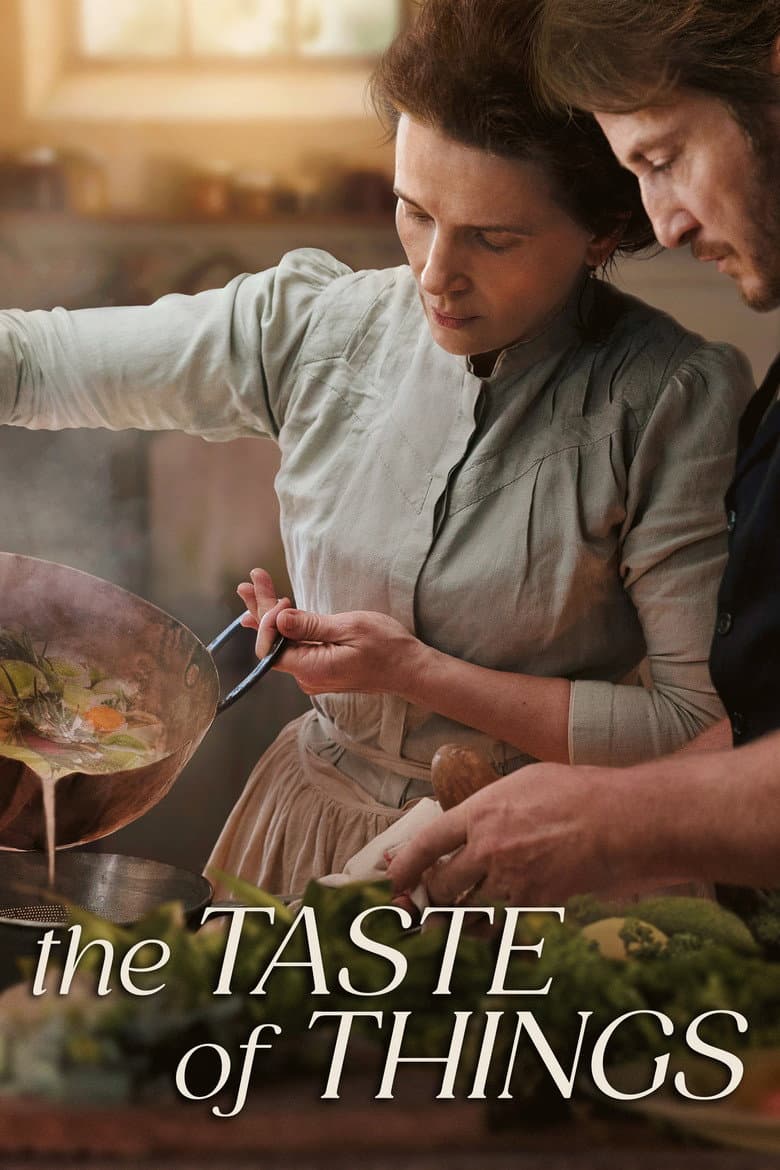
In France in 1889, famous food expert Dodin Bouffant lives with Eugénie, the cook who has worked beside him for twenty years. Their shared love of food has grown into a deep romance, but Eugénie will not marry him because she values her freedom. When illness begins to weaken her, Dodin tries to answer her care with a meal that he cooks himself. The film moves at a calm, slow pace and mixes cooking, desire, grief, and quiet humor.
The film gives Eugénie clear control over her work, her body, and the shape of her relationship. She refuses Dodin’s proposal and chooses when she wants him in her room, while he accepts her limits. She is a highly skilled cook, and the story treats her work as equal to Dodin’s ideas. After she dies, a young girl named Pauline carries the cooking tradition forward, and Dodin slowly learns to live with loss.
Community feedback
Was our 12% Woke rating accurate?
Breakdown
These are the editorial factors and ratings behind our score for The Taste of Things.
Woke representation / casting
Not present. The cast fits the French 1889 setting, with no clear identity-focused pattern in the main roles. The film does not present the casting as a diversity message.
0%
Woke political dialogue
Not present. The dialogue centers on cooking, love, marriage, work, grief, and art. It contains no modern identity, DEI, or activist speech.
0%
Identity-driven story themes
Eugénie repeatedly refuses Dodin’s marriage proposals and chooses when he may enter her room. That choice gives the central woman a mild identity-driven theme about independence from a traditional wife role. The film also makes her a highly skilled cook and treats their work as a shared partnership. The story keeps these choices inside a private romance and does not turn them into a modern political message.
24%
Western institutional / cultural critique
Not present. The film shows an unmarried couple and a woman who values independence, but it treats those choices as private. It does not attack family life, male behavior, Christianity, or Western institutions.
0%
Woke character or canon changes
Not relevant. The film uses Marcel Rouff’s characters in a new prequel story. No identity-based change to a character or historical figure is confirmed.
0%
Anti-woke backlash and complaints
Not present. Public discussion focused on food, pacing, awards, and the Oscar choice. The supplied X pass found no anti-woke complaints, and a few right-leaning posts praised the film as not woke.
0%
Creator track record context
Not present. Cached creator context shows no sustained activist, DEI, or identity-politics record among the key creators. Interviews about this film focus on food, art, lasting love, historical detail, and teaching a young cook.
0%
Production
Movie · 2022
A young couple's relationship clashes with the harsh realities of the California Gold Rush of 1850. Angel, experiencing love for the first time and facing demons unsurmountable…

Movie · 2025
Two artistic souls find harmony through music despite their contrasting worlds. As feelings deepen, age and circumstances challenge their undeniable bond.

Movie · 2016
Set during the last days of the Ottoman Empire, a love triangle develops between Mikael, a brilliant medical student, the beautiful and sophisticated artist Ana, and Chris, a…

Movie · 2025
18-year-old Noah moves from America to London, with her mother who's recently fallen in love with William, a wealthy British businessman.
Movie · 2017
The story of four characters whose lives intertwine amid the hustle and bustle of the Coney Island amusement park in the 1950s: Ginny, an emotionally volatile former actress now…

Movie · 2018
German artist Kurt Barnert has escaped East Germany and now lives in West Germany, but is tormented by his childhood under the Nazis and the GDR regime.

Movie · 2019
England, early 20th century. The future writer and philologist John Ronald Reuel Tolkien (1892-1973) and three of his schoolmates create a strong bond between them as they share…

Movie · 2023
Hadley and Oliver begin falling in love on a flight from New York to London, but when they lose each other at customs, can they defy all odds to reunite?
