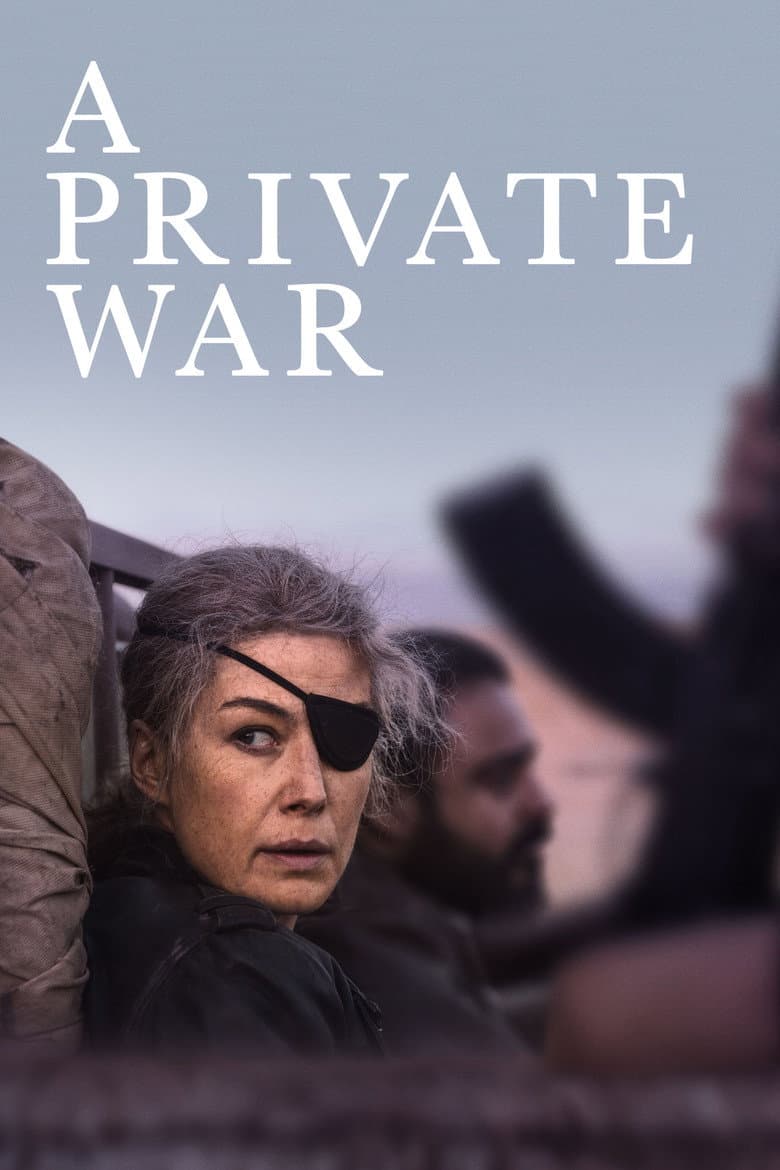
A Private War follows Marie Colvin, a bold Sunday Times reporter who travels into wars to show civilians what fighting does to them. The story moves from Sri Lanka and Iraq to Libya and Syria, where Colvin reports under fire and loses an eye. Her work brings praise, but the fear and deaths she sees follow her back to London. Alcohol, nightmares, broken relationships, and the pull of the next story wear down her private life before the siege of Homs becomes her last assignment.
The film gives its main attention to a woman who leads dangerous reporting in places where men also work, and it presents her courage and skill as real and worth honoring. Colvin repeatedly takes charge while male colleagues support her, argue with her, or try to keep her alive, but the story also shows her mistakes, addiction, fear, and damage. The movie asks viewers to care about Syrian, Iraqi, and other civilians through their own suffering rather than through battle scenes alone. Its central themes are brave journalism, human sympathy, and the cost of turning other people’s pain into a story.
Community feedback
Was our 27% Woke rating accurate?
Breakdown
These are the editorial factors and ratings behind our score for A Private War.
Woke representation / casting
Not present. Marie Colvin was a white American, and Rosamund Pike plays that real person. The film uses local refugees and actors for war-zone roles to fit the places shown, not to make a diversity statement.
0%
Woke political dialogue
Not present. The film’s political lines focus on war, journalism, and Assad’s shelling of civilians. The story does not use modern identity, DEI, or gender-politics speeches.
0%
Identity-driven story themes
The story centers on a woman who leads dangerous war reporting in a field often shown through men. Marie repeatedly takes charge, faces danger, and becomes the film’s main moral voice. The story also shows her fear, addiction, failed relationships, and damage, while male colleagues remain capable partners and rivals. The female-lead focus is recurring and central, but it supports a true-life character story rather than a broad modern gender campaign.
40%
Western institutional / cultural critique
Not present. The film criticizes Assad’s regime and the newspaper’s pressure for more stories. Those conflicts concern war and newsroom duty, not modern activist attacks on Western family life, religion, or gender roles.
0%
Woke character or canon changes
Not relevant. The film blends several real people into fictional characters and changes some relationships for storytelling. It does not change Marie Colvin’s race, sex, or sexuality.
0%
Anti-woke backlash and complaints
A Spectator opinion article called Marie Colvin one of the “woke world’s” heroes and said A Private War sanitized her life. The writer treated the film as part of identity-focused movie culture and objected to its heroic portrait of Colvin. The supplied X pass found no anti-woke reaction or specific complaints. Reddit discussion and mainstream reviews mostly treated the film as a serious war biography, so the backlash evidence is narrow.
12%
Creator track record context
Director Matthew Heineman and writer Arash Amel have mostly people-focused or outsider-focused work, with little evidence of a DEI-centered profile. Producer Charlize Theron has a clear feminist public profile, while Nicole Alexandra Shipley has focused on women’s treatment and women’s empowerment. Most other listed producers have little public activist or identity-driven history. This gives the title a mild creator track record signal, but it does not show a strong activist team.
22%
Production

Movie · 2025
Diagnosed with Tourette Syndrome at 15, John Davidson navigates his way against the odds through troubled teenage years and into adulthood, finding inspiration in the kindness of…
Movie · 2024
On the brink of the Second World War, a young Norwegian man's drive to resist the Nazis sets a new course for his future – and the future of his country.
Movie · 2019
Richard Jewell thinks quick, works fast, and saves hundreds, perhaps thousands, of lives after a domestic terrorist plants several pipe bombs and they explode during a concert…
Movie · 2016
WWII American Army Medic Desmond T. Doss, who served during the Battle of Okinawa, refuses to kill people and becomes the first Conscientious Objector in American history to…
Movie · 2020
A man refuses all assistance from his daughter as he ages and, as he tries to make sense of his changing circumstances, he begins to doubt his loved ones, his own mind and even…
Movie · 2017
Members of the Granite Mountain Hotshots battle deadly wildfires to save an Arizona town.
Movie · 2022
London, 1953. Mr. Williams, a veteran civil servant, is an important cog within the city's bureaucracy as it struggles to rebuild in the aftermath of World War II.

Movie · 2016
After his older brother passes away, Lee Chandler is forced to return home to care for his 16-year-old nephew.
