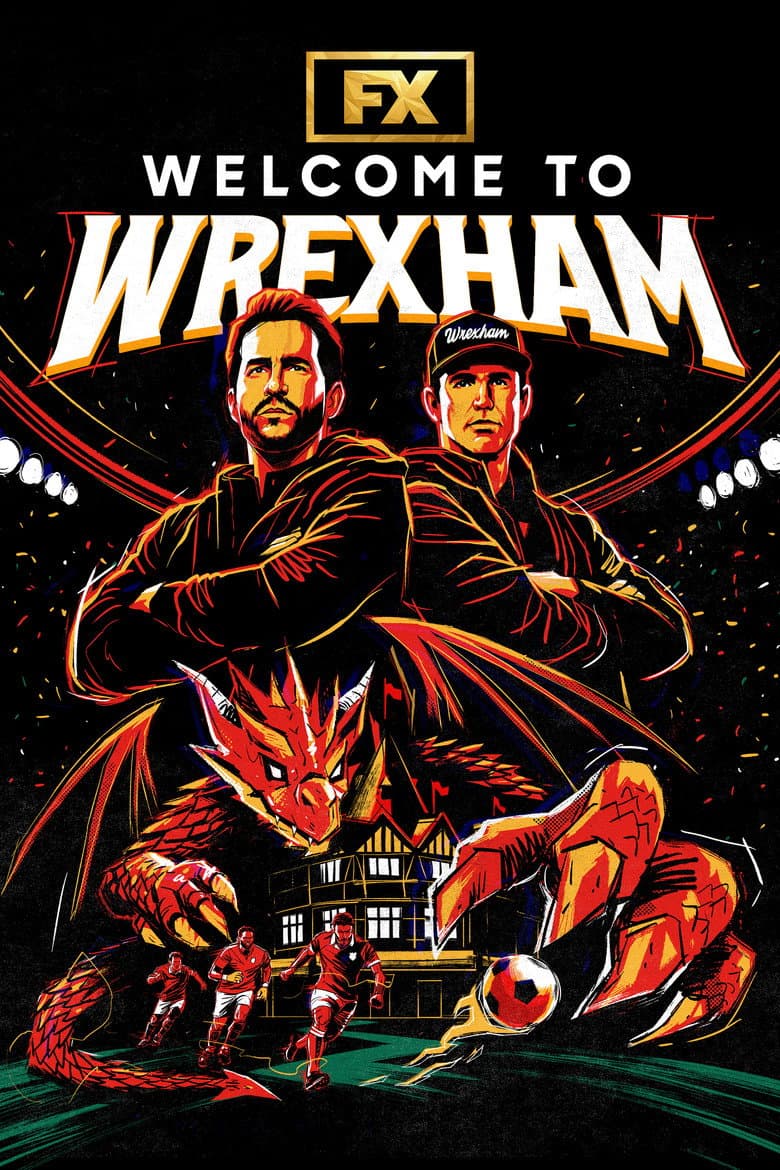
Started August 24, 2022 · Returning Series · Based on 5 seasons, 57 episodes through June 18, 2026 · TV-MA
Welcome to Wrexham follows owners Rob McElhenney and Ryan Reynolds as they learn to run Wrexham AFC in a working-class town in North Wales. The club starts in the fifth level of English football and aims to climb toward the Premier League. The owners face money problems, fan pressure, injuries, player changes, and the risks of turning a local club into a global name. The tone mixes tense matches, jokes, town history, and emotional stories about fans, players, and staff.
The show gives repeated attention to Wrexham Women, who move from amateur football and day jobs toward paid play and better facilities. It also follows disabled fans and a wheelchair football team, and it presents access and support as club duties. One major episode centers on Ollie Palmer’s gay father, while Rob talks about growing up with two mothers. These stories add visible identity and inclusion themes, but the main story remains the club’s results, business choices, and bond with the town.
Community feedback
Was our 60% Woke rating accurate?
Breakdown
These are the editorial factors and ratings behind our score for Welcome to Wrexham.
Woke representation / casting
The documentary does not cast fictional roles. It repeatedly gives major screen time to Wrexham Women, disabled fans, the wheelchair team, and LGBTQ+ family stories. These are real people linked to the club, so the pattern is an editorial focus rather than a casting mismatch. The focus is clear but does not turn the series into a diversity showcase.
48%
Woke political dialogue
The show talks about the barriers facing women’s football and the weaker pay and facilities given to women players. Rob and Ryan question the limits placed on support for the women’s side, and the club later builds a dedicated facility. The “Wromance” episode says social pressure can stop men from showing affection. These ideas recur in side stories, while most dialogue still covers football, money, and club management. The unscripted dialogue includes explicit discussions championing progressive social causes. Creative partners and interviewees speak openly about the historical struggles of the LGBTQ+ community, the importance of non-traditional family structures, and systemic barriers in women's sports.
45%
Identity-driven story themes
The show builds recurring side stories around women’s football, disability, mental health, and family identity. Seasons 2 and 3 give the women’s team promotion races and record crowds, while Season 5 follows its new manager and dedicated ground. “Family Business” centers on Ollie Palmer’s gay father and Rob’s two mothers, and the show treats those families positively. The men’s promotion race remains the main thread, and Season 5 gives the women less time.
50%
Western institutional / cultural critique
The show says football culture can make it harder for men to show affection or seek help. It shows women players facing weaker pay, facilities, and status than the men. It presents disability access and the wheelchair team as duties for the club. These critiques are clear in selected episodes, but the series does not attack Western institutions as its main subject.
32%
Woke character or canon changes
Not relevant. The show follows a real club and real people. It does not rewrite established fictional characters or historical figures around identity politics.
0%
Anti-woke backlash and complaints
A few small X accounts called the women’s team sections “woke crap” or “woke mumbo jumbo.” One right-leaning Welsh outlet used “From Rags to Woke!” while attacking a club ban, not the documentary’s story. Another post called Ukraine-related framing propaganda, but it was isolated. No sustained campaign, review-bombing, or major anti-woke coverage was found.
22%
Creator track record context
The cached profiles show a mixed creative team. Rob Mac has a strong LGBTQ+ representation record, and several Boardwalk producers have made social-issue documentaries. Ryan Reynolds and Bryan Rowland have lower scores, while Humphrey Ker and Maxine Hughes are more moderate. The context supports the show’s inclusion focus but does not show one activist-led team.
42%
Production
TV Show · 2017
A four-part documentary series that tells the stories of Jimmy Iovine and Dr. Dre -- one the son of a Brooklyn longshoreman, the other straight out of Compton - -- and their…
TV Show · 2020
A 10-part documentary chronicling the untold story of Michael Jordan and the Chicago Bulls dynasty with rare, never-before-seen footage and sound from the 1997-98 championship…
TV Show · 2022
The lives of an emerging superstar and a filmmaker intertwine in this intense, intimate docuseries charting Kanye West's career, filmed over two decades.
TV Show · 2023
With never-before-seen footage, this docuseries follows David Beckham's meteoric rise from humble beginnings to global football stardom.
TV Show · 2023
This intimate docuseries follows Arnold Schwarzenegger's multifaceted life and career, from bodybuilding champ to Hollywood icon to politician.
TV Show · 2021
The three-part documentary series, compiled from over 60 hours of unseen footage, captures the warmth, camaraderie, and creative genius that defined the legacy of music's most…
TV Show · 2019
Drivers, managers and team owners live life in the fast lane — both on and off the track — during each cutthroat season of Formula 1 racing.
TV Show · 2022
Strangers play the ultimate game of detection, backstabbing and trust in the hope of winning up to £120,000. But hidden amongst the players are three Traitors, who secretly…
