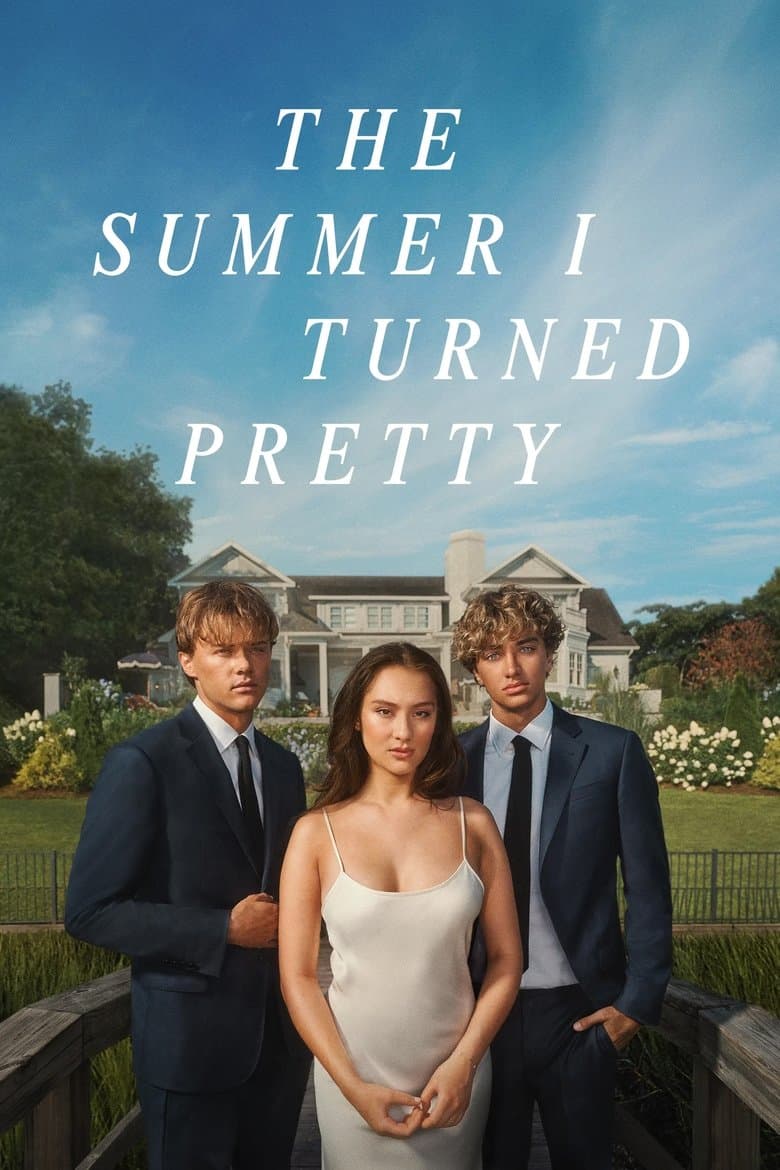
Started June 16, 2022 · Ended · Based on 3 seasons, 26 episodes through September 17, 2025 · TV-14
Isabel “Belly” Conklin spends each summer at the Fishers’ beach house in Cousins Beach with her mother, brother, and the Fisher family. At sixteen, she is suddenly noticed by brothers Conrad and Jeremiah, who have been like family to her. Belly is caught between them while the adults face divorce, illness, money problems, and grief. The show has a soft summer mood, but the story becomes more painful as the characters grow older.
The show gives Belly and her family Korean American roots, and the choice is part of the lead cast rather than a side detail. Jeremiah is sexually fluid and kisses a boy before he dates Belly, while season two adds Skye, a nonbinary cousin who dates Cam. A girl also brings her girlfriend to the debutante ball, and the show includes a brief scene about a country club accepting them. These identity elements are easy to see, but the main story stays focused on romance, family, grief, and growing up rather than political debate.
Community feedback
Was our 51% Woke rating accurate?
Breakdown
These are the editorial factors and ratings behind our score for The Summer I Turned Pretty.
Woke representation / casting
The show centers an Asian American lead family at the wealthy Cousins Beach house. The books made Belly white, but the show made Belly biracial Korean American and cast Lola Tung, Jackie Chung, and Sean Kaufman. The show also adds queer visibility through sexually fluid Jeremiah, nonbinary Skye, and a girl bringing her girlfriend to the debutante ball. The choices are visible but do not create a one-of-each ensemble.
38%
Woke political dialogue
The show has a few brief lines about changing social norms. A debutante says her club accepted her girlfriend, and another girl says Cousins likes to pretend to be woke. Laurel calls the change progressive. The story does not use political speeches or party politics.
8%
Identity-driven story themes
Most of the show is about romance, grief, and growing up. Belly’s Korean American identity appears through her family, and Laurel briefly talks about the Asian American experience. Jeremiah’s sexual fluidity and Skye’s nonbinary identity are accepted as parts of their lives, but neither drives the main plot. The series gives Belly more control over dating and sex without turning that growth into a larger activist message.
30%
Western institutional / cultural critique
The show gives a few critical moments about elite spaces. Rich club members assume Steven is good at math because he is Asian, and he weighs speaking up against losing his job. The debutante tradition is treated as old-fashioned, but the club accepts a girl and her girlfriend. The show does not make a broad attack on family, men, Christianity, or Western institutions.
15%
Woke character or canon changes
The show changes Belly from a white girl in the books to a biracial Korean American girl. The show changes Jeremiah from straight in the books to sexually fluid, and he kisses a boy before dating Belly. The show also adds Skye, a nonbinary cousin who was not in the books. These identity changes are clear and tied to Han’s stated wish to reflect 2022, so this factor is strong even though the main plot stays romance.
64%
Anti-woke backlash and complaints
A few online comments called the series woke because it changed Belly’s ethnicity and added queer characters. One low-reach conservative complaint focused on Gavin Casalegno playing a bisexual character. The supplied X search found no sustained anti-woke campaign, boycott, or review-bombing push.
8%
Creator track record context
Jenny Han’s work has a mild representation focus through Asian American lead stories and this show’s updates. David Rapaport and Lyndsey Baldasare have a track record of inclusive casting. Gabrielle Stanton has supported more diverse writers, while most listed directors and writers have limited activist records. The overall pattern supports visible representation but not a strong activist focus.
32%
Production
TV Show · 2025
"Legend of Zang Hai" follows the son of Imperial Astronomer Kuai Duo. Consumed by vengeance, he spends a decade honing his skills.

TV Show · 2016
The love story of young Countess Natasha Rostova and Count Pierre Bezukhov is interwoven with the Great Patriotic War of 1812 against Napoleon's invading army.

TV Show · 2023
The story of Bass Reeves, the legendary lawman of the wild West, is brought to life. Reeves worked in the post-Reconstruction era as a federal peace officer in the Indian…
TV Show · 2022
Oscar-winning producer Al Ruddy’s never before revealed experiences of making the iconic 1972 film The Godfather that Francis Ford Coppola directed and adapted with Mario Puzo.
TV Show · 2024
The true story of one Jewish family separated at the start of World War II, determined to survive—and to reunite.
TV Show · 2021
Inspired by the true story of Marty and the therapist who turned his life around...then took it over. When he first meets Dr. Ike, Marty just wants to get better at boundaries.

TV Show · 2024
Fascinated by cars since childhood, Brazilian racer Ayrton Senna became a sports legend — until tragedy struck, changing Formula 1 forever.
TV Show · 2026
Rip Wheeler and Beth Dutton gamble everything on a new life in South Texas, but the promise of building a future far from the ghosts of Yellowstone quickly collides with brutal…
