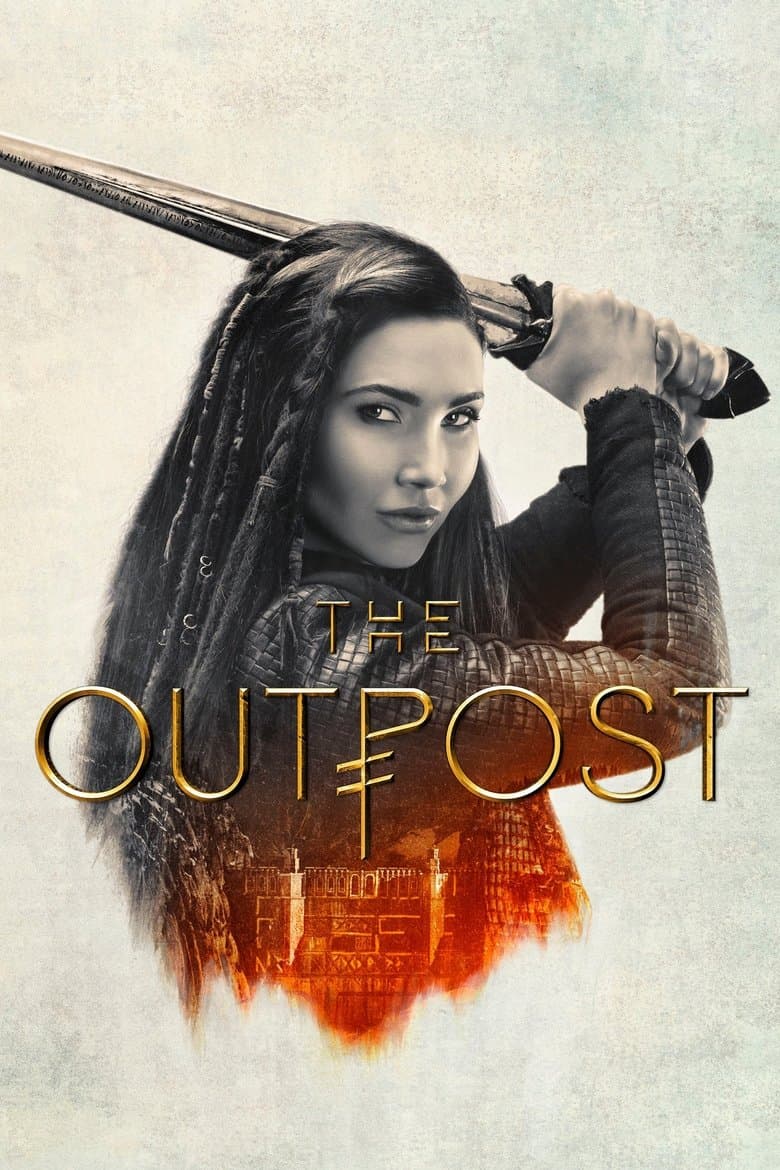
Started July 10, 2018 · Ended · Based on 4 seasons, 49 episodes through October 7, 2021 · TV-14 · 45 min
The Outpost follows Talon, the last known Blackblood, a young warrior whose family and people were killed by the Prime Order and its mercenaries. She travels to Gallwood Outpost to hunt the killers, then learns to control a power that summons dangerous creatures. Across four seasons, Talon joins humans and Blackbloods against rulers, religious leaders, a false god, and ancient beings. The tone mixes sword fights, magic, romance, jokes, monsters, and low-budget fantasy drama.
The clearest woke signal is the show's repeated focus on capable women in positions of power. Talon is the main fighter, leader, and final hero, while Gwynn, Falista, Wren, and Yavalla also rule, plan wars, or control important knowledge. The cast includes several prominent actors of South Asian or Black heritage, and the show gives a human man and a Blackblood woman a major romance and family story. Wren also gives a brief inclusion message about humans and Blackbloods raising children together, but most episodes focus on fantasy conflict rather than modern politics.
Community feedback
Was our 51% Woke rating accurate?
Breakdown
These are the editorial factors and ratings behind our score for The Outpost.
Woke representation / casting
The show places women in several major power roles. Talon is the main fighter, problem solver, and later queen. Gwynn and Falista rule, while Wren and Yavalla control important knowledge, religion, or magic. The cast also gives prominent roles to actors of South Asian and Black heritage, including Janzo, Zed, and Wren. Interviews openly frame Talon as a strong female lead and a new view of fantasy.
58%
Woke political dialogue
Wren gives a brief speech that says children of different blood types should be raised by the whole community. Wren also says couples should choose love instead of a required bloodline. The speech supports inclusion between humans and Blackbloods. Most other dialogue concerns revenge, magic, rulers, war, and prophecy.
24%
Identity-driven story themes
The story repeatedly makes Talon the person who solves the largest danger and wins the final fight. The story also gives Gwynn, Falista, Wren, and Yavalla major control over kingdoms, armies, religion, or magic. The men remain useful, but Garret, Janzo, Tobin, and Munt often serve as helpers, love interests, comic figures, or secondary fighters. The Blackblood conflict supports a message about different groups living together, but it stays inside fantasy history. The recurring female-power pattern is more noticeable than any modern political lesson.
52%
Western institutional / cultural critique
Not present. The Prime Order is an evil fantasy religion, but the show does not attack modern Western institutions, family life, Christianity, or ordinary social traditions.
0%
Woke character or canon changes
Not relevant. The show is an original fantasy story and does not change established characters, source material, or real historical figures.
0%
Anti-woke backlash and complaints
Not present. The supplied X pass found no anti-woke reaction, boycott, or review-bombing. Broader coverage focused on budget, effects, acting, and fantasy storytelling.
0%
Creator track record context
Jason Faller and Kynan Griffin have low woke scores in the cached creator summaries and mainly make fantasy and faith-friendly entertainment. Dean Devlin has a mild Democratic political record but has also criticized identity-based hiring. Most listed directors and producers have no recorded activist profile in the cached summaries. Cached summaries give higher scores to writers Laura Whang and Justin Partridge because of representation or LGBTQ-focused work outside this show. The overall creator signal is mild.
24%
Production
TV Show · 2022
A powerful sorceress in a blind woman's body encounters a man from a prestigious family, who wants her help to change his destiny.
TV Show · 2019
Iwatani Naofumi, a run-of-the-mill otaku, finds a book in the library that summons him to another world. He is tasked with joining the sword, spear, and bow as one of the Four…
TV Show · 2019
A grim drama that unfolds against the backdrop of a global catastrophe. An unknown new virus turns Moscow into a city of the dead.
TV Show · 2026
A century before the events of Game of Thrones, two unlikely heroes wandered Westeros: a young, naive but courageous knight, Ser Duncan the Tall, and his diminutive squire, Egg.
TV Show · 2023
After the party of heroes defeated the Demon King, they restored peace to the land and returned to lives of solitude.
TV Show · 2023
After washing ashore in France, Daryl struggles to piece together how he got there and why, as he navigates a fractured, walker-infested landscape to find his way home.
TV Show · 2020
Daimon and Ana Helstrom are the son and daughter of a mysterious and powerful serial killer. The siblings have a complicated dynamic as they track down the terrorizing worst of…
TV Show · 2023
Maggie and Negan travel to post-apocalyptic Manhattan - long ago cut off from the mainland. The crumbling city is filled with the dead and denizens who have made it a world full…
