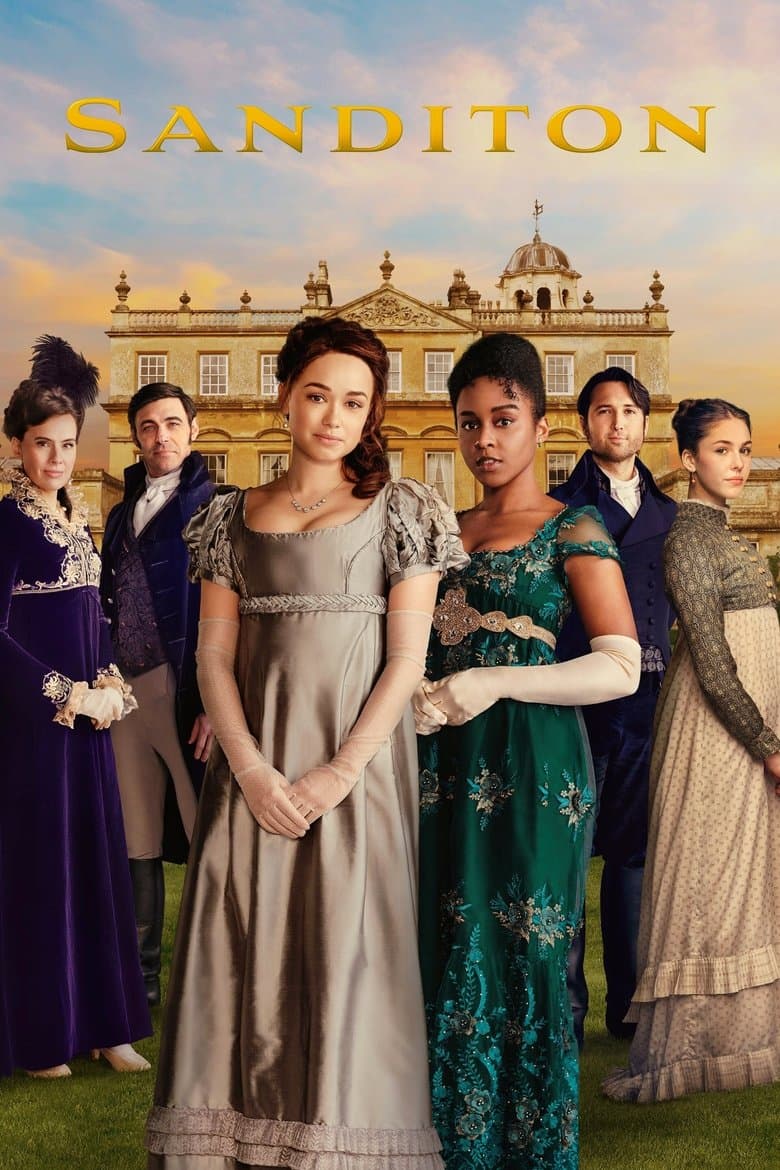
Started August 25, 2019 · Ended · Based on 3 seasons, 20 episodes through April 23, 2023 · TV-14 · 46 min
Sanditon follows Charlotte Heywood, a bold young woman from the countryside who visits a small seaside town trying to become a fashionable resort. She meets ambitious builders, wealthy families, soldiers, artists, and people searching for love. Charlotte resists the idea that marriage should decide her future, but she keeps getting pulled into difficult romances. The show mixes humor, gossip, danger, romance, and serious family troubles across three Regency-era seasons.
The show gives a large story to Georgiana Lambe, a mixed-race heiress whose wealth comes from a plantation and slavery. She faces racist treatment, leads a sugar boycott, and later fights in court to keep her fortune and control her own life. Charlotte repeatedly challenges men who expect women to be quiet, dependent, or focused only on marriage, and the town later supports a school for boys and girls. In the final season, Arthur Parker discovers that he loves Lord Montrose, so the show adds a clear gay romance to its continuing stories about love, freedom, race, and social rules.
Community feedback
Was our 53% Woke rating accurate?
Breakdown
These are the editorial factors and ratings behind our score for Sanditon.
Woke representation / casting
The show gives Georgiana Lambe, a mixed-race West Indian heiress, a major role across all three seasons. The show also places the Black abolitionist Otis Molyneux in a major Season 1 romance. Both roles have story reasons tied to their backgrounds, and Georgiana’s place in Austen’s fragment is not a race swap. The repeated identity-visible casting is noticeable, but the show does not build a broad one-of-each group.
18%
Woke political dialogue
Season 1 includes Otis speaking at an abolitionist meeting about freedom for enslaved people. Season 2 gives Georgiana a repeated sugar boycott plot and direct speeches against slavery. Season 3 uses her court case to link her fortune to slavery and to challenge racist claims about her mother. The language is direct and returns across the show, but it stays in the historical abolition story instead of turning into present-day politics.
29%
Identity-driven story themes
Georgiana’s race, family history, and inherited wealth remain important from the first season through the finale. Her plot asks who gets freedom, who controls money, and how a mixed-race woman is treated by Regency society. Season 3 adds Arthur’s same-sex love story with Lord Montrose and presents it as a real romance. These are recurring and visible side stories, while Charlotte’s romance and Sanditon’s business plans remain the main focus.
49%
Western institutional / cultural critique
Charlotte repeatedly rejects the idea that a woman should marry, stay quiet, or learn only domestic skills. Season 2 presents a man who says girls need manners rather than education, while Charlotte teaches the girls reading and science. The final season supports a school for boys and girls and has women choose work, independence, or love on their own terms. The show also criticizes men who treat women as property, but it does not make a broad attack on Christianity or every Western institution.
34%
Woke character or canon changes
The show expands Austen’s unmarried Arthur Parker into a man who realizes he is gay. Austen’s fragment does not state that Arthur has same-sex desire. Season 2 hints at this through his strong bond with Charles Lockhart. Season 3 makes it explicit through his feelings for Lord Harry Montrose, and the writers described the romance as intentional. Most other changes continue the unfinished Austen plot rather than changing a known character’s identity.
43%
Anti-woke backlash and complaints
A few small X accounts called Sanditon insufferably woke or box-ticking. They complained about the racially mixed Regency setting, Georgiana’s casting, the slavery storyline, and women speaking in modern-sounding ways. One post made an unsupported claim about a trans child, which the show does not confirm. The reaction was fringe, and no organized boycott, review-bombing, or sustained large-account campaign appeared.
15%
Creator track record context
Andrew Davies and Jane Austen have low woke scores and no clear identity-politics record. The directors and script supervisor have no recorded activist creative pattern. Theo James has sustained UNHCR refugee work, which is humanitarian support rather than title-specific activism. This context gives the factor only a small positive signal.
10%
Production
TV Show · 2021
Follow the Dutton family as they embark on a journey west through the Great Plains toward the last bastion of untamed America.
TV Show · 2025
Tells the story of the ascent of the biblical figure, David, who becomes the most celebrated king of Israel. The series follows the once-mighty King Saul as he falls victim to his…

TV Show · 2026
Rip Wheeler and Beth Dutton gamble everything on a new life in South Texas, but the promise of building a future far from the ghosts of Yellowstone quickly collides with brutal…
TV Show · 2016
The love story of young Countess Natasha Rostova and Count Pierre Bezukhov is interwoven with the Great Patriotic War of 1812 against Napoleon's invading army.

TV Show · 2022
This sweeping saga chronicles the hopes and dreams of a Korean immigrant family across four generations as they leave their homeland in an indomitable quest to survive and thrive.
TV Show · 2020
A wary CIA officer investigates a charismatic man who sparks a spiritual movement and stirs political unrest. Who exactly is he? And what does he want?

TV Show · 2019
The true story of one of the worst man-made catastrophes in history: the catastrophic nuclear accident at Chernobyl.
TV Show · 2019
In the 1960s, Israeli clerk-turned-secret agent Eli Cohen goes deep undercover inside Syria on a perilous, years-long mission to spy for Mossad.
