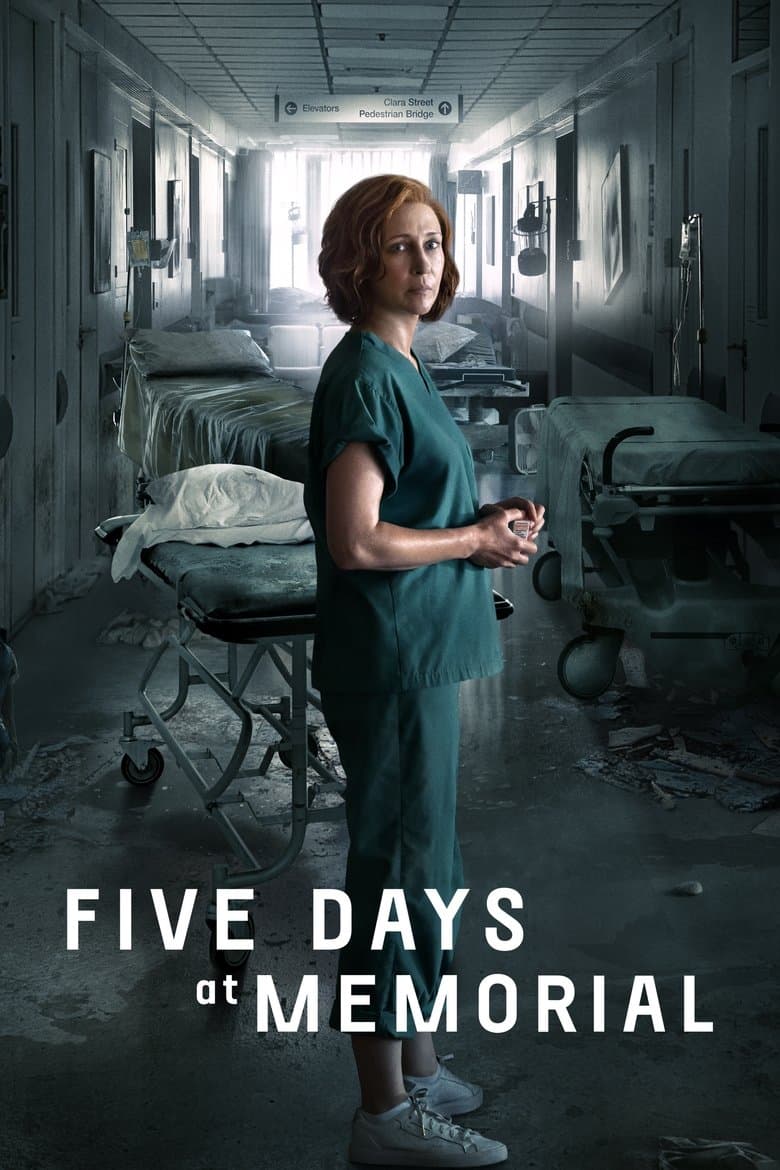
Started August 11, 2022 · Ended · Based on 1 season, 8 episodes through September 15, 2022 · TV-MA
Dr. Anna Pou leads a team of doctors and nurses inside Memorial Medical Center in New Orleans. Hurricane Katrina floods the city, cuts the hospital from help, and leaves about 2,000 people trapped without power or clean water. The staff must move patients, ration care, and decide what to do when rescue does not come. The tone is bleak, tense, and deeply serious.
The series also raises race and class questions through Dr. Bryant King, the hospital’s black doctor. He fears that Black patients could be treated as less worth saving, while mostly Black residents outside are turned away and blamed through rumors of violence. The hospital’s corporate owner, weak planning, and failed government response are shown as causes that leave workers and patients without help. These ideas return across the season, but medical ethics, survival, and the disputed deaths remain the main focus.
Community feedback
Was our 46% Woke rating accurate?
Breakdown
These are the editorial factors and ratings behind our score for Five Days at Memorial.
Woke representation / casting
Not present. The main characters are based on real New Orleans doctors and nurses, and the cast does not show a clear identity mismatch. The women leaders and Black staff fit the real setting and story.
0%
Woke political dialogue
Dr. Bryant King repeatedly talks about how Black patients may be treated during the crisis. Staff members repeat racist rumors about Black residents outside the hospital, and King challenges that view. Investigators and hospital staff also discuss government failure, medical rules, and who deserves scarce help. The dialogue stays tied to the real disaster and the ethics case instead of becoming a constant activist speech.
33%
Identity-driven story themes
Race and class shape who can reach the hospital, who is turned away, and who fears being left behind. Dr. Bryant King serves as the main Black viewpoint and asks whether Black patients will be selected first for death. The show connects the crisis to unequal care and the way poor Black residents were treated after Katrina. The main story still centers on patient sorting, death, and medical ethics, so the identity theme is important but not dominant.
35%
Western institutional / cultural critique
The hospital is shown as part of a profit-driven company that lacks a safe evacuation plan. The city, state, and federal response fail to reach people for days. The later investigation also asks whether the system made doctors into scapegoats for wider failures. These points recur across the season, although the show treats them as part of a real disaster rather than a broad attack on Western culture.
45%
Woke character or canon changes
Not relevant. The series adapts Sheri Fink’s nonfiction account, but no confirmed woke or identity-driven rewrite of a real figure or event is evident.
0%
Anti-woke backlash and complaints
One MacRumors commenter called the series left-biased. A reply used the word woke while arguing that the show was not controversial. Wider discussion focused on accuracy, Katrina trauma, and the medical ethics case. The anti-woke reaction was isolated and weak.
8%
Creator track record context
John Ridley has a strong record of stories about race, inequality, and representation. Carlton Cuse has little documented activist or identity-focused work. Sheri Fink’s work centers on health crises and institutional accountability more than identity politics. The other listed crew have mostly low or mixed records. Ridley is the main creator-track-record signal, while the full team is mixed.
42%
Production
TV Show · 2023
The story of Bass Reeves, the legendary lawman of the wild West, is brought to life. Reeves worked in the post-Reconstruction era as a federal peace officer in the Indian…

TV Show · 2024
In Japan in the year 1600, at the dawn of a century-defining civil war, Lord Yoshii Toranaga is fighting for his life as his enemies on the Council of Regents unite against him…
TV Show · 2024
The powerful real-life story of Lali Sokolov, a Jewish prisoner who was tasked with tattooing ID numbers on prisoners' arms in the Auschwitz-Birkenau concentration camp during…

TV Show · 2024
Fascinated by cars since childhood, Brazilian racer Ayrton Senna became a sports legend — until tragedy struck, changing Formula 1 forever.
TV Show · 2019
The true story of one of the worst man-made catastrophes in history: the catastrophic nuclear accident at Chernobyl.
TV Show · 2021
Follow the Dutton family as they embark on a journey west through the Great Plains toward the last bastion of untamed America.
TV Show · 2026
Rip Wheeler and Beth Dutton gamble everything on a new life in South Texas, but the promise of building a future far from the ghosts of Yellowstone quickly collides with brutal…
TV Show · 2021
Inspired by the true story of Marty and the therapist who turned his life around...then took it over. When he first meets Dr. Ike, Marty just wants to get better at boundaries.
