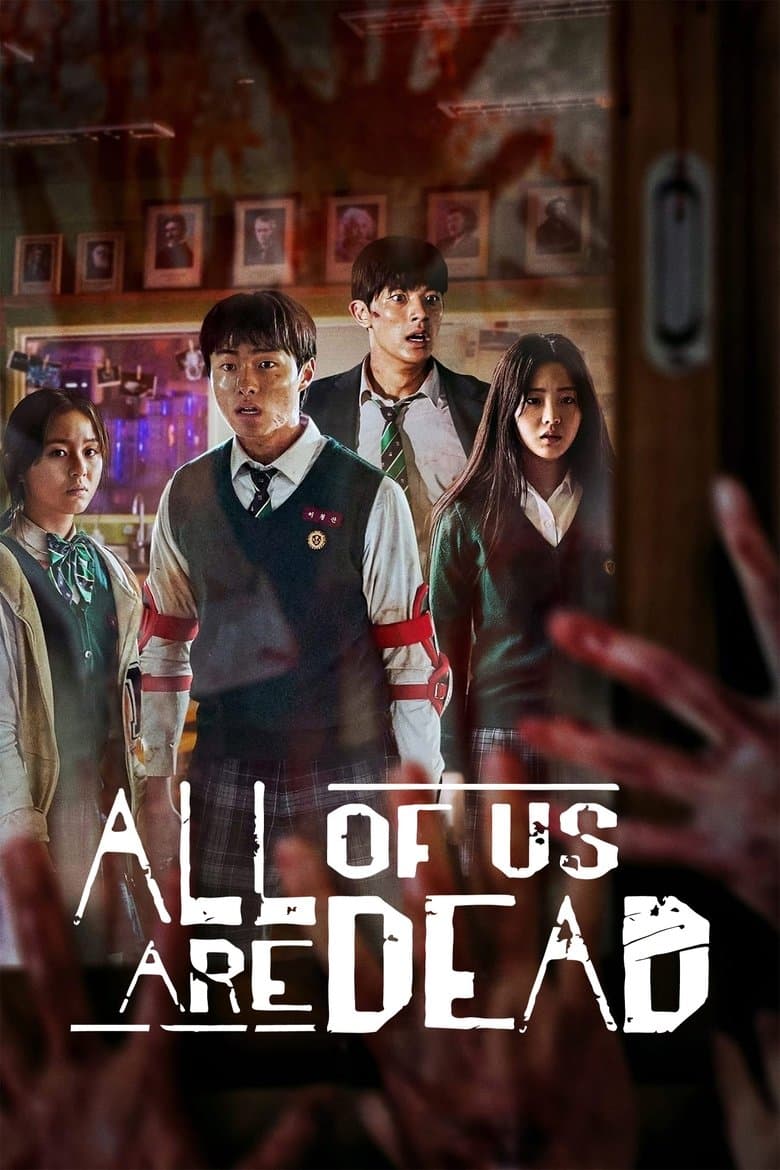
Started January 28, 2022 · Returning Series · Based on 1 season, 12 episodes through January 28, 2022 · TV-MA · 65 min · Korean
All of Us Are Dead follows Nam On-jo and her classmates after a science teacher’s experiment turns Hyosan High School into the center of a zombie outbreak. The students are trapped in classrooms, halls, and rooftops while the infection spreads through the school and the nearby city. On-jo tries to keep her friends together, while Lee Cheong-san, Lee Su-hyeok, Choi Nam-ra, and other students fight to escape. The show mixes fast zombie attacks with teen romance, grief, bullying, and harsh violence. The tone is tense, sad, and sometimes funny.
The season makes school bullying and adult failure a major part of the zombie story. A bullied boy’s father creates the virus because he wants his son to become strong enough to fight back. The story also shows sexual blackmail, class prejudice against a student from a welfare family, a pregnant student, and fear caused by hidden videos. Several girls hold important roles as fighters, archers, and leaders, while boys also lead, plan, and sacrifice themselves. The main message is that cruelty and neglect can spread through a group, while friendship and sacrifice can still save people.
Community feedback
Was our 30% Woke rating accurate?
Breakdown
These are the editorial factors and ratings behind our score for All of Us Are Dead.
Woke representation / casting
Not present. The main cast is Korean students in a South Korean high school, so the cast fits the story world. The season does not frame its casting as a diversity or identity statement.
0%
Woke political dialogue
A few lines use broad activist-style language about a violent system and people being ignored. A father says that a nobody cannot change the system after his son is bullied. The season also has arguments about government control, media, and martial law. These lines are brief and general, and they do not push gender, DEI, queer, or modern identity politics.
15%
Identity-driven story themes
School bullying drives the virus plot and returns throughout the season. The story also follows sexual blackmail, class shame toward a welfare family, teenage pregnancy, and adults who ignore children. Several girls become important fighters or leaders, including the archer Ha-ri, the tough Mi-jin, the rescue-trained On-jo, and the half-zombie class president Nam-ra. These themes make social harm and group responsibility central, but the season does not focus on race, queer identity, or a DEI program.
45%
Western institutional / cultural critique
The season repeatedly shows school leaders, police, military officers, and government officials failing to protect students. A father says that people ignored violence until it grew into a larger disaster. The story also shows a government cutting off phones and bombing the city. This is mainly a Korean crisis story, and it does not attack Christianity, family life, or traditional relationships.
18%
Woke character or canon changes
Not relevant. The TV version changes the virus origin, timing, and some character details from the webtoon. Those changes are story changes, not race, gender, sexuality, or identity changes.
0%
Anti-woke backlash and complaints
Not present. Viewers and news reports criticized graphic bullying, sexual assault scenes, teen pregnancy, missing trigger warnings, and uneven story choices. Those complaints did not say the show was pushing woke, DEI, or identity politics.
0%
Creator track record context
Chun Sung-il and Kim Nam-su have no clear public activist or DEI record. JQ Lee has discussed bullying, social violence, hierarchy, sexual exploitation, and institutional failure as drama subjects. The listed producers also have no clear identity-first public profile. The available creator records place most of these people at 0, with JQ Lee at 10, so the track record signal is very low.
5%
Production
TV Show · 2023
After the party of heroes defeated the Demon King, they restored peace to the land and returned to lives of solitude.
TV Show · 2023
After washing ashore in France, Daryl struggles to piece together how he got there and why, as he navigates a fractured, walker-infested landscape to find his way home.
TV Show · 2019
A grim drama that unfolds against the backdrop of a global catastrophe. An unknown new virus turns Moscow into a city of the dead.
TV Show · 2017
Located in the center of a remote island, the Abyss is the last unexplored region, a huge and treacherous fathomless hole inhabited by strange creatures where only the bravest…
TV Show · 2022
Navy SEAL Commander James Reece turns to vengeance as he investigates the mysterious forces behind the murder of his entire platoon.
TV Show · 2022
With the aid of unexpected friends, a gifted but introverted student confronts bullies and violent foes — unaware of how dangerous his world will become.
TV Show · 2023
At the brink of going to hell, Yee-jae must cycle through twelve separate lives and twelve separate deaths in this reincarnation drama.

TV Show · 2022
A powerful sorceress in a blind woman's body encounters a man from a prestigious family, who wants her help to change his destiny.
