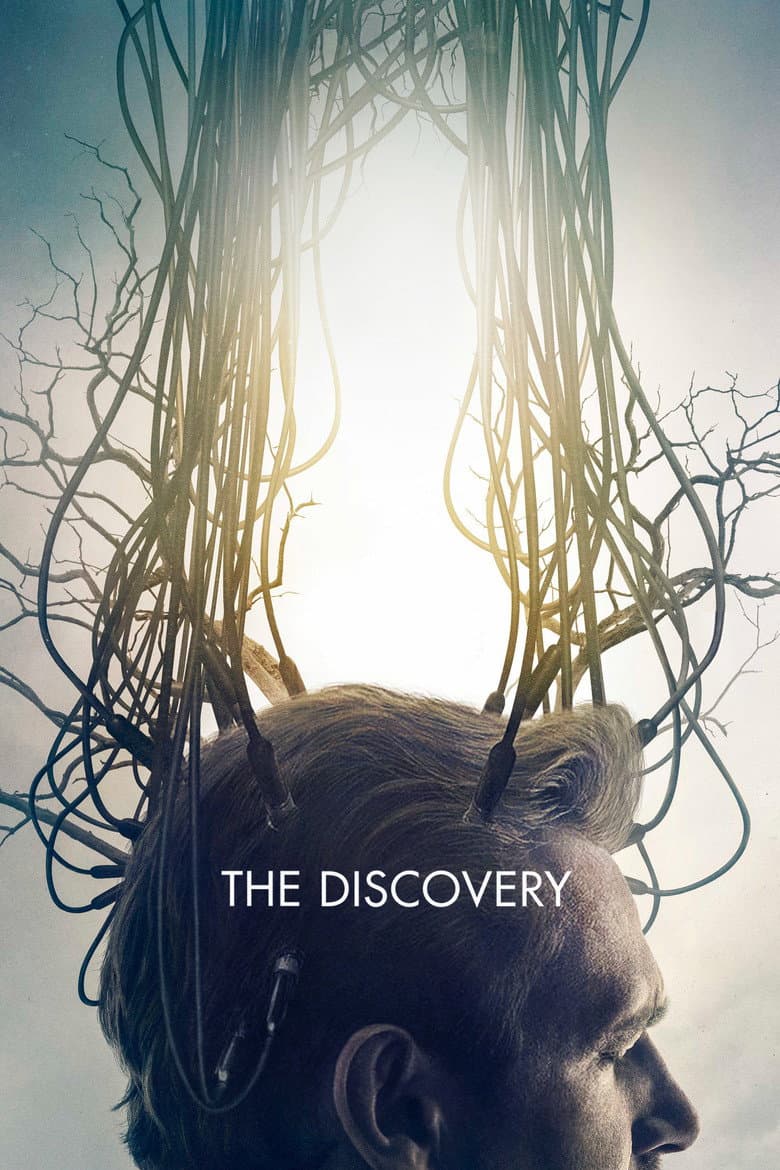
Movie review
March 31, 2017 · 102 min · R · Sci-Fi · Mystery · Thriller · Romance · Drama
The Discovery takes place in a near future after scientist Thomas Harbor proves that an afterlife exists. Millions of people kill themselves because they want to reach the next life, and society struggles to keep going. Harbor's son Will returns to his father's isolated home and meets Isla, a troubled woman tied to the discovery. The film has a quiet, gray, uneasy tone that mixes science fiction, romance, family drama, and mystery.
Will doubts his father's work, but he joins Isla and the other followers to learn what the machines show after death. The main conflict follows Will's guilt over past loss and his wish to save someone he loves. The story treats the afterlife as a strange cycle of other lives and possible second chances instead of a clear heaven or hell. Its main ideas concern suicide, regret, memory, forgiveness, family pain, and the choice to live in the present, while the final twists keep the meaning uncertain.
Community feedback
Was our 4% Woke rating accurate?
Breakdown
These are the editorial factors and ratings behind our score for The Discovery.
Woke representation / casting
Not present. The main cast uses a normal mix of white and black actors for an unnamed near-future American setting. The film does not make race, gender, or identity part of its casting message.
0%
Woke political dialogue
Not present. The dialogue asks whether death changes the meaning of suicide, murder, and regret. It does not include modern identity, gender-role, DEI, or activist lines.
0%
Identity-driven story themes
Not present. The story follows Will's guilt, his love for Isla, and the search for meaning after death. It does not center race, sexuality, gender politics, or modern group conflict.
0%
Western institutional / cultural critique
Not present. The film shows a scientist, his followers, and a society changed by his discovery. It does not attack Western institutions, family life, religion, or traditional social rules through modern activist messaging.
0%
Woke character or canon changes
Not relevant. The film uses original characters and does not change an established character, source, or real historical event.
0%
Anti-woke backlash and complaints
Not present. The supplied X research found no anti-woke reaction. Other audience discussion focused on the ending, pacing, suicide, and afterlife ideas rather than woke or DEI claims.
0%
Creator track record context
Charlie McDowell has a cached score of 41 and a liberal Hollywood family background, but his work is mainly philosophical and relational. Justin Lader has a cached score of 0 and is linked to high-concept genre stories. Alex Orlovsky has a cached score of 29, while James D. Stern has a cached score of 18. These backgrounds add mild context, but they do not show an activist purpose in this movie.
22%
Production
Movie · 2017
Verena is a nurse who arrives at an old mansion in Italy to help a young boy who has fallen silent since the sudden passing of his mother.
Movie · 2017
Dr. Steven Murphy is a renowned cardiovascular surgeon who presides over a spotless household with his wife and two children.
Movie · 2017
Paul is a down-on-his-luck screenwriter who picks up a drifter and offers him a place to stay. However, when the deranged stranger takes Paul hostage and forces him to write…
Movie · 2021
A truffle hunter who lives alone in the Oregon wilderness must visit Portland to find the mysterious person who stole his beloved foraging pig.
Movie · 2022
After surviving a car accident that took the life of her boyfriend, a teenage girl believes he's attempting to reconnect with her from the after world.
Movie · 2022
A well-to-do husband who allows his wife to have affairs in order to avoid a divorce becomes a prime suspect in the disappearance of her lovers.
Movie · 2021
A couple fights to hold their relationship together as a memory loss virus spreads and threatens to erase the history of their love and courtship.
Movie · 2018
In 1984, a young programmer begins to question reality as he adapts a dark fantasy novel into a video game. A mind-bending tale with multiple endings.
