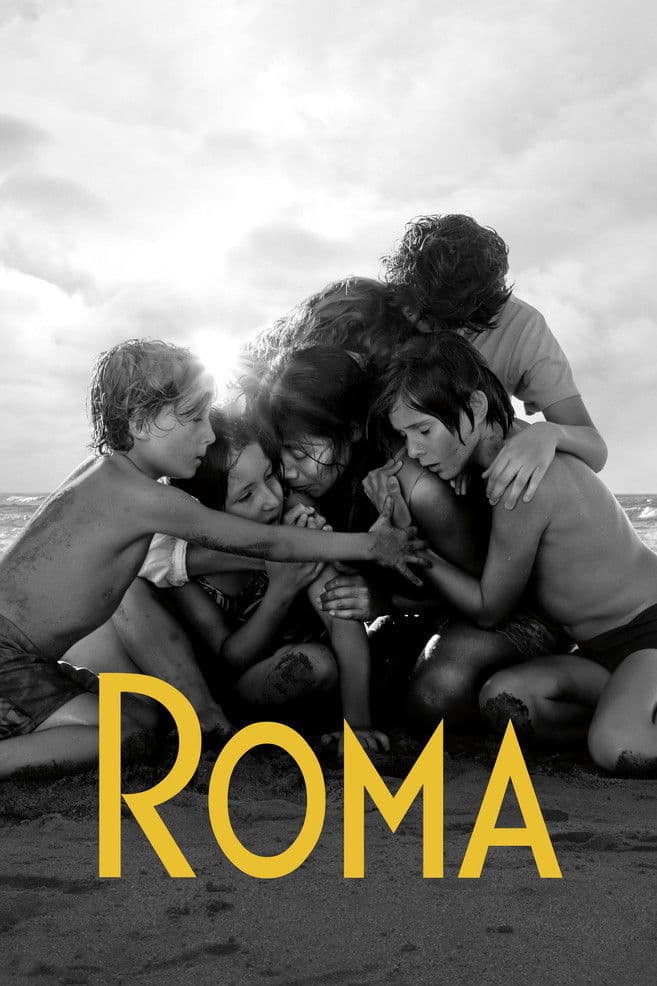
Roma follows Cleo, a young Mixtec woman who works as a live-in maid for a middle-class family in Mexico City. Cleo cooks, cleans, and cares for four children while her own life changes after her boyfriend abandons her when she becomes pregnant. The family also faces the father’s affair and departure, while student protests and a government massacre disturb the city around them. The black-and-white drama moves slowly and quietly, but it builds toward grief, danger, and a strong bond between Cleo and the children.
The film puts an Indigenous domestic worker at the center and gives her private pain, language, and family ties serious attention. It repeatedly contrasts the comfort of the employers with Cleo’s low-paid work, limited freedom, and place inside their home. Women carry most of the care and emotional work, while the key men leave, lie, or threaten violence. These identity and class themes shape the whole story, but the film presents them through personal events and historical detail rather than speeches about modern politics.
Community feedback
Was our 38% Woke rating accurate?
Breakdown
These are the editorial factors and ratings behind our score for Roma.
Woke representation / casting
Not present. Cleo and Adela are Indigenous Mixtec women, and their language fits their background and setting. Cuarón said he cast Cleo to resemble the real woman who inspired her. The casting does not add a broad, out-of-place diversity pattern beyond the story’s own world.
0%
Woke political dialogue
Not present. The film includes news and brief talk about unrest, but no character gives modern identity, DEI, or activist lines. The dialogue stays focused on family life, work, pregnancy, and the period’s events.
0%
Identity-driven story themes
The story follows Cleo, an Indigenous Mixtec woman whose work and pregnancy shape the main plot. The film keeps showing the gap between the family’s comfort and Cleo’s low-paid domestic work. Cleo and Sofía face abandonment and loss while they care for children and support each other. The story treats race, class, and women’s unseen work as linked parts of daily life. The film presents these ideas through personal and historical events instead of a modern activist speech.
48%
Western institutional / cultural critique
The story shows Antonio leaving Sofía and Fermín abandoning and threatening Cleo. The women carry the care work and keep the household going after the men leave. The film makes those male choices look harmful, but it does not turn them into a modern attack on patriarchy, Christianity, or Western institutions. The political violence comes from the real Mexican government crackdown of the period and is not framed as a current culture-war argument.
18%
Woke character or canon changes
Not relevant. The film is a personal story based on Cuarón’s childhood, not a remake that changes an established character’s race, gender, or sexuality. No established character is changed for identity reasons.
0%
Anti-woke backlash and complaints
A few small X accounts called Roma woke propaganda or linked Yalitza Aparicio’s Oscar attention to inclusion. One small post mocked Cuarón for saying the film exposed Mexican racism. These claims had almost no engagement and did not produce a boycott or review-bombing campaign. Wider coverage focused on Netflix’s release and debate about how the film portrays Cleo, not on anti-woke complaints.
10%
Creator track record context
Cuarón has a moderate record of films that examine social problems and vulnerable people. Jeff Skoll has a strong cause-driven record through Participant Media, and Nicolás Celis often backs films about inequality, violence, and Indigenous communities. David Linde has a milder issue-film background, while Jonathan King, Gabriela Rodríguez, and Natalia Moguel have little known political or activist history. Roma matches the social concerns of Cuarón, Skoll, and Celis, but the film remains a personal drama rather than a direct activist campaign.
36%
Production

Movie · 2024
On the brink of the Second World War, a young Norwegian man's drive to resist the Nazis sets a new course for his future – and the future of his country.

Movie · 2016
WWII American Army Medic Desmond T. Doss, who served during the Battle of Okinawa, refuses to kill people and becomes the first Conscientious Objector in American history to…

Movie · 2023
The true story of the inseparable Von Erich brothers, who made history in the intensely competitive world of professional wrestling in the early 1980s.
Movie · 2025
A logger leads a life of quiet grace as he experiences love and loss during an era of monumental change in early 20th-century America.

Movie · 2016
After his older brother passes away, Lee Chandler is forced to return home to care for his 16-year-old nephew.
Movie · 2016
On 15 January 2009, the world witnessed the 'Miracle on the Hudson' when Captain 'Sully' Sullenberger glided his disabled plane onto the Hudson River, saving the lives of all 155…

Movie · 2019
Richard Jewell thinks quick, works fast, and saves hundreds, perhaps thousands, of lives after a domestic terrorist plants several pipe bombs and they explode during a concert…

Movie · 2017
Members of the Granite Mountain Hotshots battle deadly wildfires to save an Arizona town.
