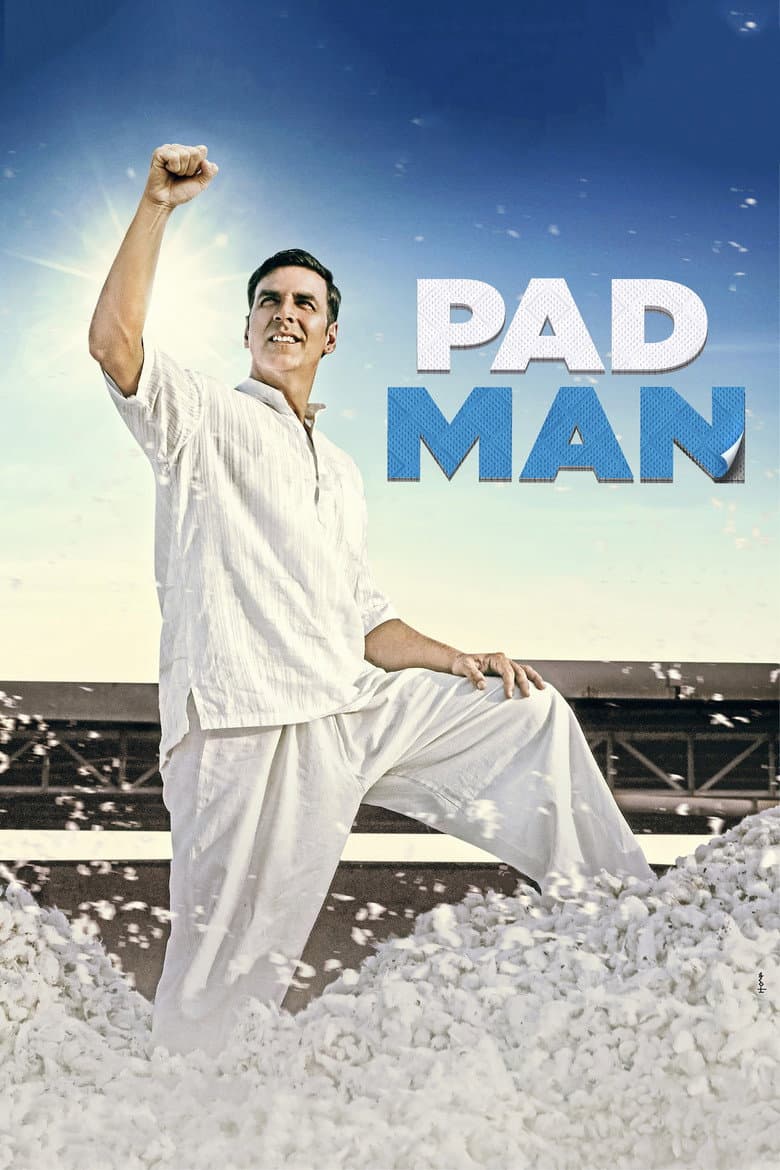
Pad Man follows Lakshmikant Chauhan, a loving but stubborn welder in a small Indian village who wants to protect his wife, Gayatri. He learns that she uses old cloth during her period because store-bought pads cost too much. He builds one cheap pad after another, tests them with animal blood, and faces shame, anger, and rejection from his family and neighbors. The comedy drama turns his lonely project into a hopeful fight to help rural women live with better health and less fear.
The film makes menstrual health, bodily dignity, and the breaking of old taboos its main social message. It shows women being kept away from kitchens, temples, and daily life, while men are told that periods are not their concern. Lakshmi's speeches and the final public address say that a good man should stand with women, and the story praises open talk over shame. The message is repeated through the invention, the women-led sales work, and the happy ending, although Lakshmi remains the main hero and the film sometimes treats him as a savior.
Community feedback
Was our 70% Woke rating accurate?
Breakdown
These are the editorial factors and ratings behind our score for Pad Man.
Woke representation / casting
The lead casting replaces the real Tamil inventor with Akshay Kumar playing a Hindi-speaking central Indian man. That change is visible in the main heroic role and moves the character away from his real regional identity. The film does not present the choice as a diversity campaign, and the movie’s own setting makes the cast plausible, so the signal is weak.
18%
Woke political dialogue
The dialogue repeatedly says that men should speak about menstruation and help women. The title song presents strong women as a source of national strength. Lakshmi calls protecting women part of being a man, and the final public speech repeats the message of dignity over shame. The lines are tied to the film’s health problem rather than to party politics, but the gender message is hard to miss.
45%
Identity-driven story themes
The film makes women’s menstrual health and access to cheap pads its central conflict. It shows shame, isolation, dirty cloth, and lack of money as problems that women should not have to accept. The story praises women who use, make, and sell pads, while it asks men to reject silence and old rules. Lakshmi remains the main hero, so the film uses a male rescuer to carry a strong women’s-dignity message rather than centering a wider identity movement.
64%
Western institutional / cultural critique
The film repeatedly treats village rules about menstruation as harmful. The family and neighbors shame Lakshmi for entering a women’s issue and keep women away from normal home life during their periods. The story also mocks the idea that men should only earn money while women stay silent. The criticism is aimed at local customs and gender roles, not at Western institutions, Christianity, or a broad economic system.
38%
Woke character or canon changes
The film changes the real inventor Arunachalam Muruganantham into Lakshmikant Chauhan, a Hindi-speaking man in central India. This identity change is visible because the real story came from Tamil Nadu and the film gives him a different regional background. The change supports a commercial Hindi adaptation, not a diversity or activist statement, so the signal is limited.
18%
Anti-woke backlash and complaints
A few small X accounts called Akshay a feminist or treated the movie as feminist propaganda. A few Reddit posts used similar anti-feminist or anti-male language. The comments did not lead to a boycott, review-bomb, large-account campaign, or sustained news cycle. Other right-leaning posts praised the film as a real-life story rather than propaganda, which points against a major anti-woke fight.
22%
Creator track record context
Twinkle Khanna’s public work centers on feminism and menstrual hygiene. Gauri Shinde often centers women’s dignity, independence, and emotional needs. R. Balki and Swanand Kirkire also have repeated social themes, but their work is mostly mainstream entertainment and not tied to a party movement. The other listed producers and casting director add less direct activist context, so the overall creator signal is moderate rather than dominant.
54%
Production
Movie · 2023
A curmudgeonly instructor at a New England prep school is forced to remain on campus during Christmas break to babysit the handful of students with nowhere to go.
Movie · 2016
Two high school girls are best friends until one dates the other's older brother, who is totally his sister's nemesis.
Movie · 2024
In 2008, during the last month of summer before high school begins, an impressionable 13-year-old Taiwanese American boy learns what his family can't teach him: how to skate, how…
Movie · 2024
When a construction worker unexpectedly joins a local theater's production of Romeo and Juliet alongside his estranged teenage daughter, the drama onstage starts to mirror his own…

Movie · 2019
An unlikely friendship between two neighbors becomes an unexpectedly emotional journey when the younger man is diagnosed with terminal cancer.
Movie · 2022
Maurice Flitcroft, a dreamer and unrelenting optimist, managed to gain entry to The British Open Golf Championship qualifying in 1976 and subsequently shot the worst round in Open…
Movie · 2018
Vignettes weaving together the stories of six individuals in the old West at the end of the Civil War. Following the tales of a sharp-shooting songster, a wannabe bank robber, two…
Movie · 2017
Brigsby Bear Adventures is a children's TV show produced for an audience of one: James. When the show abruptly ends, James's life changes forever, and he sets out to finish the…
