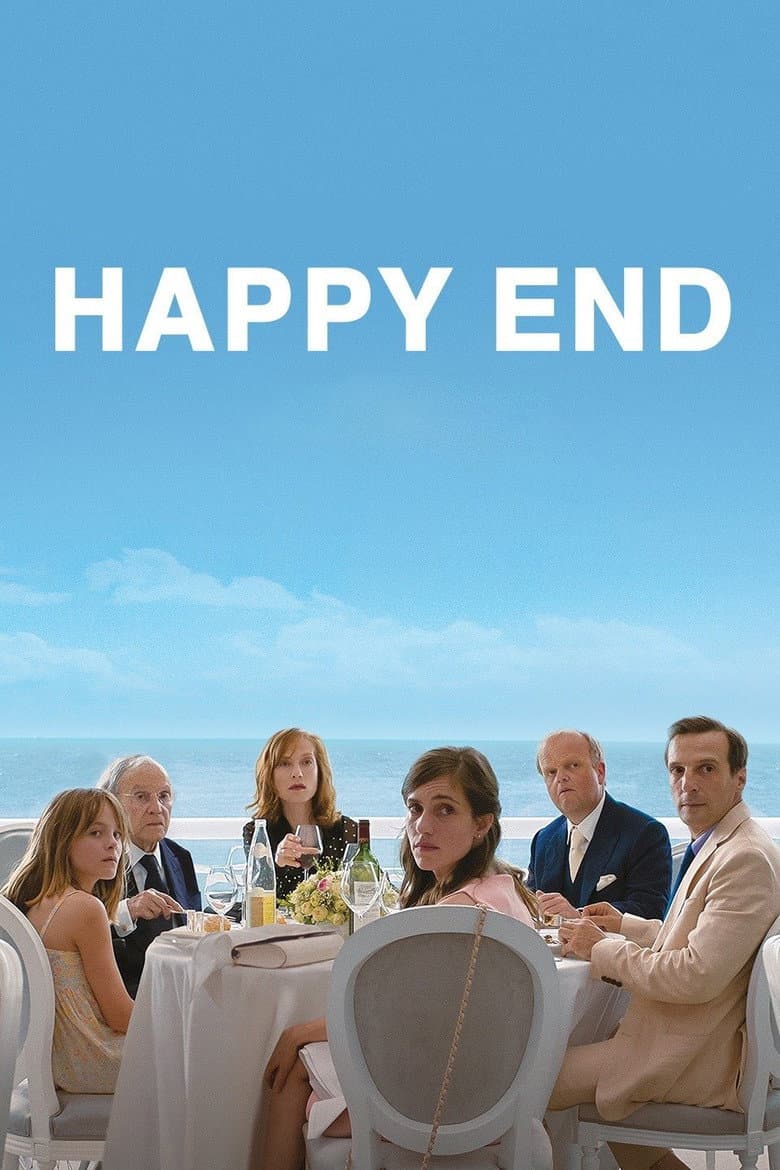
Happy End follows Eve, a quiet teenage girl who moves into her wealthy father's family home in Calais, France. Anne runs the family building company while her father Georges grows tired of life, her son Pierre drinks and fails at work, and her brother Thomas hides an affair. Eve studies the adults with her phone after her mother overdoses, while accidents and family secrets spread through the house. The film uses a cold, darkly funny tone as family shame, illness, and death gather around the family.
The story keeps the nearby refugee camp in view and places African migrants at the family's engagement party. Pierre describes one man's loss and journey, but he uses the meeting mainly to attack his mother, while the family tries to hide its embarrassment. A party discussion also argues about women's share of management jobs and compulsory quotas. These moments make the film's criticism of rich Western comfort, migrant suffering, and social indifference easy to notice, but the family drama and its focus on phone use, cruelty, and death remain larger.
Community feedback
Was our 56% Woke rating accurate?
Breakdown
These are the editorial factors and ratings behind our score for Happy End.
Woke representation / casting
Not present. The main family is white French, and the North African staff and African migrants fit the Calais setting and story. Anne runs the family company, but the film does not frame her gender as a diversity message.
0%
Woke political dialogue
The party includes a debate about women holding few management jobs and compulsory quotas. Pierre gives the guests a short account of an African migrant's family loss and journey to Calais. Other guests mention black people, Islam, and possible terrorists while they keep talking about ordinary comforts. The film puts these lines in one late party scene, and no repeated political speech drives the plot.
30%
Identity-driven story themes
The film keeps the Calais refugee crisis near the family's home. The story shows African migrants waiting, walking, and being ignored before Pierre brings them to a rich family's party. The film sets their suffering against the family's comfort and silence. The theme matters to the ending, but the movie spends more time on poison, affairs, business trouble, and suicide.
46%
Western institutional / cultural critique
The film repeatedly criticizes the rich family's indifference to suffering outside its home. The building company protects itself after a worker is badly hurt, while lawyers use money and legal pressure. Party guests worry about black migrants and Islam, then return to luxury and small talk. The story connects this comfort to a wider Western failure to care, not just to one family's flaws.
57%
Woke character or canon changes
Not relevant. The film uses original characters and does not change a known character, canon, or real historical figure.
0%
Anti-woke backlash and complaints
Not present. The search found no sustained anti-woke or anti-DEI complaint about the film. Public reaction focused on the cold style, loose story, and limited refugee viewpoint.
0%
Creator track record context
Michael Haneke has a long record of stories about class, guilt, violence, media, and social failure. Interviews about this film connect Western apathy toward migrants with colonial history, capitalism, and social media. Margaret Ménégoz has a moderate feminist and representation record. The other listed producers and crew have little public activist record.
55%
Production

Movie · 2019
Richard Jewell thinks quick, works fast, and saves hundreds, perhaps thousands, of lives after a domestic terrorist plants several pipe bombs and they explode during a concert…

Movie · 2023
The story of J. Robert Oppenheimer's role in the development of the atomic bomb during World War II.
Movie · 2016
WWII American Army Medic Desmond T. Doss, who served during the Battle of Okinawa, refuses to kill people and becomes the first Conscientious Objector in American history to…

Movie · 2016
After his older brother passes away, Lee Chandler is forced to return home to care for his 16-year-old nephew.

Movie · 2017
Members of the Granite Mountain Hotshots battle deadly wildfires to save an Arizona town.

Movie · 2022
A quiet, neglected girl is sent away from her dysfunctional family to live with relatives for the summer. She blossoms in their care, but in this house where there are meant to be…

Movie · 2026
While people across 1990s Iraq struggle to survive the war and food shortages, Saddam Hussein requires each school in the country to prepare a cake to celebrate his birthday.

Movie · 2025
Diagnosed with Tourette Syndrome at 15, John Davidson navigates his way against the odds through troubled teenage years and into adulthood, finding inspiration in the kindness of…
