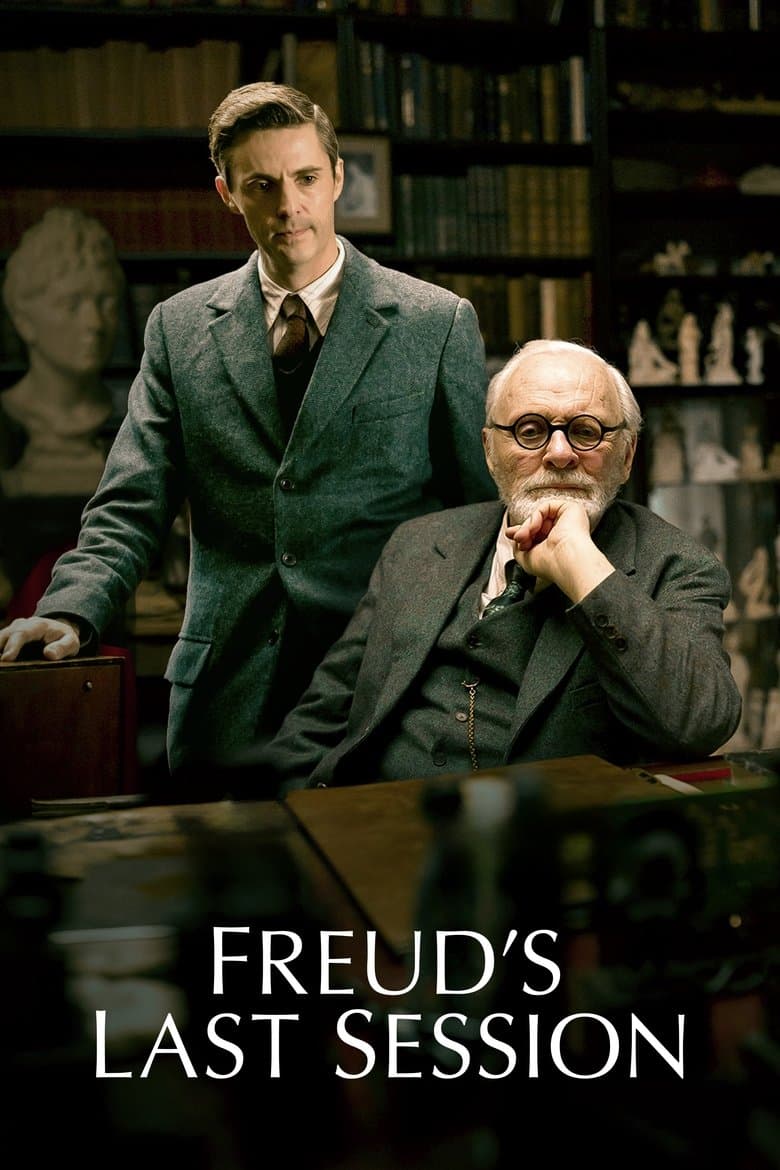
Freud's Last Session takes place in London on the day Britain enters the Second World War in 1939. Sigmund Freud is old, sick with mouth cancer, and firmly opposed to belief in God. C.S. Lewis visits him for an imagined meeting, and the two men spend the day arguing about faith, science, evil, sex, death, and pain. Flashbacks and dream scenes show their childhood wounds, wartime memories, and private fears, so the mood stays serious, tense, and often strange.
The film also follows Freud's adult daughter Anna, who lives and works with Dorothy Burlingham. The film presents Anna and Dorothy as a lesbian couple, while Freud treats Anna's sexuality and her need for Dorothy as problems he should explain or control. This gives the movie a clear identity-driven story thread and a mild critique of a powerful father's control over his daughter. The thread returns several times, but the main story remains the long debate between Freud's atheism and Lewis's Christian faith.
Community feedback
Was our 41% Woke rating accurate?
Breakdown
These are the editorial factors and ratings behind our score for Freud's Last Session.
Woke representation / casting
Not present. The main cast presents historical European figures as white and uses actors of matching gender for them. The film does not use a one-of-each cast or a diversity-first casting message.
0%
Woke political dialogue
The film has a direct argument about homosexuality and sexual morality. Freud says homosexuality is not immoral, while Lewis says sex should be between committed people. The exchange is short and stays inside the larger debate about God.
15%
Identity-driven story themes
The film shows Anna Freud in a romantic relationship with Dorothy Burlingham. Anna's bond with Dorothy returns as she tries to bring Dorothy into her father's life. Freud treats Anna's sexuality as a problem to analyze and tries to pull her back under his control. The subplot is important, but the main story remains the debate between Freud and Lewis.
42%
Western institutional / cultural critique
The film repeatedly shows Freud controlling Anna's work, time, and private life. It presents his effort to explain away her lesbian relationship as harmful paternal pressure. This gives a mild critique of male authority inside a family. The film does not turn that conflict into a broad attack on Western institutions or traditional society.
18%
Woke character or canon changes
The film adds Anna Freud and Dorothy Burlingham as an explicit romantic couple, even though Anna denied a sexual relationship. This changes how real historical people are presented and adds a queer subplot that was not in the stage play. The invented Freud-Lewis meeting is a normal what-if premise. The identity change remains secondary to the main debate.
30%
Anti-woke backlash and complaints
The Gospel Coalition criticized the lesbian subplot and said the film makes Lewis sound like a progressive Christian on sex. A Christian reviewer at 9th Hour called the Anna material a manufactured agenda that weakens the Christian debate. These complaints are clear but come from a small religious audience. Broader reviews mostly discussed pacing, acting, and the uneven adaptation.
25%
Creator track record context
The cached creator record is mostly low. Matt Brown has a low cached score, and his earlier film dealt with racial and colonial barriers. Mark St. Germain has no documented activist profile, while some producers have limited social or environmental credits. Brown's comments about bringing Anna and Dorothy's story forward provide modest identity-related context.
10%
Production
Movie · 2020
A man refuses all assistance from his daughter as he ages and, as he tries to make sense of his changing circumstances, he begins to doubt his loved ones, his own mind and even…
Movie · 2022
A quiet, neglected girl is sent away from her dysfunctional family to live with relatives for the summer. She blossoms in their care, but in this house where there are meant to be…

Movie · 2025
A logger leads a life of quiet grace as he experiences love and loss during an era of monumental change in early 20th-century America.
Movie · 2022
London, 1953. Mr. Williams, a veteran civil servant, is an important cog within the city's bureaucracy as it struggles to rebuild in the aftermath of World War II.

Movie · 2023
The story of J. Robert Oppenheimer's role in the development of the atomic bomb during World War II.

Movie · 2023
The true story of the inseparable Von Erich brothers, who made history in the intensely competitive world of professional wrestling in the early 1980s.

Movie · 2022
Based on a true tragedy, the emotionally triggering film sheds light on the plight of Kashmiri Pandits (Hindus), a religious minority in the 1990s Kashmir valley, who were…

Movie · 2017
Members of the Granite Mountain Hotshots battle deadly wildfires to save an Arizona town.
