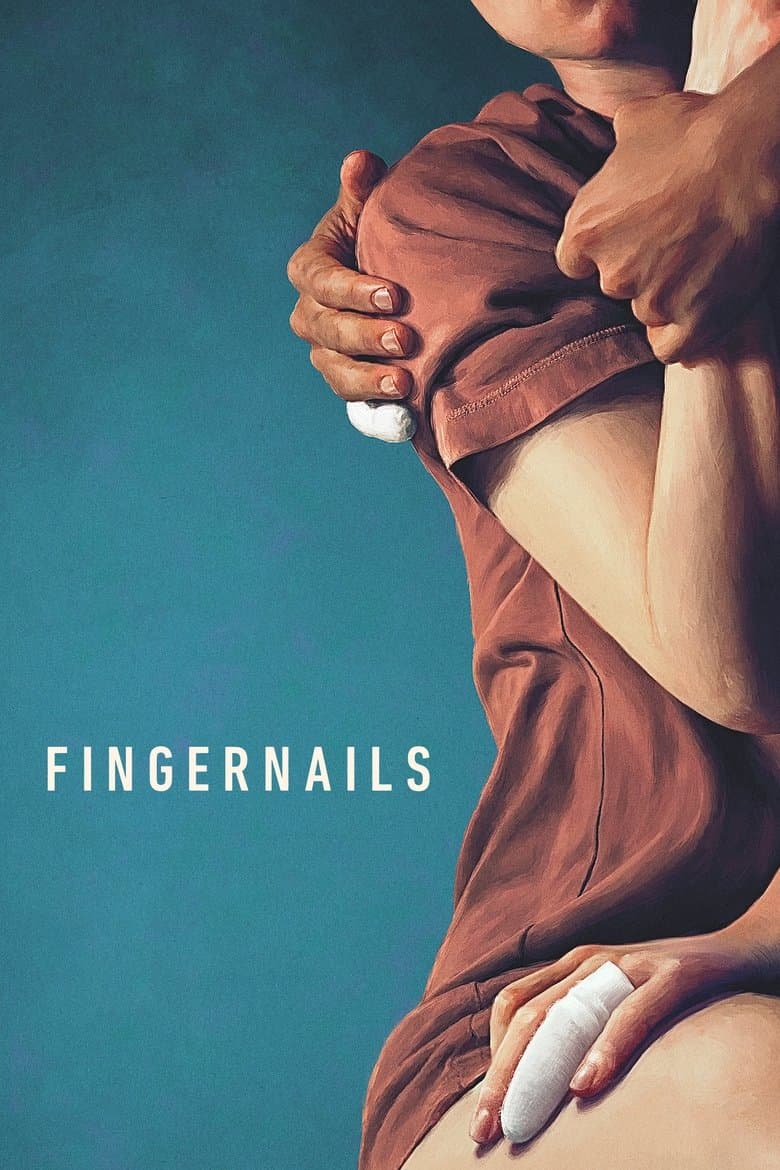
Fingernails takes place in a near future where a painful test claims to prove whether two people are truly in love. Anna and Ryan already have a 100 percent result, but Anna still feels unsure about their relationship. She takes a job at the Love Institute, where she trains couples with Amir and starts to feel close to him. The movie follows her love triangle as she weighs a safe relationship against a new and risky bond. Its tone is quiet, strange, sad, and sometimes darkly funny.
The film shows one same-sex couple among the couples who use the institute, so it has a small LGBTQ representation element. That couple appears briefly and does not control the plot or teach a lesson about identity. The main story questions whether romance can be measured by a machine and whether people should trust their own feelings over pressure from partners, family, and society. Anna’s choice also challenges the idea that one test can prove a person has found the only right partner. The movie treats that challenge as a private love problem rather than a political campaign.
Community feedback
Was our 9% Woke rating accurate?
Breakdown
These are the editorial factors and ratings behind our score for Fingernails.
Woke representation / casting
Not present. The cast includes an interracial romance and one same-sex couple. The film treats these relationships as ordinary parts of its love story and does not frame the cast as a diversity or identity statement.
0%
Woke political dialogue
Not present. The characters discuss love, doubt, testing, and personal choice rather than politics or activism. A brief complaint about changing an old school story does not become a broader identity or political message.
0%
Identity-driven story themes
One same-sex couple appears among the couples who visit the Love Institute. The couple is a brief part of the film and does not lead the conflict or teach a lesson about identity. Anna’s main struggle concerns love, doubt, and a possible affair, not sexuality or group politics.
10%
Western institutional / cultural critique
Not present. The Love Institute and social pressure around the test are treated as a strange relationship problem. The film does not attack Western institutions, capitalism, religion, family life, or traditional gender roles in an activist way.
0%
Woke character or canon changes
Not relevant. The film is an original story rather than an adaptation of a known book, franchise, or real event. No established character or canon is changed.
0%
Anti-woke backlash and complaints
Not present. Audience complaints focus on the slow pace, odd science, cheating, body horror, and unclear ending. No substantial anti-woke backlash about DEI, identity politics, race, gender, sexuality, or activist messaging appears in the reviewed coverage.
0%
Creator track record context
Christos Nikou and the writers have no clear record of activist or DEI work. Producer Coco Francini has strongly supported women, transgender, and non-binary filmmakers. Producer Cate Blanchett and Andrew Upton have milder social-cause links, and casting director Carmen Cuba has some diversity-focused work. Most other listed creators have little public activist record. This is background context, not a clear message in the movie.
20%
Production

Movie · 2024
Remi and Barnes, two very different teenagers, meet by chance in the winter of their senior year, then spend four days together over the course of a year that will change their…

Movie · 2017
Thirty years after the events of the first film, a new blade runner, LAPD Officer K, unearths a long-buried secret that has the potential to plunge what's left of society into…

Movie · 2020
Young musician Zach Sobiech discovers his cancer has spread, leaving him just a few months to live. With limited time, he follows his dream and makes an album, unaware that it…
Movie · 2018
German artist Kurt Barnert has escaped East Germany and now lives in West Germany, but is tormented by his childhood under the Nazis and the GDR regime.

Movie · 2017
A brilliant but impulsive young surgeon spirals into self-destruction after a painful breakup, struggling to cope with love, loss, and the consequences of his own temper.

Movie · 2023
Hadley and Oliver begin falling in love on a flight from New York to London, but when they lose each other at customs, can they defy all odds to reunite?
Movie · 2024
In 1985, the murder of a government-sponsored superhero draws his outlawed colleagues out of retirement and into a mystery that threatens to upend their personal lives and the…
Movie · 2020
At the height of the Cold War, a Soviet spacecraft crash lands after a mission gone awry, leaving the commander as its only survivor.
