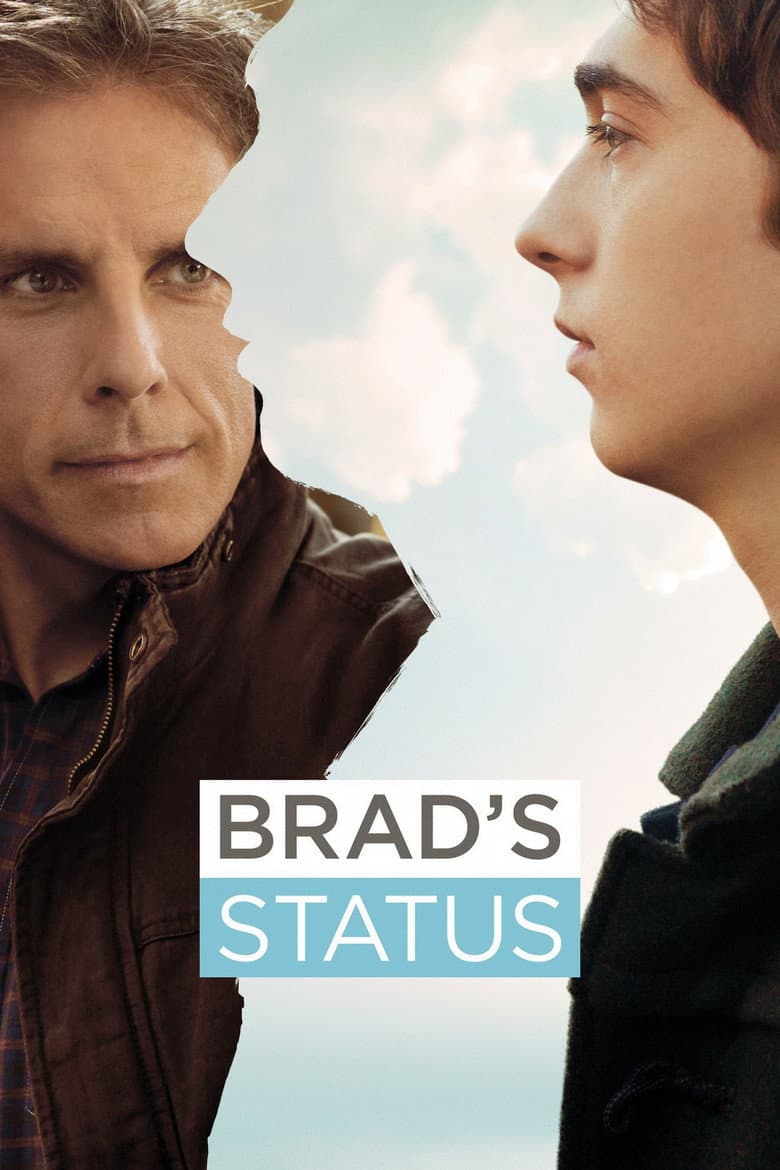
Brad Sloan lives in comfortable suburban Sacramento with his wife, Melanie, and their gifted teenage son, Troy. Brad runs a small nonprofit, but he feels like a failure because his old college friends have more money, fame, and power. A college trip to Boston makes him compare his life with theirs and with the future he wants for Troy. The film uses anxious voice-over, awkward jokes, and sad family moments to show a man facing envy, age, and fear.
The film gives a clear place to modern identity politics during Brad's long talk with Ananya, an Indian American Harvard student. She calls his worries white privilege, male privilege, and first-class problems. She links his race and sex, college competition, colonialism, the oppression of women, and harm to the environment. The film also shows a gay friend marrying his male partner and uses jokes about being cisgender. These ideas are important in one long middle section, but the main story returns to Brad's family, status worries, and need to value his life.
Community feedback
Was our 56% Woke rating accurate?
Breakdown
These are the editorial factors and ratings behind our score for Brad's Status.
Woke representation / casting
The main cast is mostly white and fits a modern American setting. The film gives visible supporting roles to an Indian American Harvard student and an Asian American friend, and it includes a gay married friend. These choices are noticeable, but the film does not frame them as a diversity campaign or use a clear casting mismatch.
18%
Woke political dialogue
Ananya leads a long talk about privilege, class, and social responsibility. She calls Brad's problems white privilege, male privilege, and first-class problems. She links college competition to colonialism, women's oppression, and damage to the environment. Students also organize a protest for need-blind admissions, and a brief joke uses the word cisgender.
49%
Identity-driven story themes
The story asks Brad to face his position as a wealthy white man. Ananya makes race, sex, class, colonialism, and gender part of his moral lesson. The film also shows a gay friend marrying his male partner and treats that relationship as normal. The larger lesson rejects money and status and asks Brad to value family, but the identity lesson remains an important middle section.
55%
Western institutional / cultural critique
The film attacks status competition and the idea that rich people deserve more respect. Ananya links competition to colonial history, women's oppression, and environmental harm. A political pundit is called sexist and shallow, while wealthy friends are shown as dishonest or troubled. The story uses these points to push Brad toward self-correction, though it is not a full attack on Western institutions.
45%
Woke character or canon changes
Not relevant. Brad's Status is an original story with no established characters or source canon to change.
0%
Anti-woke backlash and complaints
A small number of reviews objected to the film's white privilege framing and said the lecture toward Brad was unfair or preachy. The supplied X search found no anti-woke posts or complaints. No major backlash, campaign, or review-bombing was found.
12%
Creator track record context
Mike White's cached score is 22/100, and his work is mainly character-based satire. Plan B producers Dede Gardner and Jeremy Kleiner have made socially themed films. Aïcha Diop has a stronger representation-focused record, but her role here is producing. The wider creator group has no strong shared activist record.
30%
Production
Movie · 2018
Thirteen-year-old Kayla endures the tidal wave of contemporary suburban adolescence as she makes her way through the last week of middle school — the end of her thus far…
Movie · 2024
Pansy is a woman so full of rage that every interaction she has devolves into lashing out, whether at her utterly cowed husband and son, or random strangers who have the temerity…

Movie · 2019
An unlikely friendship between two neighbors becomes an unexpectedly emotional journey when the younger man is diagnosed with terminal cancer.
Movie · 2017
Matt Ryder is convinced to drive his estranged and dying father Benjamin Ryder cross country to deliver four old rolls of Kodachrome film to the last lab in the world that can…
Movie · 2016
Two high school girls are best friends until one dates the other's older brother, who is totally his sister's nemesis.
Movie · 2018
In 1990s Los Angeles, a 13-year-old spends his summer navigating between a troubled home life and a crew of new friends he meets at a skate shop.
Movie · 2017
When dictator Joseph Stalin dies, his parasitic cronies square off in a frantic power struggle to become the next Soviet leader.
Movie · 2019
The story of Rudy Ray Moore, who created the iconic big screen pimp character Dolemite in the 1970s.
