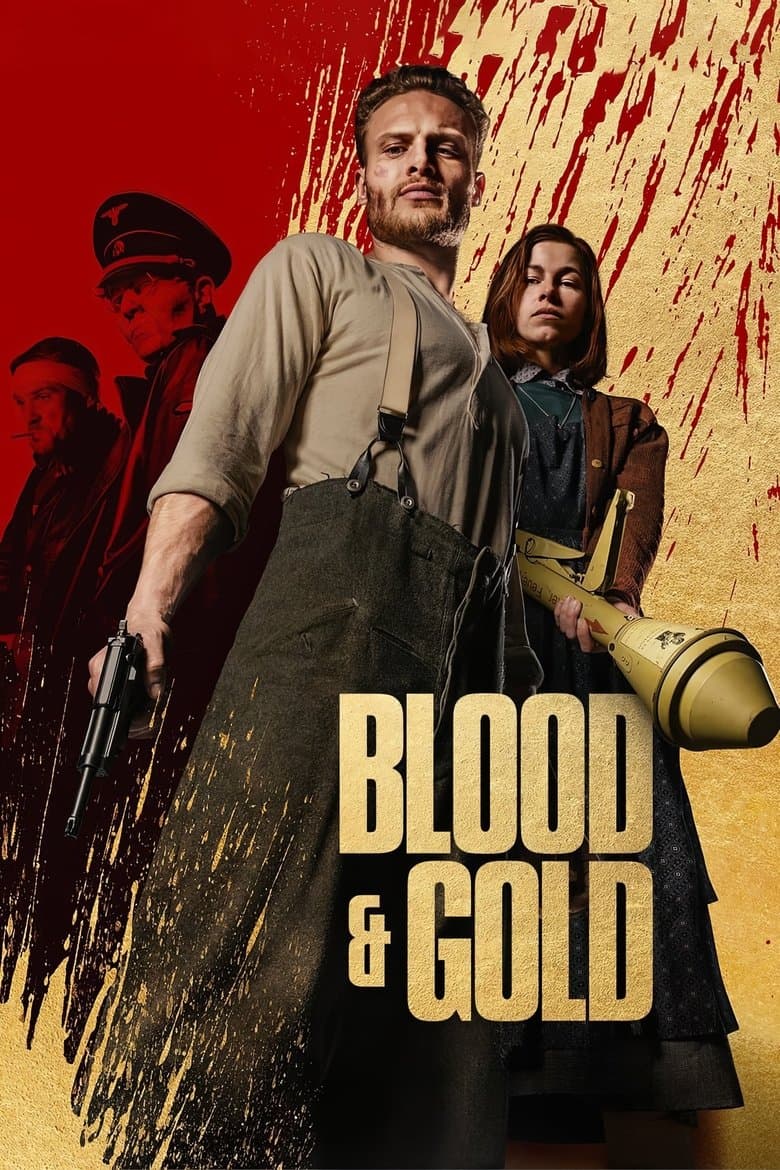
Blood & Gold follows Heinrich, a German soldier who deserts near the end of World War II and tries to reach his young daughter. An SS unit captures him, leaves him hanging, and then searches a ruined village for Jewish gold. Elsa, a farm woman, cuts him down and becomes his partner as the soldiers terrorize her home and the town. The film uses a grim but playful western style, with sharp violence, dark jokes, and a fast stream of gunfights.
Elsa is a central action hero who saves Heinrich, protects her brother Paule, and kills or fights SS men during the main conflict. The film also gives Sonja and Irmgard active roles in the final battle, so women are shown as fighters instead of only victims or helpers. Paule's disability is tied to the Nazi threat and to Elsa's reason for resisting, while the Jewish family's stolen gold drives the mystery. The story condemns Nazi racism, greed, and cruelty, but it keeps those ideas inside a historical revenge story rather than turning them into a modern political lesson.
Community feedback
Was our 35% Woke rating accurate?
Breakdown
These are the editorial factors and ratings behind our score for Blood & Gold.
Woke representation / casting
Elsa is a central German farm woman who rescues Heinrich and takes part in the main gun battles. Sonja and Irmgard also act in the final fight, so several women get active roles in a war story. Simon Rupp, who has Down syndrome, plays Paule, a prominent disabled character whose safety drives the plot. Thorwarth's title interview highlights strong female figures and Elsa's use of weapons. Paule's disability is tied directly to the period threat, so this signal is not dominant.
36%
Woke political dialogue
Not present. The film uses Nazi, anti-Jewish, and anti-Christian speech from its villains, but it does not promote modern DEI, activist, or identity-politics ideas.
0%
Identity-driven story themes
Elsa repeatedly protects her farm, saves Heinrich, and fights the SS beside him. The story gives women important action and survival roles, and it treats Elsa as a capable partner rather than a helpless victim. Heinrich remains a skilled co-lead, so the film does not make women the only heroes or men into simple helpers.
45%
Western institutional / cultural critique
Not present. The film shows Nazi rule, anti-Jewish hatred, and wartime abuse as part of its 1945 plot. It does not turn them into a modern critique of patriarchy, capitalism, Christianity, or Western institutions.
0%
Woke character or canon changes
Not relevant. The film is an original story with fictional characters. It does not change an established character, source, or real historical figure.
0%
Anti-woke backlash and complaints
Not present. The supplied X research found no anti-woke complaints. Other searches found no sustained public complaint that the film pushes woke or DEI ideas.
0%
Creator track record context
Thorwarth's public work is mainly commercial action, crime, comedy, and genre entertainment. The other key creators are mainly known for film craft, production, and popular storytelling, with no clear DEI or identity-activist pattern. Thorwarth's title interview highlights Elsa as a strong woman who joins the fighting. That adds a small context signal without making the crew's wider record activist.
15%
Production

Movie · 2022
April, 1940. The eyes of the world are on Narvik, a small town in northern Norway, a source of the iron ore needed for Hitler's war machine.

Movie · 2017
Set in a dugout in Aisne in 1918, a group of British officers, led by the mentally disintegrating young officer Stanhope, variously await their fate.

Movie · 2021
After a blood- soaked jujitsu match in Dubai, fighting legend Mickey Kelley falls to superstar Blaine. But years later, an online video proves that Blaine cheated, and the world…

Movie · 2022
A fictional history of two legendary revolutionaries' journey away from home before they began fighting for their country in the 1920s.

Movie · 2017
May, 1980. Man-seob is a taxi driver in Seoul who lives from hand to mouth, raising his young daughter alone.
Movie · 2020
A small unit of U.S. soldiers, alone at the remote Combat Outpost Keating, located deep in the valley of three mountains in Afghanistan, battles to defend against an overwhelming…

Movie · 2019
Vietnam War, 1966. Australia and New Zealand send troops to support the United States and South Vietnamese in their fight against the communist North.

Movie · 2023
The hardened son of a powerful industrialist returns home after years abroad and vows to take bloody revenge on those threatening his father's life.
